
Sandbar Boating: Tides, Anchoring and Etiquette
How sandbars form, how the tide changes them, how to anchor bow and stern safely, protect seagrass, avoid groundings and follow Florida law at a sandbar.
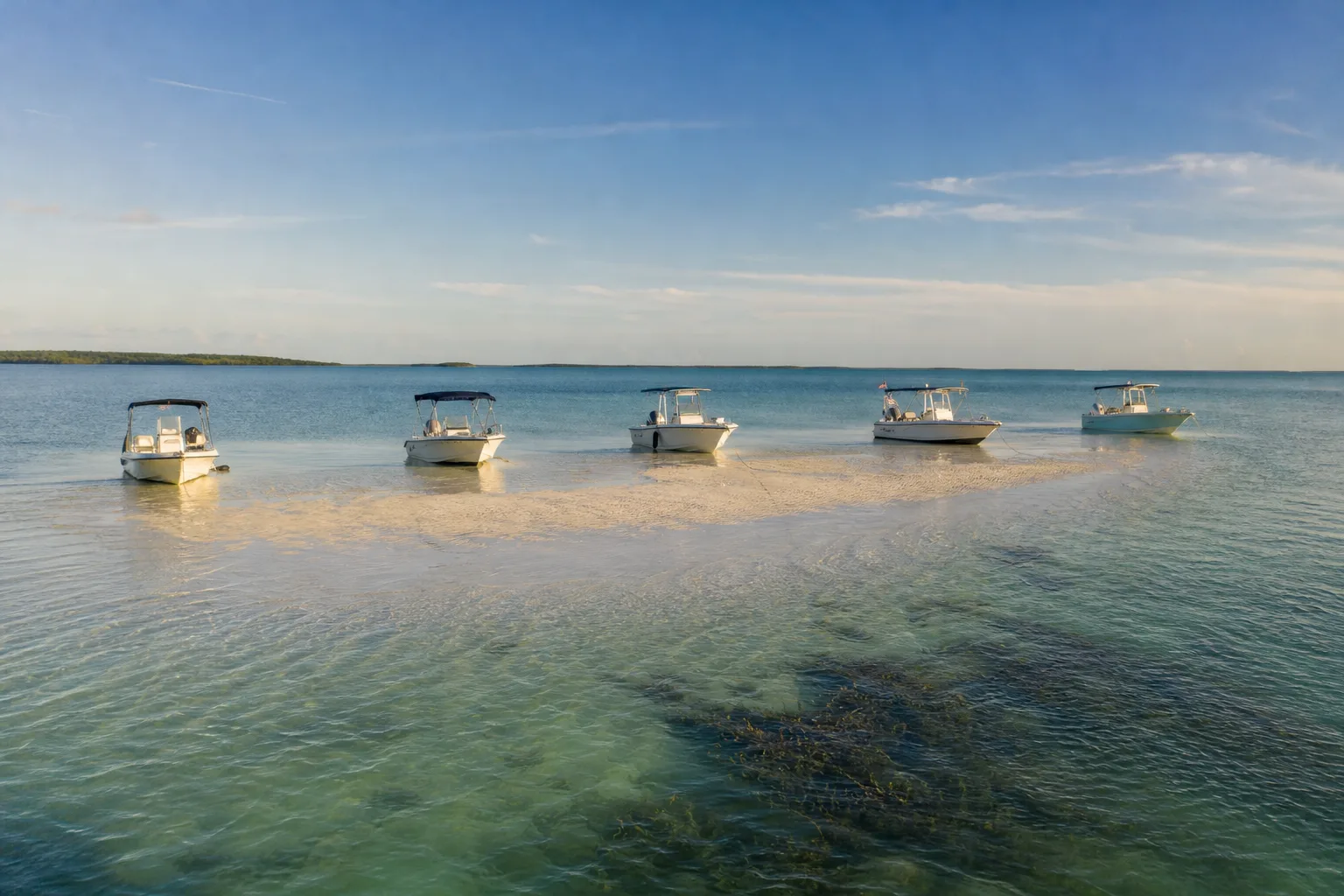
A sandbar is a ridge of sand built up by moving water, and it can sit just under the surface or rise above it at low tide. The safest way to boat at one is to arrive on a rising or high tide, approach slowly with someone watching the bottom, anchor in water deep enough to stay afloat as the tide drops, and leave before the tide strands you. Stay out of seagrass and stay sober at the helm.
This guide is for beginners and intermediate boaters. It covers how sandbars form and move, how to read the tide before you go, anchoring bow and stern, prop and swimmer safety, protecting seagrass, and the Florida laws that apply. For place-specific advice, see our guides to the Haulover sandbar, the Islamorada sandbar and Crab Island in Destin.
How sandbars form and move
Waves, tidal currents and river flow carry sand and drop it where the water slows down. That happens near inlets, at bends, and where a current spreads out into open water. Over time the deposit builds up into a bar. The same forces move it: storms, strong currents and dredging can shift or flatten a bar, or build a new one in a different spot. The lesson for boaters is simple: a bar you visited last month may not be where you remember it, and printed charts show depths from past surveys.
Always use a current NOAA nautical chart or a chartplotter with up-to-date charts as a starting point, then confirm with your eyes and your depth sounder. Polarized sunglasses help you see the bottom; lighter water usually means shallower water, darker patches can be deeper water or seagrass.
Reading the tide before you go
The tide decides how much water you have. Check a tide table for the nearest place and plan your arrival, your stay and your departure around it:
- Arrive on a rising tide, before high water. If you do touch bottom, the rising water will lift you off. Arriving on a falling tide is how boats get stuck.
- Know the next low. Anchor so that you will still float at the next predicted low, with a margin, or plan to leave before it.
- Watch the range. A large range between high and low drains a bar fast. See spring and neap tides and king tides on Marinalo for the days when the range is largest.
- Remember wind. Strong wind can push water in or out and make the real level differ from the prediction.
If the words are new to you, read how to read a tide chart and ebb, flood and slack tide. Marinalo has tide charts for Florida places, built from NOAA data (not for navigation), and the main tides page covers the rest.
| Tide stage | What it means at a sandbar | What to do |
|---|---|---|
| Rising | Water is deepening; a grounded boat can float off | Best time to arrive |
| High / slack | Most water over the bar; little current | Best time to anchor and swim |
| Falling | Water is draining; the bar emerges; current may build | Get ready to leave |
| Low | Least water; some boats may be stranded | Only for shallow draft; stay clear if unsure |
Approaching without grounding
- Slow down to idle early. Slow speed also reduces damage if you touch.
- Put a spotter at the bow and approach at a shallow angle from the deeper side. Do not run straight at the bar.
- Know your draft with the engine tilted and down; see draft, beam and freeboard and, if your boat is a flats type, skiff, bay boat and flats boat.
- If you run aground, stop. FWC advises boaters in shallow seagrass to pole the boat into deeper water instead of powering off with the propeller, which scars the bottom.
Anchoring bow and stern
At a busy sandbar, boats swing with changing wind and current. A single anchor off the bow lets your boat swing in a wide circle and bump neighbors. Some boaters set a second anchor off the stern (a "bow and stern" or two-point set) to hold the boat in one direction, usually with the bow into the wind or current. The method:
- Pick a spot with enough depth at the next low tide and enough room around you.
- Approach into the current or wind, drop the bow anchor and let out scope as you back down slowly.
- When the anchor holds, set a second anchor off the stern, or walk one to the sandbar and bury it in the sand.
- Check that the lines are not crossing prop areas, and watch your position against a landmark to make sure you are not dragging.
Sand holds a lightweight fluke-type anchor well, but sandbars can shift, so check for drag regularly. See boat anchor types for which anchor suits sand and boating knots for the cleat hitch and bowline. Do not leave the boat unattended on the anchor.
Florida law (s. 327.44) forbids anchoring or mooring a vessel in a way that unreasonably or unnecessarily creates a navigational hazard or interferes with another vessel. Do not anchor in a marked channel or across the approach lane used by other boats.
Prop safety and swimmers
- Turn the engine off and stay clear of the propeller whenever anyone is in the water or boarding the boat.
- Keep the ladder and swim area on the side away from the engine; see boat propellers.
- Wear a life jacket in current or deep channels, even if you are a strong swimmer; see Coast Guard approved life jackets.
- Do not tow tubes in crowded sandbar areas; see boat tubing safety.
- Keep a lookout for dinghies and paddlers; the Florida kayak launches list shows where paddlers get on the water.
Protecting seagrass and wildlife
Many Florida sandbars sit next to seagrass beds, which provide habitat and food for fish, manatees and sea turtles. According to FWC, propeller scars in seagrass can take months or even years to recover. FWC's advice for shallow water:
- Stay within marked navigation channels whenever possible and avoid taking shortcuts through seagrass beds.
- Know your boat's operating depth.
- In shallow seagrass, pole, paddle or use an electric trolling motor instead of the propeller.
Manatees graze on seagrass, and FWC suggests avoiding shallow areas where they feed, wearing polarized sunglasses to spot them, and slowing down in posted zones. Manatee protection zones use two main speeds: "Idle Speed - No Wake," the minimum speed that maintains steerageway, and "Slow Speed - Minimum Wake," which means fully off plane and settled in the water. Zones differ by location, so follow the signs; see manatee season in Florida and no-wake zones.
Florida laws that apply at a sandbar
We did not find a statewide Florida law specific to sandbars. Specific sandbars sometimes have local rules, and we only state those we could verify (for example, Okaloosa County's Crab Island ordinances, covered in our Crab Island guide). General state law still applies:
- Boating under the influence. Under s. 327.35, it is a crime to operate a vessel at a blood or breath alcohol level of 0.08 or more, or while alcohol impairs your normal faculties regardless of the test result. A first offense carries a fine of $500 to $1,000 and up to six months in jail, among other penalties. A sandbar day often involves drinking, so choose a sober operator before you leave the dock.
- Boating-restricted areas. Under s. 327.46, FWC and local governments can set idle-speed and slow-speed zones, including near boat ramps and fuel docks: within 500 feet on waterways wider than 300 feet and within 300 feet on narrower ones. Zones are enforceable where clearly marked.
- Education and registration. See the Marinalo Florida boating license and registration page and do you need a license to drive a boat.
Etiquette
- Leave room between boats, and do not squeeze into a gap that leaves everyone's anchor lines crossed.
- Keep music at a level that lets you hear horns and your neighbors.
- Take your trash off the water; wind carries bags away.
- Do not run your engine or generator in a way that fills the area with exhaust close to swimmers.
- Leave early enough to clear the bar on a falling tide, and slow down on the way out.
If you are looking for a place to launch, Marinalo lists ramps near you and across the state in the Florida boat ramps directory.
FAQ
What is the best tide for a sandbar?
Arrive on a rising tide, before high water. A rising tide floats you off if you touch bottom; a falling tide can strand you.
How do I anchor at a sandbar?
Choose water that will still float your boat at low tide, drop the bow anchor, back down to set it, then add a stern anchor if you want to hold your direction. Check for dragging.
What if I run aground on a sandbar?
Stop, check for damage and people aboard, and pole or push off toward deeper water. Do not rev the engine in seagrass. On a rising tide you may float free; on a falling tide call for help sooner.
Can I drink on a boat at a sandbar in Florida?
The operator may not be impaired and may not operate at 0.08 blood or breath alcohol or above (s. 327.35). Designate a sober operator.
Are there special rules for sandbars in Florida?
Not statewide that we could find, but state boating law, manatee zones and local ordinances apply, and some sandbars such as Crab Island have county ordinances. Check with the local county or FWC.
Sources
- Florida Statutes s. 327.35, Boating under the influence
- Florida Statutes s. 327.44, Interference with navigation
- Florida Statutes s. 327.46, Boating-restricted areas
- FWC, Seagrass FAQ (boating tips and propeller scars)
- FWC, Manatee information for boaters and PWC operators
- Marinalo data, October 2026: Florida tide charts