
Skiff, Bay Boat or Flats Boat? Choosing an Inshore Boat
Skiff, bay boat and flats boat compared: draft, ride in chop, deck layout and best uses for shallow Florida and Texas waters, plus why the tide matters.
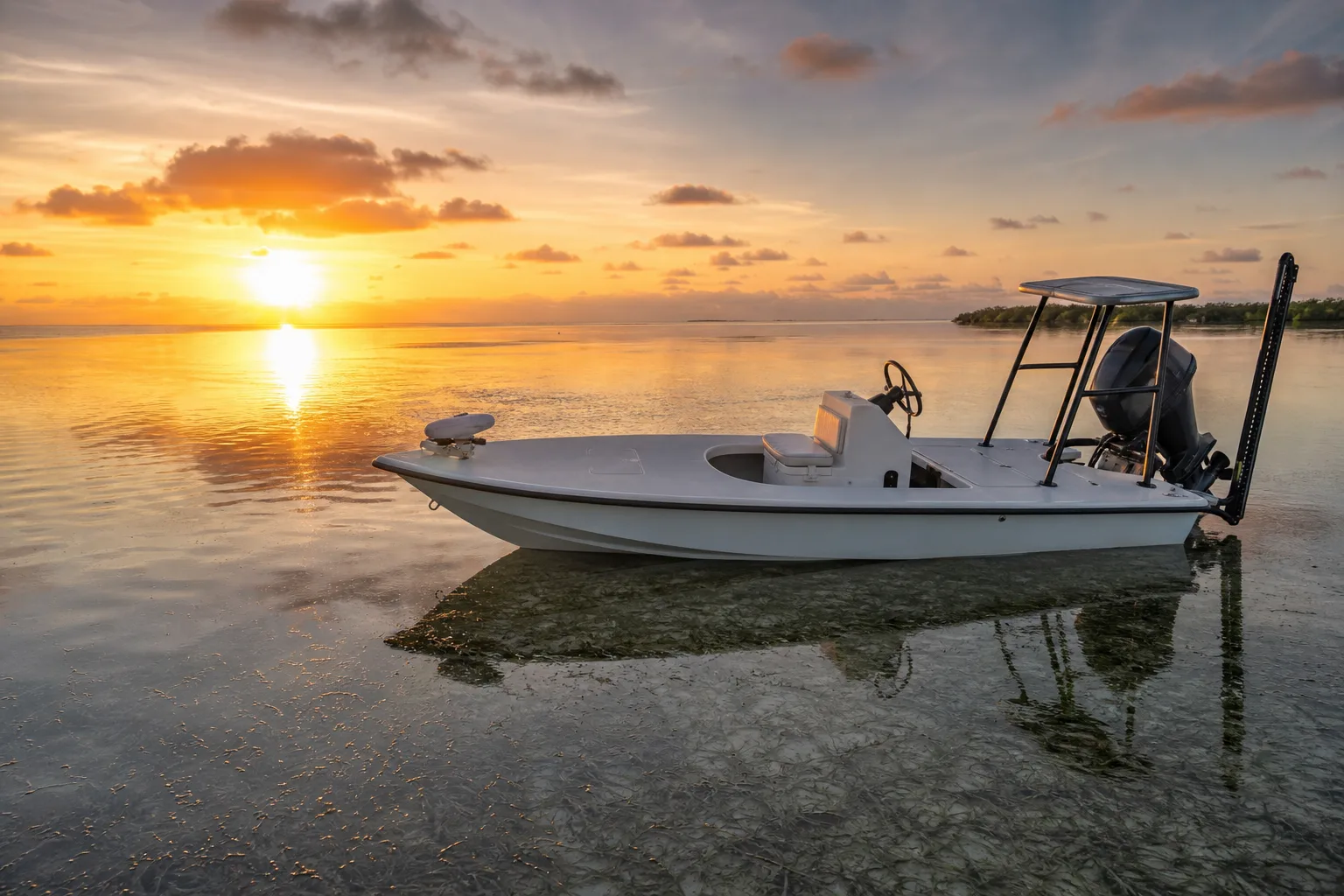
A skiff or flats boat is a light, shallow-draft fishing boat built to run and pole in very skinny water, while a bay boat is a heavier, deeper-V center console that trades a little draft for a drier, more comfortable ride in open bays. If you fish creeks, marsh edges and grass flats, choose a skiff or flats boat. If you cross open water to get to your spots, a bay boat is usually the better tool.
The words overlap, and builders and anglers do not use them the same way from one coast to the next. This guide explains how the three types usually differ, what that means in Florida and Texas, and why the tide chart matters more in the shallows than almost anywhere else.
The short version
| Type | Hull and build | Best water | Trade-off |
|---|---|---|---|
| Skiff | Light, low-sided, often a modified-V or flat-ish hull; the term is used loosely, sometimes for any small shallow-water boat | Creeks, flats, marsh edges, small bays | Wet ride in a blow; small crew |
| Flats boat | Nearly flat bottom, low profile, casting decks, often a poling platform | Very shallow flats, mangroves, lagoons | Least protection from wind and spray |
| Bay boat | Heavier, deeper V, higher sides, console, more storage | Open bays, nearshore water, mixed depth | Draws more water; cannot go as skinny |
What is a skiff?
"Skiff" is the loosest of the three terms. In some places it means a specific kind of ultra-light flats skiff designed for poling. In others it simply means any small, open, shallow-draft boat used in back bays. A jon boat is a close relative at the simple end of the range; if you are weighing a basic aluminum hull, read our guide to jon boats first.
When you see "skiff" in a listing, ask the builder or seller for the hull type, the stated draft and the recommended horsepower. Those three facts tell you more than the name does.
What is a flats boat?
Discover Boating, the consumer site run by the boating industry, describes a flats boat as a shallow-water fishing vessel for anglers who sight-cast or fly fish in areas such as mangroves, lagoons and marshes. Its hull is nearly flat and low in profile, and the page suggests looking for a draft of about 6 to 10 inches. Typical features include:
- A poling platform above the outboard, so you can see fish and push the boat through narrow channels without a motor.
- Clean casting decks with flush hardware so line does not snag.
- A light build and a high-mounted outboard (often on a jack plate) to keep the whole boat out of the mud.
- A trolling motor for quiet, precise positioning.
The same source cautions that a flats boat gives limited protection from wind and spray and is not meant for open ocean or rough inlets. It is also not the boat for hauling a big group to a sandbar.
What is a bay boat?
A bay boat is a center console with a deeper V, higher sides and more storage and livewell capacity than a flats boat. Boating Magazine, comparing a flats boat, a bay boat and a hybrid, describes the bay boat as a design for bigger water and larger crews that can also serve as a faster alternative when the skinny spots are far away. In that comparison, the bay boat's higher gunwales add security and comfort in larger waves, and its stated minimum draft is a few inches deeper than the flats boat's. Discover Boating says a bay boat generally handles about a two-foot chop, which is a useful rule of thumb rather than a guarantee, since hull design, load and wave period all matter.
Many builders also sell a "hybrid" that tries to combine shallow draft with a deeper-V hull and more freeboard. These can be a sensible compromise if you fish both skinny water and open bays, but compromises cost something: a hybrid is rarely as shallow as a true flats boat or as dry as a true bay boat.
Planning to go further out? See our guide to center console boats, which covers sizes, offshore versus inshore use and engine choices.
Draft: the number that decides where you can go
Draft is how far the boat sits below the waterline. It is the first number to compare, but treat it carefully:
- Builders usually quote draft with a light load and sometimes without the engine. Add passengers, fuel, ice, a full livewell and a trolling motor, and the boat sits lower.
- The lower unit of the outboard often draws more than the hull. A jack plate or a tunnel hull can help, but you still have to trim the engine up carefully.
- Boats that draw a few inches more spend more time stuck or poling when the water is low, and in grass flats a prop that digs in can scar the seagrass. Florida and Texas both have protected seagrass areas, so learn local rules before running skinny water.
Ride in chop
The trade-off in this whole category is simple: a flatter hull draws less water but slaps and sprays more in chop, and a deeper V rides softer but needs more water under it. In Boating Magazine's comparison, the flats example has a shallow deadrise of 13 degrees at the transom, the bay example a 20-degree deep V. Higher sides and bow flare keep spray off the deck.
Open bays can build steep, short waves quickly when wind blows against the tide. Large, shallow bays such as those along the Texas coast and Florida's Gulf side can turn uncomfortable fast, so a flats skiff owner often plans around the wind forecast, not just the tide. Check the marine forecast, and see our guide to special marine warnings and small craft advisories so you know what the alerts mean.
Why tides matter more in the shallows
NOAA explains that tides are very long-period waves caused by the gravitational pull of the moon and the sun, and that the rise and fall of the water can have a marked effect on maritime activities. On a deep-water route you may never notice a one-foot swing. On a flat, a one-foot swing can be the difference between running comfortably and being aground.
- Low tide. Many flats and creek mouths become too shallow to cross. Plan to be on the water before the tide drops, not stuck behind a bar.
- Rising tide. Fish often move onto flats and into marsh edges as water floods in, which is why anglers like it, but the same water covers oyster bars and shoals you cannot see.
- Spring and neap tides. Tidal range is larger near the new and full moon and smaller in between. Read our explainers on spring and neap tides and how the moon affects tides.
- Wind. In shallow bays, strong wind can push water out and make the actual level lower than the prediction. Tide tables are predictions, not guarantees.
Pull up the tide times for your launch before you go: for example Key West in Florida or Galveston in Texas, or browse all Texas tide stations and the Florida stations. For the terms used in tide tables, see our guide to ebb, flood and slack tide.
Florida and Texas: what changes on the water
- Florida. Shallow grass flats, mangrove shorelines and the Keys backcountry reward the shallowest draft. Always check your launch: browse Florida boat ramps to find a ramp near the water you want to fish.
- Texas. Bays such as Galveston, Matagorda, Aransas and the Laguna Madre are shallow and wind-driven, with oyster reefs and sand flats. A bay boat is popular for crossing big water; a flats boat suits the back lakes and marsh. Find a launch on our Texas boat ramps page.
A motorized boat on public water in either state must be titled and registered, whatever its length. See our Florida boating license and registration guide, and check the Texas Parks and Wildlife Department for Texas rules.
How to choose
- Write down where you fish. If most of your trips are in water that gets very shallow at low tide, lean skiff or flats boat.
- Be honest about distance. A long run across open bay in a flats boat is a wet, slow trip. A bay boat gets you there more comfortably.
- Count your crew. Flats boats suit one to three anglers. Bay boats carry more people and gear.
- Check the capacity plate. Boats under 20 feet carry a plate with maximum persons, weight and horsepower, required by Coast Guard rules for monohull boats of that size. Do not exceed it.
- Think about parking and towing. A lighter boat is easier to trailer. Larger ones may need a bigger tow vehicle and a wider slip. If you plan to keep it in the water, compare Florida slip prices for 30-ft boats and the equivalent Texas page, or see boat storage options for alternatives.
FAQ
Is a skiff the same as a flats boat?
Often, but not always. "Skiff" can mean a specialized poling skiff or simply any small shallow-water boat. Compare hull type and draft instead of the name.
How shallow can a flats boat go?
Discover Boating suggests looking for a draft of about 6 to 10 inches. Real-world draft is higher once the boat is loaded, so use the manufacturer's figure only as a starting point.
Is a bay boat better than a flats boat?
Neither is better in general. A bay boat rides drier in chop and carries more people; a flats boat reaches shallower water.
Can I take a bay boat offshore?
Some can make short runs in good weather, but they are designed for bays and nearshore water. Check the builder's guidance and the forecast, and see the center console guide for offshore-oriented boats.
Do I need to know the tide to use a shallow-draft boat?
Yes. Even a boat that draws only inches can ground on a falling tide. Check tide times before each trip.
Sources
- Discover Boating: Flats boats buying guide
- Boating Magazine: Flats boat vs. bay boat vs. hybrid
- NOAA National Ocean Service: What are tides?
- 33 CFR Part 183, Subpart B: Display of Capacity Information
- Florida Highway Safety and Motor Vehicles: vessel titling and registration FAQ
- Texas Parks and Wildlife Department: titles, registration and tax