
Center Console Boats: The Complete Guide
Center console boats explained: sizes, inshore vs offshore hulls, single vs twin outboards, fuel range planning and what slip size to budget for in Florida and Texas.
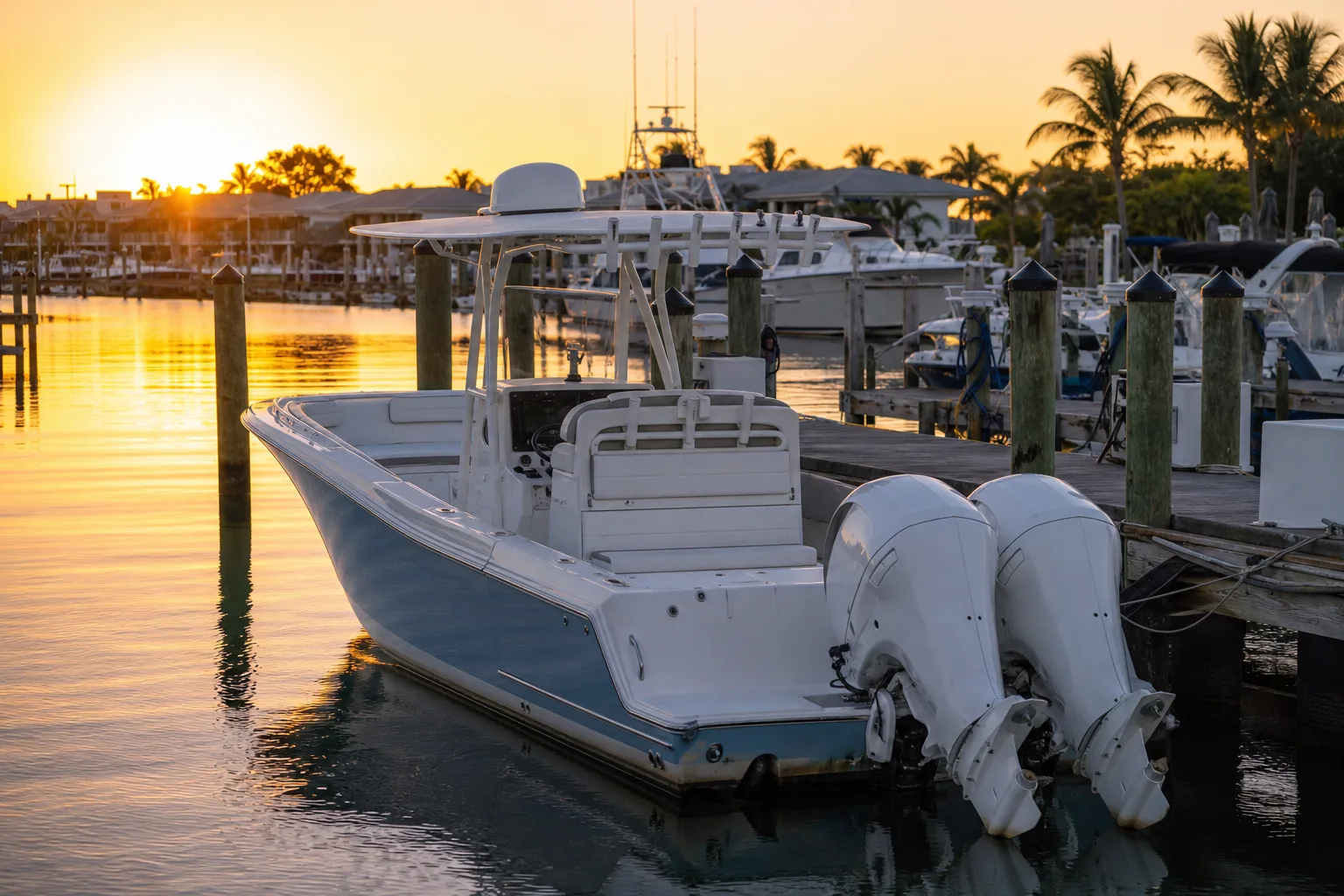
A center console boat is an open powerboat with the steering station in the middle of the deck, which leaves walkable space all the way around the boat for fishing, diving or cruising. They range from small inshore boats to large offshore models with twin or triple outboards, and the right one depends mostly on where you will run it, how many people you carry and how far you need to go.
This guide covers how center consoles are laid out, how size and hull shape change what the boat can do, when to choose one engine or two, how to think about fuel range without guessing, and what the size means for your slip or trailer.
What makes a center console different
The console holds the helm, and often a small head or storage compartment inside. Because the console sits in the middle, you can walk around the whole boat. That is why center consoles are the default for anglers: you can follow a fish from bow to stern. Typical features include:
- Open deck with no cabin. More room and a simpler layout, but less protection from sun, rain and spray. A T-top or hardtop adds shade and a place for rod holders and electronics.
- Livewells, fish boxes and rod storage built into the deck, bow and transom.
- Outboard power. Most modern center consoles use outboards, from a single engine on smaller boats to multiple engines on large ones.
- Seating and leaning post. A leaning post or helm seats give a place to sit or brace on the way out.
BoatTEST, an independent boat-review publication, notes that center consoles have become the second most popular boat configuration in the US, after pontoon boats, and argues that for many buyers another type of boat would suit better. That is a useful warning: an open boat is not the best answer for every family. If your trips are mostly relaxed cruises with a group, compare it with a pontoon in our deck boat vs pontoon guide.
Inshore, bay or offshore: size and hull
Center consoles are not one boat. The hull and length change what the boat is for:
| Category | Typical hull | Water it suits | Notes |
|---|---|---|---|
| Small inshore | Flatter, shallow draft, light | Creeks, flats, calm bays | See our skiff, bay boat and flats boat comparison |
| Bay boat | Deeper V, higher sides | Open bays, nearshore | Dryer in chop; draws more water |
| Mid-size coastal | Deep V, more flare | Nearshore and short offshore trips | Often a good all-around family and fishing boat |
| Large offshore | Deep V, high freeboard, strong bow flare | Offshore, Gulf Stream, canyon runs | Usually twin or more outboards; needs a real slip |
The general rule is that a deeper V and more length give a softer, safer ride in rough water, while a flatter hull gives a shallower draft. Boaters often say that no boat is a good rough-water boat in all conditions. Check the forecast, learn the difference between a special marine warning and a small craft advisory and stay home when conditions are beyond your boat or your experience.
Single or twin outboards?
BoaterSecretWeapon, a boating retailer's guide, notes that twin engines provide redundancy for offshore fishing, while single engines are often reliable and cost-effective. In practice:
- Single outboard. Lower purchase price, less maintenance, less weight and simpler rigging. Good for inshore and nearshore use. If it fails, you need a tow or a second plan, such as a kicker motor or a call to a towing service.
- Twin outboards. Redundancy if one engine fails, better maneuvering at the dock, and more power for heavy loads. They cost more to buy, fuel, service and winterize, and they add weight at the transom.
Whichever you choose, the boat's capacity plate gives the maximum horsepower. Boats under 20 feet must display one under Coast Guard rules (33 CFR Part 183), and larger boats usually carry a builder's rating. Do not exceed the rating. If you fish where cell coverage drops, carry a VHF radio and consider an EPIRB or personal locator beacon.
Fuel range without guesswork
Fuel burn depends on the engine, the hull, the load, the sea state and the speed you run, so any single figure published for a boat is only a starting point. Do not trust a brochure number; measure your own boat.
- Use the rule of thirds. Boating Safety magazine describes it as using no more than one-third of the tank to reach the destination, one-third to get back and keeping the last third in reserve.
- Adjust for conditions. The same source notes that if the wind comes up and waves build, you will need more fuel to return than you would in calm seas.
- Keep a log. Note gallons added and hours or miles run on each trip. After a few outings, you will know your real range at your usual cruising speed.
- Know where fuel is. Find fuel docks along your route in advance. We list Florida fuel docks and Texas fuel docks.
- Use the right gas. Many outboards and tanks do better with fuel that has little or no ethanol. See our ethanol-free gas guide.
Use our nautical miles to miles converter and knots to mph converter when you convert a plan from a chart into fuel math.
Slip, trailer and storage implications
Length is only one part of the equation. A center console with a T-top, twin outboards and a bow pulpit is longer overall than its hull length, and many marinas price by length overall, which can include swim platforms, pulpits and engine brackets. Ask each marina how it measures before you compare rates.
- Rack storage or trailer. Smaller center consoles can be trailered and launched from a public ramp; check the boat's weight against your tow vehicle's rating. Check ramps on our Florida and Texas pages.
- In-water slip. Larger boats go in a wet slip. Compare current rates on our 30-ft and 40-ft Florida slip price pages, and the Texas 30-ft page. Slip rates are reported by marinas and vary widely by location and season.
- Air draft and height. A T-top or tower adds height, which matters for bridges, trailer routes and covered storage.
- Other options. See boat storage options for dry stack, trailer and wet slip.
Safety and paperwork
Federal rules require wearable life jackets for each person aboard, and boats 16 feet and longer need a throwable device too (33 CFR 175.15). Our guide to Coast Guard approved life jackets explains what to carry. In Florida, all motorized vessels on public waters must be titled and registered; read our Florida boating license and registration page. In Texas, a motorized boat needs current registration, so confirm details with Texas Parks and Wildlife.
Buying checklist
- Define your top three uses: bay fishing, offshore fishing, family day trips.
- Pick the length and hull for the roughest water you will really run.
- Choose single or twin outboards based on how far you go from help.
- Check the capacity plate or builder's rating for horsepower, people and weight.
- Find out where you will keep it, and ask about the fees before you buy.
- Take a sea trial in conditions that match your use, with a typical load.
FAQ
What is a center console boat best for?
Fishing and general open-deck boating. The walk-around deck makes them popular with anglers, divers and day boaters.
Are center console boats good for offshore?
Larger ones with deep-V hulls can be, but the boat is only part of the answer. Weather, equipment, fuel plan and experience matter just as much.
Are two engines better than one?
Two give redundancy and better dock handling; one costs less to buy and maintain. Match the choice to how far you run from help.
How do I work out my fuel range?
Track fuel use on real trips and apply the rule of thirds, leaving more margin in rough water.
How big a slip does a center console need?
Many marinas price by overall length, which can include engines and platforms. Ask each marina how it measures, then compare rates on our slip price pages.
Sources
- BoatTEST: How to choose the right center console boat
- Boater's Secret Weapon: Guide to choosing the right center console boat
- Boating Safety magazine: Four techniques to avoid running out of fuel
- 33 CFR Part 183, Subpart B: Display of Capacity Information
- 33 CFR 175.15: Personal flotation devices required
- Florida Highway Safety and Motor Vehicles: vessel titling and registration FAQ
- Texas Parks and Wildlife Department: titles, registration and tax