
Boat Storage Options: Wet Slip, Dry Stack, Trailer or Lift
Compare boat storage options: wet slip, dry stack, trailer and boat lift. Protection, access, upkeep, hurricane risk, and Florida monthly slip prices by boat length.
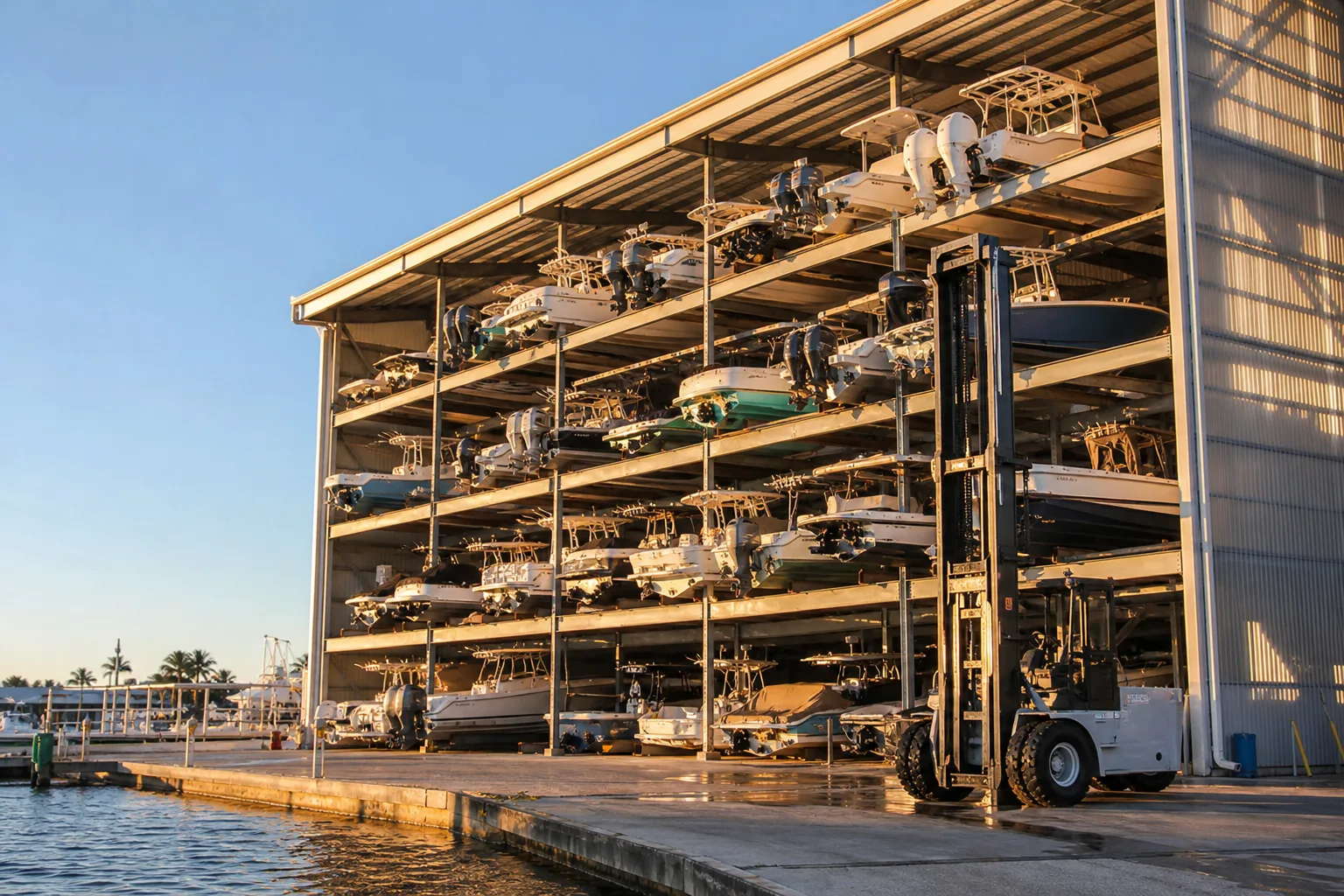
The main boat storage options are a wet slip in the water, a dry stack rack in a building or open-air structure, a trailer at home or in a yard, and a boat lift. A slip is the most convenient, dry storage is easier on the hull, and a trailer is the cheapest to keep if you have somewhere to put it. The best option depends on your boat size, how often you go out, and how much you worry about storms, bottom growth and upkeep.
The four main options compared
| Option | Protection | Access | Upkeep | Hurricane risk |
|---|---|---|---|---|
| Wet slip | Boat stays in the water, exposed to sun, rain and marine growth | Walk down the dock and go; best for frequent use | Bottom paint and hull cleaning, plus electrical and pump checks | Highest of the four, because the boat is in the water |
| Dry stack | Out of the water and often under a roof | Staff launch the boat with a forklift; usually need to call ahead | Less growth on the bottom; you still wash, service and check the boat | Lower than a slip, but depends on the facility |
| Trailer | Depends on where it sits; a garage is best, open yard worst | Need to tow and launch at a ramp each trip | Trailer tires, bearings and lights as well as the boat | Can be moved inland before a storm |
| Boat lift | Boat sits above the water at your own dock | Lower the lift and go | Lift motor, cables and bunks to maintain | Boat can be lifted high, but a surge can still reach it |
Wet slip storage
A wet slip puts the boat in the water at a marina, tied to a dock with lines (see our guide to boating knots and docking lines). It is the most convenient way to keep a boat if you go out often, and it is the usual choice for larger boats that are hard to haul. The trade-off is that the hull sits in the water all the time. Marine growth builds up on the bottom, so you need bottom paint and periodic cleaning, and the boat takes the weather in the open.
A marina usually charges nightly, monthly or yearly rates by boat length. Slip pricing can differ widely between marinas, so compare before you commit. Slips at the dock may also come with water and electric service, while others charge extra for utilities.
Dry stack storage
At a dry stack facility, boats are stored on racks, often stacked several levels high. The marina's staff lift your boat out of the rack with a forklift and put it in the water when you want it. Because the hull stays dry between trips, there is less marine growth to clean. The catch is access: you usually have to request a launch ahead of time, and most facilities limit the size of boat they can handle. Check the maximum length and weight, and ask what the marina does with the boats before a hurricane.
Trailer storage
If you have a trailerable boat, you can keep it at home, in a storage yard or in a garage. This has the lowest recurring cost if you have free space, and it lets you use public boat ramps anywhere. You will launch and retrieve at the ramp each time, and you take on trailer maintenance as well. Check any home owners association or city rule about storing a boat in a driveway. Texas boaters can look at the Texas boat ramps list.
Smaller boats such as jon boats and many center consoles are easy to keep on a trailer, while larger boats are impractical to tow.
Boat lifts
A boat lift keeps the boat out of the water at a private dock, which cuts down on bottom growth and takes strain off the hull. You need a dock and the permission to install a lift, plus power and upkeep for the lift itself. A lift is not an option for most renters or for boaters without waterfront access.
What a wet slip costs in Florida
Marinalo collects official marina rates. These figures are medians of the monthly rates posted by Florida marinas with published prices for each boat length. The counts show how many marinas contributed to each median. Your marina may charge more or less, and utilities and fees can add to the total.
| Boat length | Median monthly rate | Marinas with a monthly rate | Median nightly rate |
|---|---|---|---|
| 20 ft | $410 | 21 | $55 |
| 30 ft | $675 | 24 | $86 |
| 40 ft | $976 | 26 | $120 |
| 50 ft | $1,250 | 25 | $150 |
| 60 ft | $1,410 | 24 | $180 |
Source: Marinalo data, October 2026. Marinalo does not have comparable published prices for dry stack, trailer yards or lifts, so this guide gives no figures for them. Ask the facility for its current price list, and check what is included: launch fees, fuel, insurance requirements and utilities. You can also browse Florida marinas or Texas marinas.
Hurricane considerations
If you keep a boat in Florida or along the Texas coast, the storm season matters. BoatUS guidance on hurricane preparation points to a clear order: a boat stored ashore on high ground generally does better than one left in the water, and a dry stack building is the preferred option ashore if it was built to modern standards. BoatUS also notes that dry stack is not risk-free: in Hurricane Sandy, boats on the lower levels of a Staten Island dry stack were carried off by surge. Surge height can matter more than the storage method.
- Read your marina contract for hurricane rules: who moves the boat, when, and who pays.
- If your boat stays in a slip, double the lines and leave slack for the rise in water. Tie them with secure knots and use chafe protection.
- If your boat is on a trailer, move it inland above the expected surge, and check tires and bearings before you need them.
- Check your insurance policy for storm rules, such as named-storm deductibles or required haul-out plans.
How to choose
- Size. Boats too large to tow or to fit a rack usually go in a wet slip.
- Use. If you boat every weekend, a slip or a lift saves time. If you go a few times a season, dry storage or a trailer is often enough.
- Budget. Compare the full cost of each option, including bottom paint, trailer costs, launch fees and insurance.
- Location. The closer the storage is to good water, the more you will use the boat.
- Storms. Decide in advance what you will do when a hurricane is forecast. See our guide to the types of boats to think about what fits your needs.
FAQ
Is dry stack better than a wet slip?
It depends. Dry stack keeps the hull out of the water and reduces bottom growth, while a wet slip gives immediate access. Dry stack usually requires a launch request.
How much does a boat slip cost in Florida?
Marinalo data from October 2026 shows a median monthly rate of $410 for a 20 ft boat and $976 for a 40 ft boat among Florida marinas with published prices. Rates vary by marina.
What is the cheapest way to store a boat?
For a boat you can tow, a trailer at home is usually the least expensive if you have the space and the local rules allow it.
Is it safe to leave a boat in a slip during a hurricane?
BoatUS ranks in-water slips as the weakest option in a storm. If you must leave the boat in a slip, double the lines and leave slack for surge, and follow your marina's plan.
Do I need a lift or a slip for a small boat?
Not necessarily. Many small boats stay on a trailer and launch at a ramp.