
Jon Boats: Uses, Sizes and What to Know Before You Buy
Jon boat basics: flat-bottom hull, sizes, motors, shallow-water use, pros and cons, plus Florida and Texas registration and safety rules before you buy.
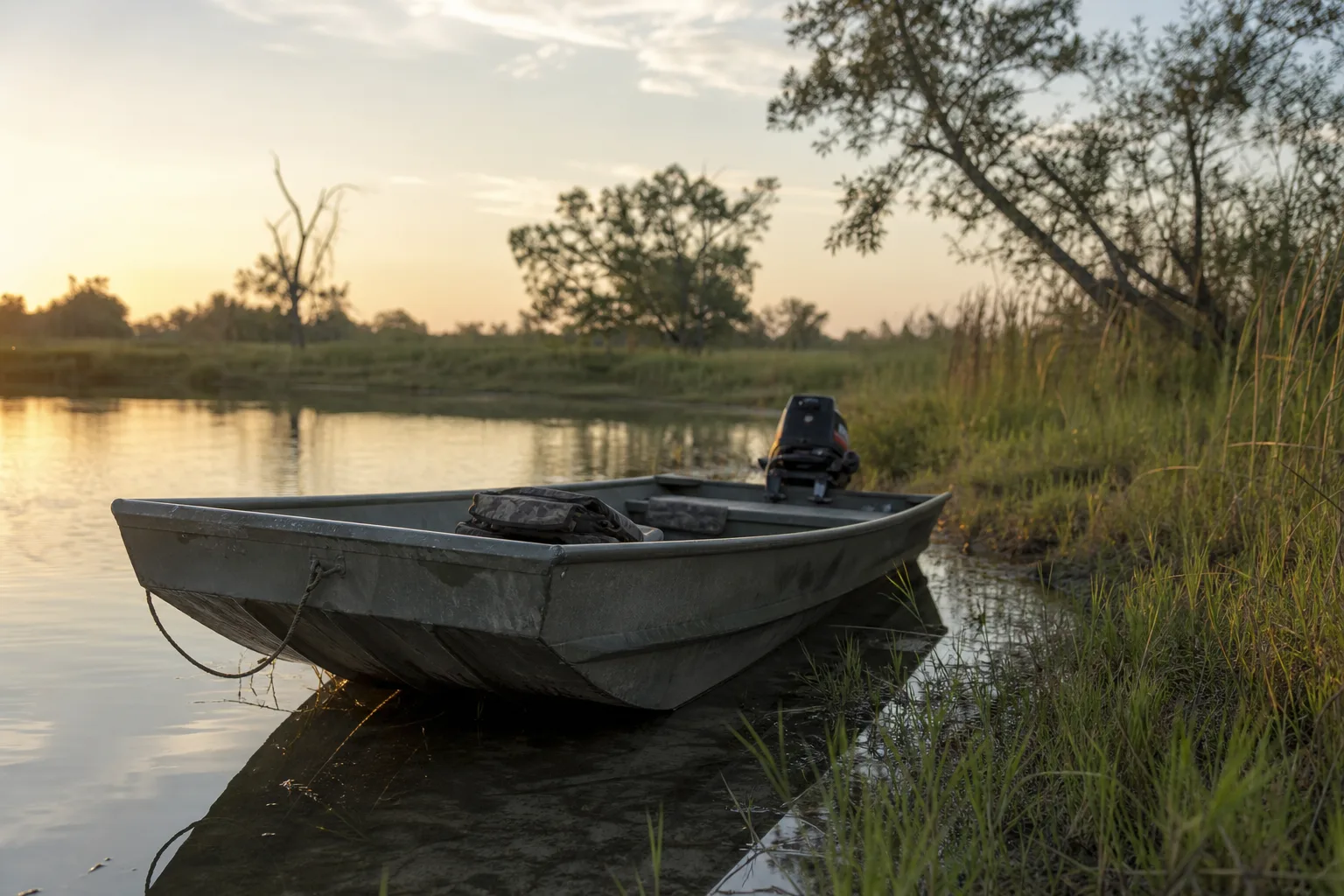
A jon boat is a small, flat-bottomed boat with a square bow, usually made of aluminum. The flat hull draws very little water, so it works well in shallow creeks, ponds, marshes and backwaters where deeper boats cannot go. It is popular with anglers and hunters because it is simple, light, stable and easy to tow.
What makes a jon boat different
Most boats have a pointed bow and a bottom that slopes into a V. A jon boat has a flat bottom and a blunt, squared-off front, which gives it a distinctive look and some clear characteristics.
- Flat bottom. The hull sits on top of the water instead of cutting into it, so it floats in shallow water.
- Square or "punt" bow. The squared bow gives more usable floor space up front for fishing or hauling gear.
- Open layout. Most have bench seats and no cabin or heavy cover.
- Simple materials. Aluminum is the most common choice, though fiberglass and plastic versions exist.
If you want to compare the parts of this kind of hull with other boat types, a general guide to the parts of a boat covers hull shapes in more detail.
Common uses
- Freshwater fishing on small lakes, ponds and rivers.
- Fishing shallow flats and marsh edges in calm coastal water, where depth is limited. Only in suitable conditions, because a flat hull is not built for open water.
- Waterfowl hunting in marshes and backwater, where a light boat is easier to slide through vegetation.
- Utility work such as hauling gear, checking property lines along a pond, or moving between a dock and a cabin.
Sizes and hull styles
Jon boats are sold in a wide range of lengths, from small boats that one person can lift onto a truck to larger models that need a trailer and a bigger motor. Each manufacturer publishes its own length, beam and weight for each model, so use the spec sheet rather than guessing. What matters more than a "typical" size is how it fits your use:
| Style | Hull | Best for |
|---|---|---|
| Basic flat-bottom jon | Flat bottom, straight sides | Calm, shallow, protected water; the lightest and simplest option |
| Modified V (MV) jon | Flat or nearly flat stern with a V-shaped bow section | Water with a bit of chop; less pounding and a drier ride |
The modified V is a common compromise. It keeps much of the shallow draft of a basic jon boat while splitting waves better.
Motors and power
Jon boats are usually powered by one of these:
- Small outboard motor. Gas outboards are the most common way to move farther or faster.
- Electric trolling motor. Quiet and good for fishing at slow speed. Many owners use one alone on small waters or as a second motor.
- Paddles, oars or a push pole. Light jon boats can be rowed or poled across calm water.
Every boat has a limit on engine power. Boats under 20 feet that are monohulls are required by federal rules to have a capacity plate, which states the maximum horsepower, the maximum persons and the maximum weight capacity. Do not exceed it. A larger motor than the plate allows can be dangerous and may cause trouble with insurance or registration. Also check the transom, since a jon boat's transom must support the weight and thrust of the motor.
If you choose a gas motor, read our article on ethanol-free gas for boats, especially if your boat sits unused for stretches of time.
Shallow water: strengths and limits
A jon boat's shallow draft lets you reach places many boats cannot. But shallow water brings its own hazards:
- Stumps, rocks and sandbars can damage a motor's lower unit and propeller. Tilt the motor up when you go very slow in very skinny water.
- Tides and currents change how deep the water is. On coastal waters, check tide times before you head out, and plan to be back before the water drops too low.
- Wind and waves affect a flat hull more than a deep-V hull. A flat bottom can slap hard on chop.
Plan your launch with the water in mind. Our directories of Florida public boat ramps and Texas public boat ramps are a good starting point for finding a place to put in.
Pros and cons
| Pros | Cons |
|---|---|
| Floats in very shallow water | Rough ride in chop, especially a basic flat bottom |
| Light and easy to tow and launch | Not built for open or rough water |
| Stable when sitting still (good for standing to fish) | Can feel less stable when loaded unevenly or at speed |
| Simple, with few parts to maintain | Aluminum is noisy and can dent |
| Usually among the least expensive boats to own | Limited weather protection and often no storage |
Price varies a lot by size, brand and whether a motor and trailer are included, and I have not listed numbers here. Use our annual boat cost calculator to estimate what owning a boat will cost each year.
Registration and titling in Florida and Texas
If your jon boat has a motor, you will almost certainly need to register it in your state.
Florida
The Florida Highway Safety and Motor Vehicles department (FLHSMV) says all motorized vessels operated on Florida's public waters must be titled and registered, whatever their length. Non-motorized vessels shorter than 16 feet do not need to be titled or registered. Applications go through your county tax collector or license plate agent. Florida does not require a boating license, but people born on or after January 1, 1988 who operate a vessel with a motor of 10 horsepower or more must complete an approved boating safety course and carry an identification card issued by the FWC. Read the details in our Florida boating license and registration guide.
Texas
Texas Parks and Wildlife Department (TPWD) says a motorized boat on Texas public water needs current registration regardless of length. Adding an outboard or a trolling motor to a boat that would otherwise be exempt requires titling and registration. Registration in Texas is valid for two years. Non-motorized canoes, kayaks, rowboats and other vessels under 14 feet that are paddled, poled or oared are exempt. Confirm current rules and fees with TPWD, since they can change.
Other things to check
Look for the hull identification number (HIN) and confirm that the seller can show proof of ownership. Buying a used jon boat without a title or paperwork can lead to problems when you try to register it.
Safety basics for small flat-bottom boats
- Life jackets. Both states require a wearable U.S. Coast Guard-approved life jacket for each person on board. Florida requires children under 6 to wear one while underway on vessels under 26 feet, and Texas requires children under 13 to wear one on vessels under 26 feet while underway.
- Fire extinguisher. Both states require a Coast Guard-approved fire extinguisher on powerboats under 16 feet, with an exception for open-construction outboard boats under 26 feet that have no permanently installed fuel tanks. Many simple jon boats fall under that exception, but check your boat against the official rules.
- Sound signal. Florida lists a whistle or horn for vessels under 16 feet.
- Do not overload. Follow the capacity plate and keep weight low and balanced.
- Do not stand up in rough conditions. A flat hull is stable on calm water but can tip if you shift suddenly in waves or wakes.
- Watch the weather. Small open boats are vulnerable to sudden storms. Check marine forecasts and head in when the sky turns.
What to check before you buy
- Hull condition. Look for cracked welds, loose rivets, dents and corrosion. On a riveted boat, look for seeping around rivets.
- Transom. Check for flexing, cracks or damage where the motor attaches.
- Capacity plate. Make sure it is there and legible.
- Paperwork. Confirm the HIN, title and registration status.
- Trailer. Check the tires, lights, bunks or rollers and the hitch.
- Motor. If one is included, ask when it was last serviced and run it if you can.
- Intended water. Match the boat to where you will use it: a pond, a river or a protected bay.
FAQ
What is a jon boat used for?
Fishing and hunting in shallow, calm water, and light utility work. Its flat bottom lets it float where deeper boats would run aground.
Can you use a jon boat in saltwater?
Yes, in protected shallow areas like bays, marsh edges and backwater, and aluminum boats are used there. Rinse the boat and motor with fresh water afterward. It is not suited to open water or rough conditions.
Do I have to register a jon boat?
If it has a motor, yes, in both Florida and Texas, regardless of length. This includes adding a trolling motor in Texas. Non-motorized boats are exempt under certain lengths, as described above.
How big of a motor can a jon boat take?
No more than the maximum horsepower on the boat's capacity plate, if it has one. Check the manufacturer's specifications too.
Are jon boats stable?
They are generally stable at rest, which is why people stand to fish from them. But stability depends on the load, the water and the hull style, so they can be tippy when overloaded or in waves.
What is the difference between a jon boat and a john boat?
None. Both spellings refer to the same type of boat.
Sources
- Florida Highway Safety and Motor Vehicles: vessel titling and registration FAQ
- Florida Fish and Wildlife Conservation Commission: required equipment for vessels under 16 feet
- Texas Parks and Wildlife Department: titles, registration and tax
- Texas Parks and Wildlife Department: powerboats less than 16 feet, required safety equipment
- 33 CFR Part 183, Subpart B: Display of Capacity Information (monohull boats less than 20 feet)