
Coast Guard Approved Life Jackets: Types, Labels and the Rules
Coast Guard approved life jackets explained: Type I to V, the new performance level labels, federal carriage rules, Florida and Texas child rules, fit and care.
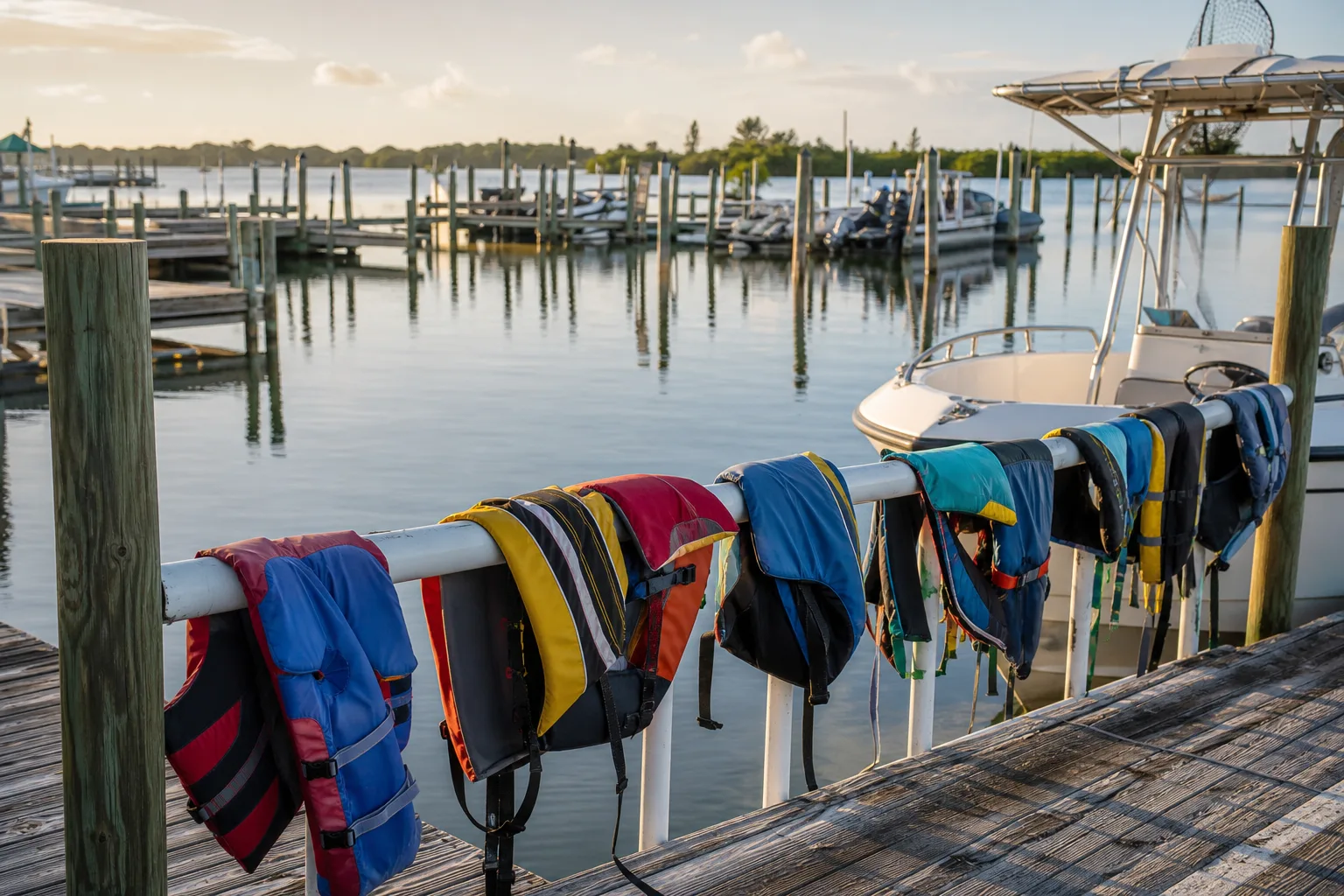
A Coast Guard approved life jacket is one that has passed U.S. Coast Guard approval and carries a label saying so. Federal rules require a wearable approved life jacket of the right size for each person aboard a recreational boat, and a throwable device on boats 16 feet or longer (not canoes or kayaks). Look for the approval label inside the jacket, and for the type or performance level printed on it.
Life jacket types at a glance
For decades, life jackets were labeled Type I through Type V. The Coast Guard has been moving to a system based on performance levels. The Coast Guard's boater's guide notes that federal regulations no longer use the type codes and speak instead of "wearable" and "throwable" life jackets, but it keeps the type codes to help readers compare old and new wording. You will still find both systems on boats and in stores.
| Type | Description | Typical use | Performance level (approximate) |
|---|---|---|---|
| Type I | Offshore life jacket with the greatest required inherent buoyancy | Open water, rough seas, remote areas where rescue may be slow | No exact match; higher levels such as Level 150 and Level 275 are for offshore-type use |
| Type II | Near-shore vest | Calm inland water where help is likely to come quickly | No exact match; commonly Level 70 |
| Type III | Flotation aid, intended to support a conscious person in an upright position | Paddling, fishing, water skiing, general boating | Level 70 is considered equivalent |
| Type IV | Throwable device such as a ring buoy or boat cushion | Thrown to someone in the water; not meant to be worn | Throwable |
| Type V | Special-use device, including some inflatables and work vests | Specific activities; must be used as the label states | Varies by product |
The performance-level equivalents are approximate. The Coast Guard says that a Level 70 jacket provides an equivalent level of safety to a Type III in its harmonization rulemaking, and its wear guide describes Level 150 as for general application or foul weather and Level 275 as primarily for offshore use in extreme conditions. Always go by the label on the jacket you own, not by a chart.
Old Type labels vs new performance labels
The new labels use a number tied to the buoyancy of the jacket, measured in newtons: Level 50, Level 70, Level 100, Level 150 and Level 275. They also come with icons that show how and where to use the jacket. The move aligns U.S. standards with international ones, so the same jacket can be sold in more than one country.
- Jackets with a valid Type I, II, III or V approval label are still Coast Guard approved, as long as they are in good, serviceable condition.
- Newer jackets may carry only a performance level label.
- Be cautious with Level 50. The Coast Guard has addressed Level 50 devices in recent rulemaking, but it is not a general replacement for a Level 70 jacket, and the rules for counting it toward carriage requirements are not simple. If a jacket you are buying is labeled Level 50, check that its label says it is Coast Guard approved and satisfies carriage requirements.
The transition dates have been reported differently across sources, and I could not find a single authoritative date to cite. Check the Coast Guard's Boating Safety Division pages for the current status before you buy a jacket to replace older ones.
Federal carriage rules
- One wearable per person. Every recreational boat must carry one Coast Guard-approved wearable life jacket in good and serviceable condition for each person on board, of the right size for the wearer.
- Throwable on larger boats. Boats 16 feet or longer must also carry one throwable device. The Coast Guard FAQ states that a throwable is not required on canoes or kayaks.
- Readily accessible. Life jackets must be where you can reach them quickly, not packed in a locker under gear.
- Carrying is not wearing. The rule requires carriage. The Coast Guard recommends wearing a life jacket at all times when the boat is underway.
Inflatable life jackets
Inflatable life jackets are slim and comfortable, which makes people more likely to wear them. The Coast Guard FAQ says they are generally intended for people over 80 pounds, and that the wearer must be over 16 years of age to count toward carriage requirements. They need regular checks: the cylinder must be full and all status indicators on the inflator must be green, or the device is not serviceable. Read the label for the activities it is approved for, because inflatables are not suitable for every activity, such as water skiing or personal watercraft use unless the label says so.
Florida rules
- A person may not operate a vessel under 26 feet unless every child under 6 aboard is wearing a Coast Guard-approved life jacket while the vessel is underway. FWC says a Type I, II or III is required. "Underway" means at all times except when the vessel is anchored, moored, made fast to the shore or aground.
- Other boaters follow the federal rules above.
For a wider overview of requirements, including boater education for younger operators, read our Florida boating license and registration guide.
Texas rules
- TPWD states that children under 13 must wear a Coast Guard-approved wearable life jacket in a vessel under 26 feet while underway.
- Vessels, including canoes, kayaks and other paddlecraft, must carry a wearable life jacket for each person on board.
- The federal throwable rule (boats 16 feet or longer, not canoes or kayaks) applies as described above.
Rules change, so check the TPWD boating pages before the season. If you boat in both states, remember that the child age differs: 6 in Florida and 13 in Texas. In both cases, a life jacket that fits an older child is the safer choice, whatever the minimum age.
Fit and care
- Choose by weight and chest size. Use the ranges on the label. A jacket that is too large can slip over the head in the water.
- Fasten every buckle, zipper and strap. Then lift the shoulders of the jacket: if it rides up over your chin or ears, it is too loose.
- Test in shallow water. Let your children try the jacket in the water with you present.
- Check children's jackets for a crotch strap and a head support if the label calls for it.
- Inspect before each season. Look for tears, mildew, broken buckles, faded fabric and crushed or waterlogged foam. Retire any jacket that is damaged.
- Rinse and air dry. Rinse in fresh water after saltwater use and hang to dry out of direct sun. Do not dry on a radiator or in a dryer.
- Keep inflatables serviced. Follow the manufacturer's rearming and inspection steps.
- Do not use them as kneeling pads or seat cushions. It crushes the flotation material over time.
Where life jackets matter most
The best life jacket is the one you will actually wear. If you boat from a ramp, store life jackets in the same bag as your keys. Before you go, look at the Florida boat ramps or Texas boat ramps directories to plan your launch, and use the annual boat cost calculator to include replacement life jackets in your yearly budget.
FAQ
What does Coast Guard approved mean on a life jacket?
It means the jacket passed U.S. Coast Guard approval and carries a label that says so. The label also states the type or performance level, the size range and the allowed uses.
What are the five types of life jackets?
Type I is offshore, Type II is near-shore, Type III is a flotation aid, Type IV is throwable and Type V is for special uses.
How many life jackets do I need on my boat?
One wearable, Coast Guard-approved life jacket of the right size for each person aboard, plus a throwable on boats 16 feet or longer other than canoes and kayaks.
Do children have to wear life jackets in Florida and Texas?
In Florida, children under 6 on vessels under 26 feet while underway. In Texas, children under 13 on vessels under 26 feet while underway.
Can an adult use an inflatable life jacket?
Yes. The Coast Guard says the wearer must be over 16 years of age to count toward carriage requirements, and the jacket must be properly armed and serviceable.
Do old life jackets with Type labels still count?
Yes, if they have a valid Coast Guard approval label and are in good and serviceable condition.
Sources
- U.S. Coast Guard Boating Safety Division: Frequently Asked Questions
- U.S. Coast Guard Boating Safety Division: Life Jacket Wear
- U.S. Coast Guard: A Boater's Guide to the Federal Requirements for Recreational Boats
- Federal Register: Lifejacket Approval Harmonization
- eCFR: 33 CFR Part 175, Subpart B, Personal Flotation Devices
- Florida Fish and Wildlife Conservation Commission: Boating regulations
- Texas Parks and Wildlife Department: Boating