
Deck Boat vs Pontoon Boat: Which One Fits You?
Deck boat vs pontoon: hull, ride in chop, capacity, uses, trailering and salt vs fresh water compared, with a link to our cost calculator before you decide.
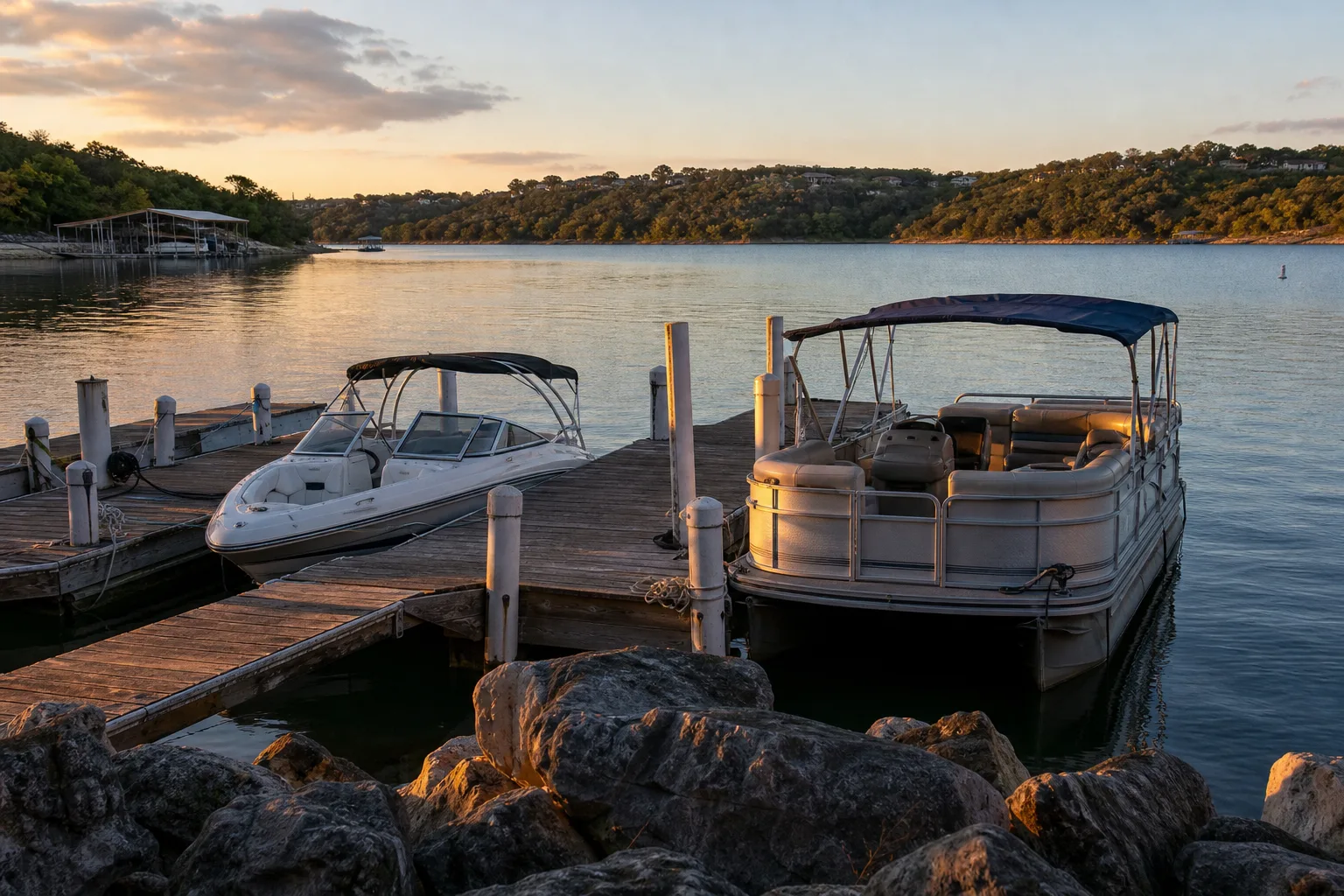
A deck boat has a single V-shaped fiberglass hull with a wide, open deck, while a pontoon sits on two or three aluminum tubes. A deck boat is usually the better pick if you want speed, water sports and a better ride in choppy water; a pontoon is usually better for a stable, roomy, social platform in calm water.
The two types look similar from the dock and overlap in price and use, so the decision usually comes down to the water you boat on, how many people you carry and what you want to do once you get there. Here is how a deck boat compares with a pontoon in the areas that matter most.
Side-by-side comparison
| Feature | Deck boat | Pontoon boat |
|---|---|---|
| Hull | One V-shaped hull, usually fiberglass | Deck on two or three aluminum tubes |
| Ride in chop | V-hull cuts through waves and has more bow buoyancy | Steady at rest and in calm water; can pound in chop |
| Stability at rest | Good, but a V-hull can rock with passengers moving | Very stable, wide, flat deck |
| Typical capacity | About 8 to 12 people | About 10 to 20, depending on the model |
| Speed and power | Often faster; can take big outboards or sterndrives | Sport pontoons are closing the gap |
| Water sports | Slight advantage for towing | Fine for tubing; sport models add towers |
| Weight | Heavier, often a lot heavier | Lighter |
| Best for | Wake sports, bays, bigger lakes | Relaxed cruising, sandbars, calm lakes and rivers |
The capacity, speed and water-sports figures come from Pontoon & Deck Boat magazine, which gives approximate ranges. Real capacity is set by the capacity plate on each boat, not by the type.
Hull and ride in chop
Pontoon & Deck Boat magazine notes that deck boats typically have a V-shaped hull, while pontoons ride flat on two or three aluminum tubes. The V of a deck boat helps it slice through waves, and it usually carries more buoyancy up front, which helps keep the bow up. The same source says V-hulls are the most fuel-efficient at high speed, while pontoons use less fuel at slower speeds.
A pontoon feels solid on smooth water but is designed mainly for sheltered lakes and rivers. In steep chop it can pound and push spray over the front. If your home waters are open lakes, bays or the Intracoastal Waterway on a windy day, a deck boat is generally the more comfortable choice. If you check conditions first, our guide to special marine warnings and small craft advisories explains the alerts to watch.
Capacity and layout
Pontoons offer a big, flat, open deck and are usually laid out for socializing, with seating that can face any direction. Deck boats generally put seating around a bow area and cockpit, with more of it facing forward. The same magazine says pontoons can typically fit anywhere from 10 to 20 people, depending on the model, and deck boats about 8 to 12. Treat these as ballparks: always read the Coast Guard capacity plate on the exact boat. Boats under 20 feet carry a federally required plate showing maximum persons, weight and horsepower, and you should never exceed it.
Remember that wearable life jackets for everyone aboard are required, and a throwable device is required on boats 16 feet or longer. See our life jacket guide.
Uses
- Family cruising and entertaining. A pontoon's open layout and stability make it a popular party barge for calm water and sandbars.
- Tubing, skiing and wakeboarding. The magazine says a 150-hp pontoon can tow amateur tubers, but pontoons may need more power for more advanced skiers. A deck boat with a larger outboard has a slight advantage, though sport pontoons with wake towers are narrowing that gap.
- Fishing. Both can be set up for fishing. If fishing in skinny water is the plan, see our skiff, bay boat and flats boat comparison and our center console guide.
- Coastal use. Deck boats do better in open bays; pontoons are best kept in sheltered water.
Trailering and storage
- Weight. Deck boats are often heavier, so check your vehicle's tow rating against the boat's weight plus engine, fuel and gear.
- Width. Both types are wide. A wide boat may need a permit to trailer on some roads; ask your state transportation agency.
- Ramps. Both launch easily at a standard ramp. Find one near you: Florida boat ramps, Texas boat ramps, or a lake page such as Lake Ray Hubbard (see also our Lake Ray Hubbard boating guide).
- Slips and storage. A wet slip costs money. Compare rates on our 20-ft slip prices and Texas 30-ft slip prices, or read about boat storage options such as dry storage and trailer parking.
Salt water vs fresh water
Both types are used in both. Fresh water is gentler on any boat. In salt water, you need to rinse the boat, engine and trailer after each trip, watch for corrosion at fittings and hardware, and use anodes where the manufacturer specifies. Aluminum pontoon tubes in salt water need care; ask the builder about coatings, warranty limits and what saltwater use does to the warranty. Deck boat hulls are generally fiberglass, which resists corrosion but needs bottom paint if kept in the water. Marinas along Florida's coast and Texas bays are where most owners keep saltwater boats; browse them on our Florida and Texas pages.
Questions to ask before you buy
- What does the capacity plate say for people, weight and horsepower?
- Is the boat built for the water where I will use it: protected lake, big lake, bay or coast?
- What is covered by the warranty if I use it in salt water?
- What is the dry weight, and what does it weigh with the engine, fuel and gear when I tow it?
- Where will I keep it, and what does that cost every month?
- What registration and boating safety requirements apply in my state? For Florida, see our boating license and registration guide; for Texas, check Texas Parks and Wildlife.
What will it cost?
New and used prices vary widely by size, engine, builder and options, so we do not quote a price here. To figure out what a boat will really cost, add the purchase price, financing, insurance, storage or slip, fuel, maintenance and registration. Our boating cost calculator and boat loan calculator help you run the numbers before you visit a dealer. If you already own a boat, see how much my boat is worth.
Quick decision guide
- Choose a deck boat if you boat on open water, want to pull skiers or riders, or want to handle a short chop.
- Choose a pontoon if you mostly cruise calm water with a big group and want a stable, open deck.
- Look at a tritoon (three tubes) if you want a pontoon with more power and a firmer ride.
- Always test both in conditions like your home water, with your usual crew weight.
FAQ
Is a deck boat better than a pontoon?
Not universally. A deck boat generally handles chop and speed better; a pontoon is more stable and roomy in calm water.
Can a pontoon boat handle rough water?
Pontoons are designed mainly for sheltered lakes and rivers and can ride rough in chop. Check the forecast and stay in protected water.
Which holds more people?
Pontoons usually hold more, but the capacity plate on the specific boat is what counts.
Are deck boats good for fishing?
They can be, especially with a fishing package, but dedicated fishing boats have more rod storage and casting space.
Can I use a pontoon or deck boat in salt water?
Yes, with rinsing and corrosion care. Ask the builder about saltwater use and the warranty.