
No Wake Zones: Rules, Signs and Fines in Florida and Texas
What a no wake zone means, how idle speed differs from slow speed in Florida, how Texas defines no wake, how to read the signs and what happens if you break the rules.
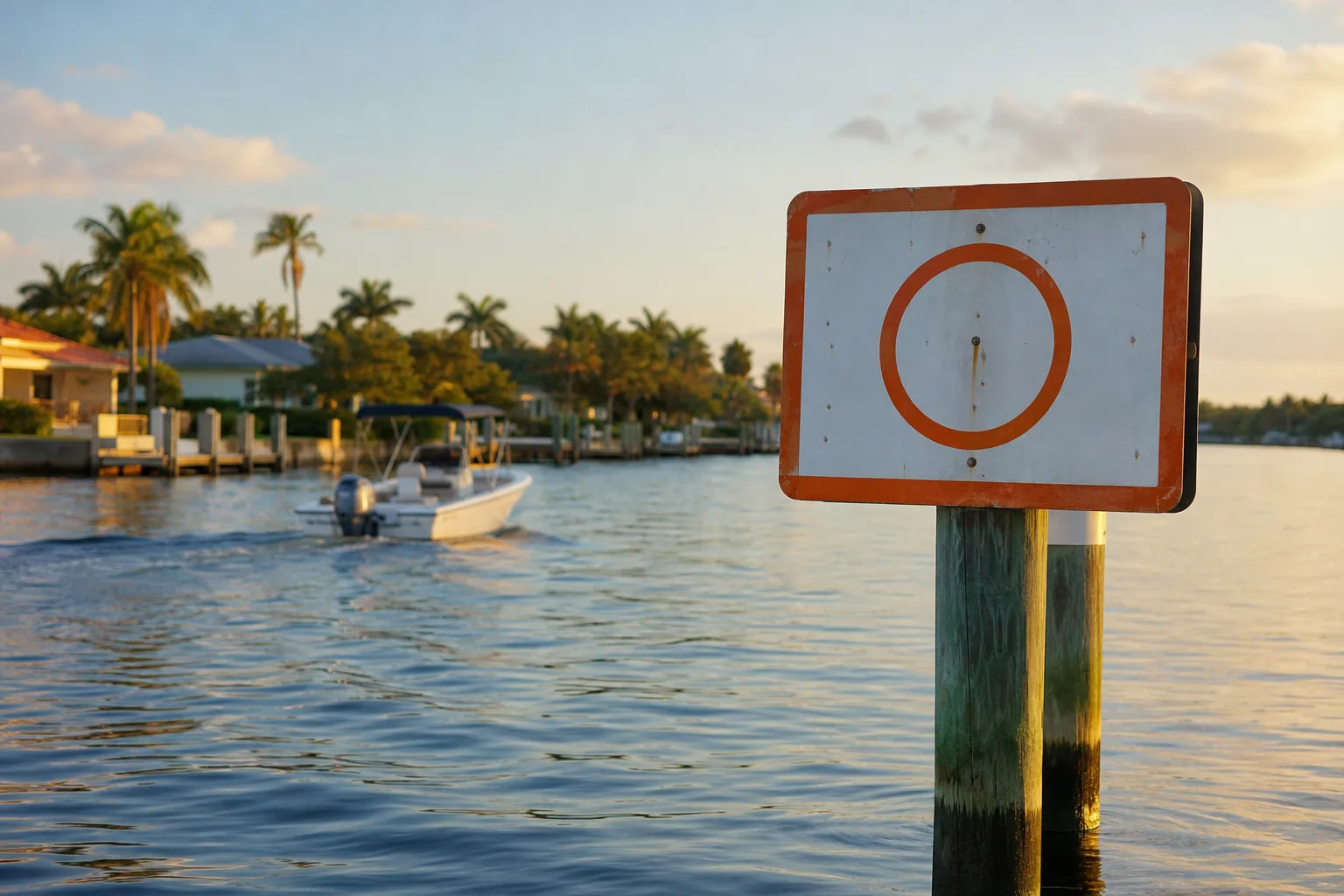
A no wake zone is an area where you must slow your boat so that it makes little or no wake. In Florida, an "Idle Speed No Wake" sign means the slowest speed that keeps the boat under control, and "Slow Speed Minimum Wake" means the boat must be fully off plane and settled in the water. In Texas, a "no wake" area means headway speed, without creating a swell or wake.
Why no wake zones exist
A boat's wake can damage docks, erode shorelines, swamp small boats and hurt swimmers or manatees. Speed rules are also used near boat ramps, fuel docks, bridges and narrow canals, where boats and people are close together. In practice, slowing down where signs and common sense say so is the easiest way to avoid a ticket and a dispute with your neighbors.
Florida: idle speed vs slow speed
The Florida Fish and Wildlife Conservation Commission (FWC) rules define the two main terms (Florida Administrative Code 68D-23.103, with matching definitions elsewhere in FWC rules).
| Sign wording | What it means |
|---|---|
| Idle Speed No Wake (or Idle Speed) | The boat may go no faster than the speed that maintains steerageway and headway. You are never required to go so slowly that you lose control of the boat or anything you tow. |
| Slow Speed Minimum Wake (or Slow Speed) | The boat must be fully off plane and completely settled into the water, then proceed at a reasonable and prudent speed to avoid an excessive wake or other hazardous condition. A boat on plane, or in the process of coming onto or off plane, is not meeting this rule. |
| Caution zone | An area with a navigation hazard, or frequently used by manatees, where vessels must be operated with particular alertness and caution |
There is no set number of miles per hour in either definition. A small skiff and a large cruiser reach those conditions at different speeds. "Slow Down Minimum Wake" is an older marker wording that FWC allows to stay in place for areas authorized before 2001.
Who creates Florida speed zones
The state can establish boating-restricted areas by FWC rule, and local governments can create certain areas by ordinance. Section 327.46 of the Florida Statutes lists what cities and counties may do. For example, a local ordinance may set an idle speed, no wake area within 500 feet of a public boat ramp or marina fuel dispenser on waterways more than 300 feet wide, or within 300 feet on narrower waterways, and inside or within 300 feet of a lock. Slow speed, minimum wake areas may be set within 300 feet of a bridge fender system, on creeks or canals less than 75 feet wide, on lakes smaller than 10 acres and in permitted mooring fields. The statute is detailed, so check the current text or your local ordinance for a particular area.
Even outside posted zones, Florida requires careful operation. Section 327.33 says to operate in a reasonable and prudent manner, having regard for other traffic and posted speed and wake restrictions.
Manatee zones
Many Florida speed zones protect manatees. Signs show the speed rule and, where it applies, the dates. The FWC defines the zone types, and the "caution zone" is the lightest. See manatee season in Florida for when and where zones apply and how to spot manatees. Rules differ by county, and zones change, so read the signs each time.
Penalties in Florida
Under Section 327.73, violations of boating-restricted areas and speed limits set by FWC or by local governments under Section 327.46 are noncriminal infractions. The civil penalty is $100 unless the statute provides otherwise, and a court can impose up to $500 after a hearing. This describes the statute text as published for 2025, so confirm current amounts with FWC or the clerk of court. For a boater, a better rule is simple: when you see the sign, slow down.
You also need the proper credentials to run a boat in the first place. Marinalo's Florida boating license and registration guide explains boater education and registration.
Texas: what "no wake" means
Texas Parks and Wildlife (TPWD) lists it as unlawful to operate within a designated "no wake" area except at headway speed without creating a swell or wake. For personal watercraft, TPWD defines headway speed as a slow, idle speed, or speed only fast enough to maintain steerage.
Other Texas rules that act like no-wake rules:
- Hazardous wake or wash. It is unlawful to operate in a manner that causes a hazardous wake or wash.
- Restricted areas. You may not operate within an area designated as bathing, fishing, swimming or otherwise restricted.
- Diver-down flags. Boats must stay at headway or steerage speed within 150 feet of a diver-down flag, and stay at least 50 feet away from it, according to TPWD.
- Personal watercraft. A PWC may not operate within 50 feet of another PWC, motorboat, vessel, platform, person, object or shore except at headway speed without creating a swell or wake.
The 50-foot dock-and-shore rule in TPWD's operation rules is written for personal watercraft. TPWD's operation pages do not state a general 50-foot idle requirement for ordinary motorboats. Lake authorities and local rules may add their own limits, such as no-wake distances near docks and shorelines on a particular reservoir, so read the lake's rules before you go. Penalties vary with the offense and the local court, so check TPWD or the game warden if you need specifics.
Two Texas lakes that are popular with boaters have their own guides: Lake Ray Hubbard and Lake LBJ. Marinalo also lists Lake Ray Hubbard boat ramps.
Reading waterway markers
Speed and area restrictions are normally shown with regulatory markers under the Uniform State Waterway Marking System. Across states the symbols are consistent, though buoy details vary:
| Marker | Meaning | Typical use |
|---|---|---|
| Orange circle with a white center | Control or restriction on vessel operation | Slow, no wake, speed limit, no skiing |
| Orange diamond | Danger | A hazard, usually named on the marker |
| Orange diamond with a cross | Exclusion, boats keep out | Areas such as swim zones, often labeled with the message |
Buoys used as regulatory markers are white with orange horizontal bands, according to Virginia's state guide, and fixed signs mount on pilings or posts. The text on the sign matters, so read it. Lateral markers, the green and red channel aids, are a separate system. Their job is to show the channel edge, not a speed limit.
Check speed zones before you launch. Marinalo's Florida boat ramps and Texas boat ramps pages are a starting point. For long runs, the Intracoastal Waterway crosses many posted zones in both states.
Be a good neighbor: tips
- Slow down early, not at the sign. Waves keep moving after you cut the throttle.
- Off plane means the bow is down and the boat is settled, not just throttled back.
- Slow near docks, kayaks, anglers and anchored boats even when no sign says so. Wake damage is still your responsibility.
FAQ
What is a no wake zone?
An area where boats must slow down so they create little or no wake. The exact wording on the sign decides how slow.
What is the difference between idle speed and slow speed in Florida?
Idle speed is the minimum speed that keeps steerage. Slow speed requires the boat to be fully off plane and settled, then to travel at a reasonable speed that avoids an excessive wake.
How fast can I go in a no wake zone?
There is no fixed speed in Florida's definitions. In Texas, TPWD says headway speed without a swell or wake. Go as slowly as you need to keep wake to a minimum.
How much is a ticket for speeding in a no wake zone in Florida?
Under Section 327.73, the civil penalty is $100 unless the statute says otherwise, and a court can impose up to $500 after a hearing. Confirm current amounts with FWC or the clerk of court.
Is there a 50-foot rule near docks in Texas?
For personal watercraft, yes, within 50 feet of shore, a person, object or vessel they must stay at headway speed. TPWD's pages do not set the same 50-foot rule for other motorboats, but local lake rules may.
Sources
- Florida Administrative Code 68D-23.103: Definitions (FWC boating-restricted areas)
- Florida Statutes 327.46: Boating-restricted areas
- Florida Statutes 327.33: Reckless or careless operation of a vessel
- Florida Statutes 327.73: Noncriminal infractions
- Texas Parks and Wildlife: Operation of Your Boat
- Texas Parks and Wildlife: Operation of Personal Watercraft
- Virginia Department of Wildlife Resources: Regulatory Markers on Public Waters
- Oregon Administrative Rules 250-010-0240: Characteristics of Waterway Markers