
Boat Anchor Types and How to Anchor Properly
Boat anchor types explained: Danforth, plow, claw, mushroom and grapnel, plus rode, scope ratios, bottom types, setting the anchor, tides and anchor lights.
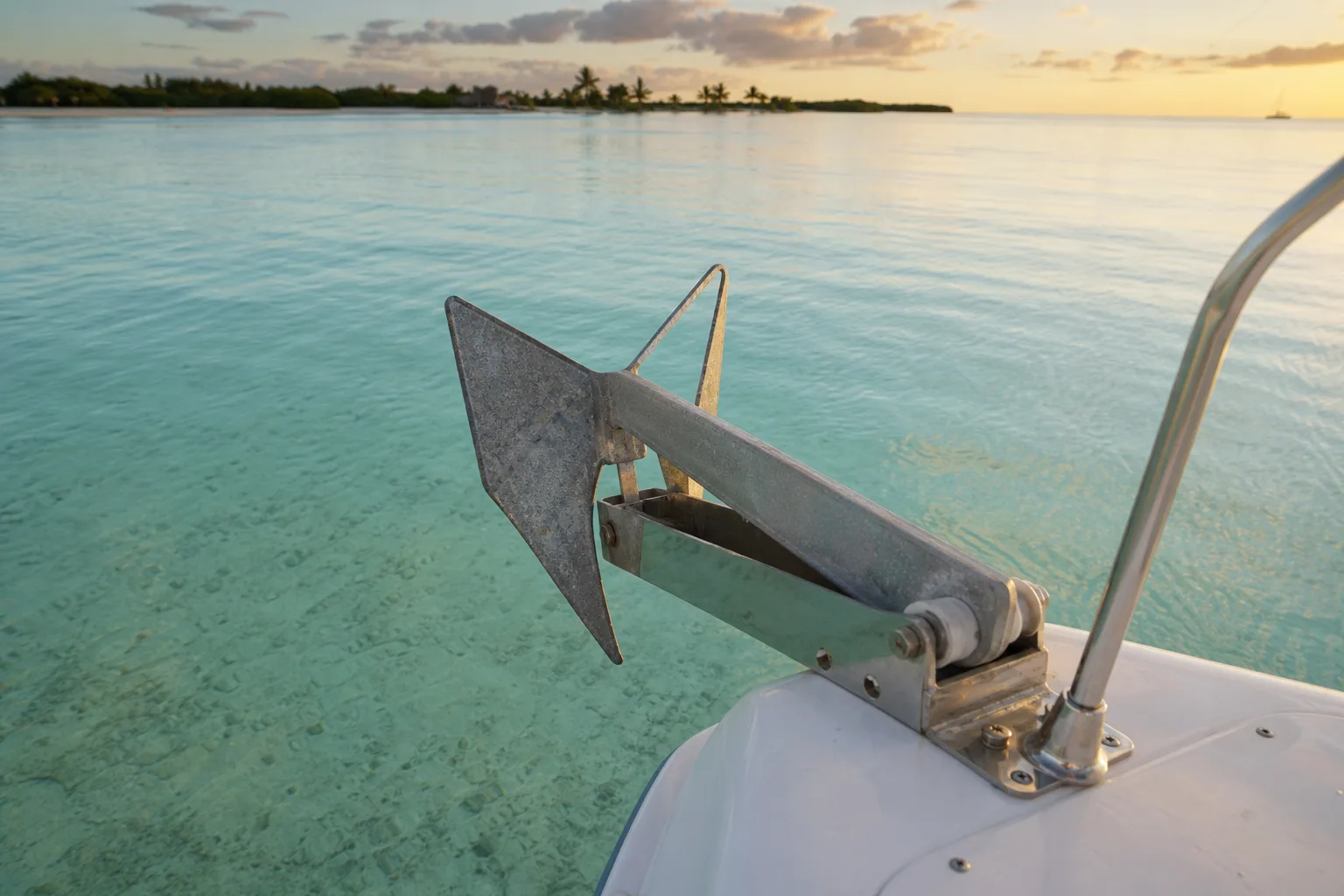
A Danforth anchor is a lightweight fluke-style anchor that digs deeply into sand and mud, which makes it a favorite for small and mid-size boats in those bottoms. Other common boat anchor types are plow, claw, mushroom and grapnel, each suited to different bottoms. Whichever you carry, it only works when you pair it with enough anchor rode and enough scope.
This guide covers the main anchor types, which bottoms they hold in, how to choose and set the rode, how tides and lights change the plan, and how to protect seagrass and coral.
Boat anchor types at a glance
| Type | Design | Best in | Watch out for |
|---|---|---|---|
| Fluke (Danforth style) | Two flat flukes on a pivoting stock | Sand and mud | Weak in rock, heavy weed and thick grass |
| Plow (CQR, Delta style) | Plow-shaped, one-piece or hinged | Mixed bottoms, sand, mud, grass | Bulky to stow on some bow rollers |
| Claw (Bruce style) | Single-piece curved claw | Sand, mud, rock and grass | Can be slow to set in hard bottoms |
| Mushroom | Dome-shaped weight | Soft mud and silt on small craft, light moorings | Poor holding on firm bottoms |
| Grapnel | Several hooks or tines | Rocks, reefs, debris on small boats and dinghies | Can snag and be hard to free |
| New-generation (Rocna, Mantus, Spade and similar) | Roll bar or concave fluke designed to set fast | Wide range of bottoms | Often larger and more expensive; check bow-roller fit |
Fluke or Danforth anchors
The Danforth design is light for its holding power and stows flat. It digs in when it is pulled along the bottom, so it needs a steady horizontal pull from a long rode. It can break out when the wind or tide shifts and pulls from the other side, which is why it is better for a short stop than for a night in changing conditions.
Plow, claw and new-generation anchors
These designs are meant to reset when the direction changes, and they cope with a broader range of bottoms. They are popular on cruising boats and on bow rollers. New-generation models claim faster setting and stronger holding for their weight, but sizes and ratings differ by maker, so check the manufacturer's size chart for your boat's length and displacement.
Mushroom and grapnel anchors
A mushroom anchor holds by weight and by sinking into soft mud, and it suits small boats and permanent moorings. A grapnel is a folding multi-tine hook, handy on a kayak, canoe or dinghy, and useful for hooking rocks or wrecks. Neither is a good primary anchor for a larger boat.
Match the anchor to the bottom
- Sand: good holding for most anchors; flukes and plows excel.
- Mud and silt: holds well once buried, but soft mud can let light anchors slide; a fluke or a larger new-generation anchor works.
- Grass and weeds: hard for many anchors to penetrate; a plow or a new-generation anchor often does better. Avoid anchoring in seagrass if you can.
- Rock and coral: hard to set and easy to damage. A grapnel can hook, but it can also get stuck. In protected areas, anchoring on coral is prohibited.
Use the chart or a depth sounder to read the bottom, and look at the water color. In the Keys and clear Gulf waters, sand shows as light patches and grass as dark ones.
Anchor rode: chain, line and the connection
The anchor rode is everything between the anchor and the boat. A common setup is a length of chain next to the anchor, then nylon line. Chain adds weight that keeps the pull low and horizontal, resists abrasion on sand and shell, and helps the anchor set. Nylon line stretches, which cushions shock loads from waves. Mixed chain-and-line rode is common on small and mid-size boats, and all-chain on larger vessels.
- Chain length: manufacturers' sizing charts suggest a chain length based on boat size and conditions.
- Shackles: use a shackle sized for the chain and secure the pin with seizing wire or a zip tie so it cannot back out.
- Bitter end: tie the inboard end of the rode to the boat, so you do not lose everything if it runs out. Learn the right hitches in boating knots.
- Marks: mark your rode at regular lengths so you know how much is out. BoatUS recommends marking the rode.
Scope: how much rode to put out
Scope is the ratio of rode length to the depth of water. BoatUS describes 5:1 as a good baseline, about 3:1 as a minimum for a short stop in benign conditions while someone stays aboard, and about 7:1 for rough weather or when you leave the boat, provided there is room to swing. Measure depth from the bottom to the bow roller, not just the sounder reading, which is often several feet less.
| Situation | Scope guidance (BoatUS) |
|---|---|
| Quick stop, calm weather, someone aboard | About 3:1 |
| Typical anchoring | About 5:1 baseline |
| Rough weather or unattended | About 7:1, with room to swing |
For example, if the water is 10 feet deep and the bow roller sits 3 feet above the surface, you measure 13 feet. At 5:1 that is 65 feet of rode. More scope is almost always better, if room allows. Many anchor-drag incidents are blamed on too little scope.
Setting and retrieving the anchor
- Choose your spot. Check depth, bottom, other boats and swing room. Anchor on the approach, bow into the wind or current.
- Stop the boat over the spot, then lower the anchor, don't throw it.
- Back down slowly as you pay out rode until you have the scope you want.
- Cleat the rode and back down gently in reverse to set the anchor. You should feel it bite.
- Check your hold. Pick two landmarks on shore and watch them for a few minutes. If they move relative to each other, you are dragging.
- To retrieve, motor slowly toward the anchor while taking in rode, then break it out and bring it aboard. Wash off mud and stow it safely.
Never wrap anchor line around your hand or foot, and keep fingers clear of the windlass. If you boat at a popular sandbar, read sandbar boating, since anchoring is central to the day there.
Anchoring and tides
In tidal waters, the depth changes while you are anchored. A tide rise means you need rode for the highest water you expect, and a falling tide can leave you aground if you anchor in shallow water. Check predictions before you set the hook; how to read a tide chart explains the numbers, and Marinalo's Florida tide pages show daily times. Tidal current also swings the boat, so give yourself room, and check that the swing circle will not touch another boat or shallow water.
Anchor lights at night
Under Rule 30 of the Navigation Rules, a vessel at anchor must show the lights the rule requires, normally an all-round white light visible from all directions. Smaller vessels have limited exemptions that depend on location, so read the rule text rather than assuming. See the full text of Rule 30, and the general light rules in boat navigation lights. An all-round white light on a pole is a cheap upgrade for overnight stays.
Protecting seagrass and coral
Anchors, chains and propellers can tear up seagrass beds and coral, which take years to recover. In the Florida Keys National Marine Sanctuary, NOAA's regulations in 15 CFR Part 922, Subpart P, restrict anchoring on coral, and its penalty schedule lists anchoring on coral in shallow water as a violation. NOAA has also proposed no-anchoring rules for sanctuary preservation areas as part of its Restoration Blueprint, so check the sanctuary's current rules before you anchor. Use mooring balls where provided, and anchor on sand away from grass and reef. For Keys planning, see the Key West boating guide, the Key West marina page and the Key West boat ramps.
FAQ
What is a Danforth anchor best for?
Sand and mud bottoms, where its flukes dig in and give strong holding for the weight. It is not ideal for rock or thick grass.
How much anchor rode do I need?
Plan on a scope of about 5:1 as a baseline, with about 7:1 in rough weather, per BoatUS, and measure depth from the bow roller to the bottom.
Do I need chain on my anchor rode?
Chain is recommended by most anchor makers, since it keeps the pull low and resists abrasion. Check your anchor maker's sizing chart.
How do I know if my anchor is dragging?
Line up two shore landmarks and watch them. If their alignment changes, or you feel vibration in the rode, reset the anchor.
Can I anchor on coral in the Florida Keys?
No. Anchoring on coral is a violation under sanctuary rules, and some zones restrict anchoring further. Check NOAA's current rules or use a mooring ball.
Sources
- BoatUS: Marking anchor chain (scope ratios of about 3:1, 5:1 and 7:1; measure from the bow roller)
- BoatUS: Calculate the right scope
- 33 CFR 83.30, Rule 30: Vessels anchored, aground and moored barges
- 15 CFR Part 922, Subpart P: Florida Keys National Marine Sanctuary
- NOAA Florida Keys National Marine Sanctuary