
Boat Navigation Lights: Rules, Colors and What They Mean
Boat navigation lights explained: red and green sidelights, white masthead and stern lights, anchor lights, when to turn them on and how to read other boats at night.
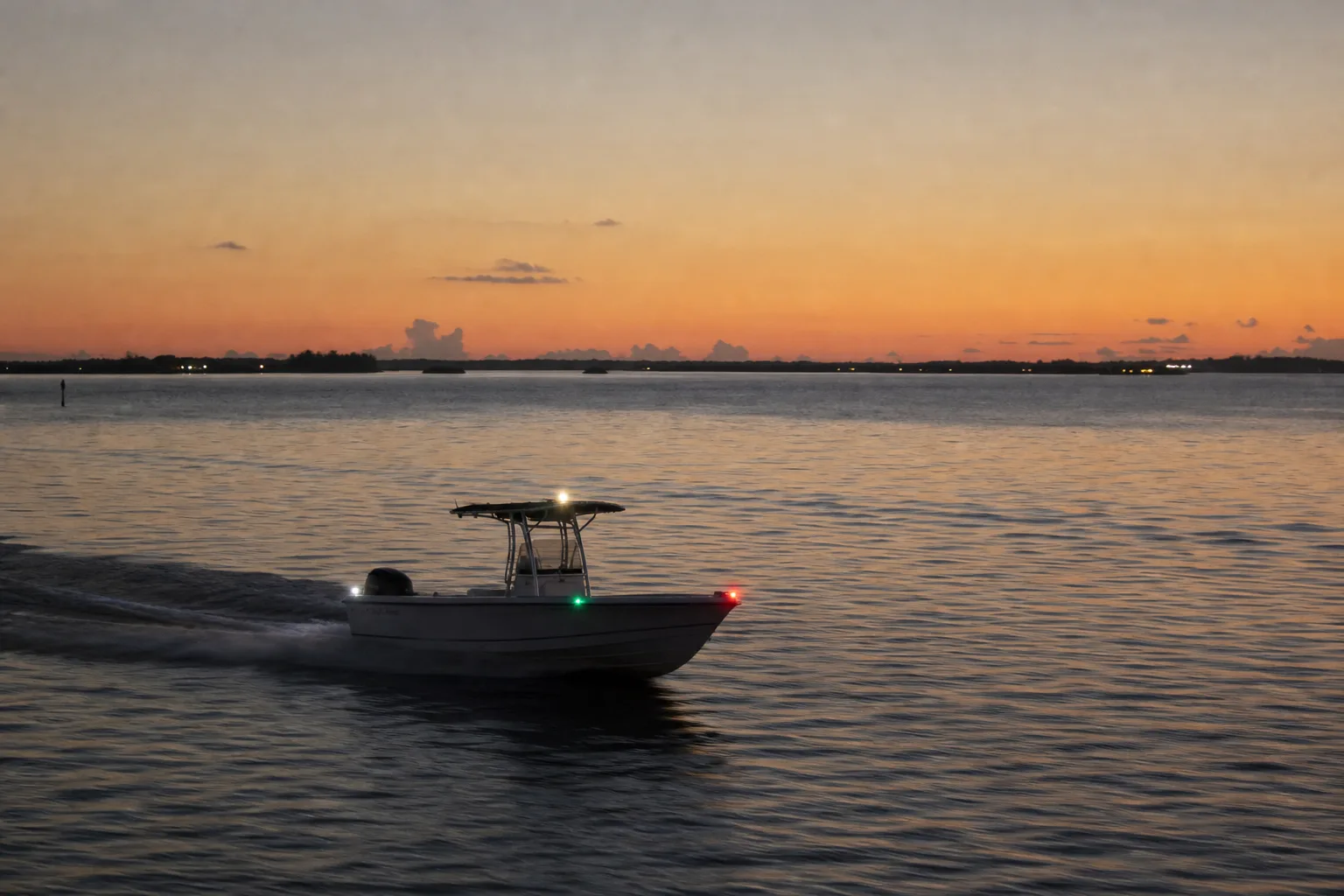
Boat navigation lights are the colored and white lights every boat must show between sunset and sunrise, and in restricted visibility such as fog or heavy rain. A red light is on the port (left) side, a green light is on the starboard (right) side, and a white light shows at the stern. Together they tell other boaters what you are, which way you are heading and whether you are underway or at anchor.
What the rules say about when to use lights
The Inland Navigation Rules (33 CFR Part 83, Rules 20 to 31) require that lights be shown from sunset to sunrise, in all weathers. Rule 20 also says that lights you carry must be shown from sunrise to sunset in restricted visibility. During the required hours you may not show other lights that could be mistaken for the prescribed lights or that impair their visibility or distinctive character. Rule 20 allows navigation lights to be lowered if necessary to pass under a bridge.
The Inland Rules apply on inland waters such as bays, rivers, lakes and the Intracoastal Waterway. The International Rules (COLREGs) apply on the high seas and use nearly the same light scheme, but small details differ, so this article follows the Inland Rules text. Both sets are published by the Coast Guard.
The five basic lights
Rule 21 defines each light by its color and the arc of the horizon it covers. Knowing the arc is what lets you read another boat's heading.
| Light | Color | Arc of the horizon | Where it is seen |
|---|---|---|---|
| Masthead light | White | 225 degrees | From dead ahead to 22.5 degrees behind the beam on each side |
| Sidelights | Green on starboard, red on port | 112.5 degrees each | From dead ahead to 22.5 degrees behind the beam on its own side |
| Sternlight | White | 135 degrees | 67.5 degrees from dead astern on each side |
| All-round light | White (or other color where specified) | 360 degrees | All directions |
| Towing light | Yellow | 135 degrees | Same arc as a sternlight |
Red is always on the port side and green on the starboard side. Our guide to port vs starboard has more memory tricks. For the bow and stern themselves, see parts of a boat.
Lights for power-driven boats
Under Rule 23, a power-driven vessel underway shows a masthead light forward, sidelights and a sternlight. A vessel under 50 meters (about 164 feet) is not required to show the second, higher masthead light.
Most recreational boats are under 12 meters (about 39 feet). Rule 23(d) lets a power-driven vessel of that size show an all-round white light and sidelights instead of the masthead and sternlight combination. This is why many small boats have a single white pole light at the stern plus red and green bow lights, often in one combined fixture.
Rule 23(e) lets a power-driven vessel operating on the Great Lakes carry an all-round white light in place of the second masthead light and sternlight.
Lights for sailboats and paddlecraft
Under Rule 25, a sailing vessel underway shows sidelights and a sternlight. If the vessel is under 20 meters, those lights may be combined in one lantern at or near the top of the mast. A sailboat under sail alone does not show a masthead light. Once the engine is running, it is treated as a power-driven vessel and shows the lights in Rule 23.
A sailing vessel under 7 meters (about 23 feet), and any vessel under oars, has a lighter requirement. It should show the sailing lights if practicable. If it does not, it must show an all-round white light or have a flashlight or lantern with a white light ready at hand, shown in time to prevent a collision. Kayakers and paddleboarders who go out near dusk should carry an all-round white light, not just a headlamp tucked in a pocket.
Anchor lights
Rule 30 covers vessels at anchor. A vessel at anchor normally shows an all-round white light in the fore part and a second all-round white light at or near the stern, at a lower level than the forward one. A vessel under 50 meters (about 164 feet) may show a single all-round white light where it can best be seen instead of the two lights.
There are exceptions. A vessel under 7 meters at anchor does not need to show an anchor light if it is not in or near a narrow channel, fairway or anchorage, or where other vessels normally navigate. A vessel under 20 meters anchored in a special anchorage area designated by the Coast Guard also does not need to show anchor lights. In practice, if you anchor overnight in a popular cove or near a channel, turn the light on.
How far your lights must be seen
Rule 22 sets minimum visibility ranges, measured in nautical miles, and they depend on the length of the vessel.
| Light | Under 12 m (39 ft) | 12 m to under 50 m | 50 m (164 ft) or more |
|---|---|---|---|
| Masthead light | 2 miles | 5 miles (3 miles if under 20 m) | 6 miles |
| Sidelight | 1 mile | 2 miles | 3 miles |
| Sternlight | 2 miles | 2 miles | 3 miles |
| All-round white light | 2 miles | 2 miles | 3 miles |
Those are minimums for equipment performance, not guarantees of what you will see on a given night. Haze, background shore lights and spray can all shorten the range.
How to read other boats at night
Treat what you see as a puzzle with three questions: which colors, how many whites and are they moving?
- You see green only. You are looking at another boat's starboard side. If it is crossing, it is passing from your right to your left in front of you. Review the steering and sailing rules for crossing situations before you head out at night.
- You see red only. You are looking at the other boat's port side.
- You see red and green together, plus white. The boat is heading toward you, or nearly so. Both sidelights are visible only near the bow. Slow down and prepare to alter course early and clearly.
- You see white only. Either you are behind a boat going the same way, or you are looking at a boat at anchor.
- The light does not move against the shore lights. It may be an anchored vessel, a channel marker with a light, or a dock. Check the chart.
- A yellow light above a white one. This is a towing vessel. A yellow light has the same arc as a sternlight and shows behind a tug.
- Two red lights in a vertical line above anchor lights. A vessel aground (Rule 30 requires this display if practicable).
Do not rely on a single light. Boats close to shore are mixed in with city lights, bridge lights and channel marker lights, and a flashing green or red light on a mark is not a boat. When in doubt, slow down and use a spotlight sparingly. A strong spotlight pointed at another boat can ruin its helmsman's night vision.
Practical tips for small boats
- Test your lights before every evening trip. A bulb that fails is the most common problem, followed by corroded sockets and connectors.
- Carry a spare bulb or a handheld white light. LED fixtures last longer, but check that they are rated for marine use.
- Do not leave deck floodlights or a bright cabin light on while underway. The Rules forbid other lights that impair the visibility of your navigation lights or interfere with lookout.
- Decorated boats at holiday events show their regular navigation lights as well. See our guide to Florida Christmas boat parades for how festive lighting and the rules fit together.
Before a night trip, plan your route and your ramp or marina arrival in daylight if you can. Marinalo lists Florida boat ramps and Texas boat ramps, and Florida fuel docks if you need to top up before dark.
FAQ
When do I need to turn on my boat lights?
From sunset to sunrise, and in daylight when visibility is restricted by fog, rain or smoke. Lights you carry must be shown in those conditions.
What color is the starboard light?
Green. The port light is red. The sternlight is white.
Does a boat at anchor need lights?
Generally yes. An anchored vessel shows an all-round white light (a vessel under 50 meters may show just one). Very small boats, and boats in a Coast Guard special anchorage area, can be exempt, but showing a light is safer.
What lights does a kayak need?
A vessel under oars should show sailing-vessel lights if practicable, or else an all-round white light or a flashlight ready to show in time to prevent a collision. State rules may add requirements, so check with your state agency.
Can I use a headlamp instead of navigation lights?
Not on a powerboat, which must show the lights described above. On a manually propelled boat, Rule 25 asks for an all-round white light or a white light ready at hand, so a headlamp worn on your head is a poor choice because your body can block it from some angles.