
Boat Propellers: How to Choose Pitch, Diameter and Material
How to choose a boat propeller: what pitch and diameter mean, how to use your engine's wide-open-throttle RPM range, aluminum vs stainless, and signs of a wrong prop.
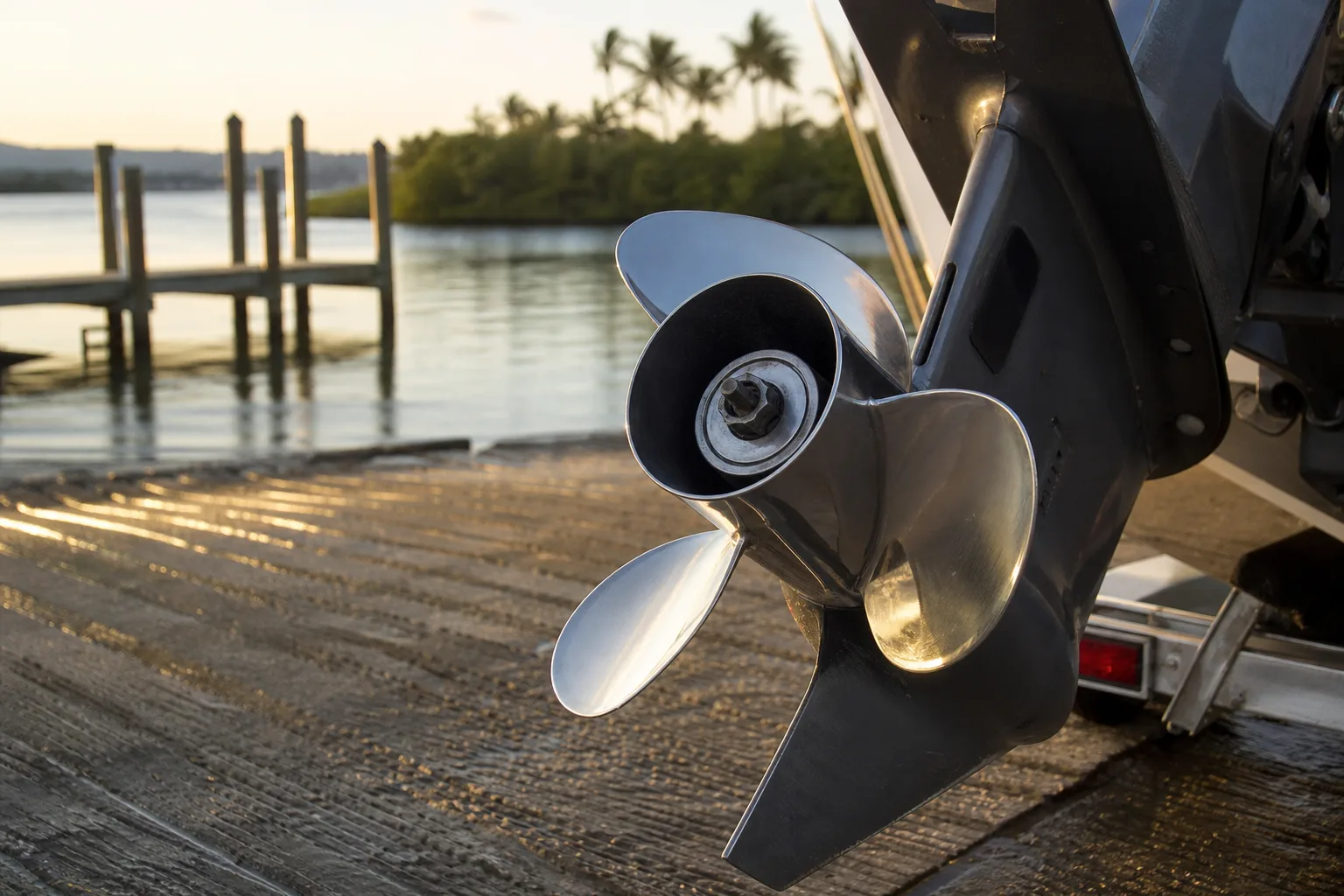
The right boat propeller is the one that lets your engine reach the top of its recommended wide-open-throttle (WOT) RPM range with a normal load on board. Pitch is the main lever for that: more pitch lowers WOT RPM, less pitch raises it. Diameter, blade count and material fine-tune how the boat feels and how long the prop lasts.
This guide explains how to read the numbers stamped on a prop, how to use your owner's manual to pick pitch, what aluminum and stainless steel each do well, how to tell a prop is wrong for your boat, and how to handle dings, repairs and safety around a spinning propeller.
What the numbers on a propeller mean
Most props have two numbers stamped on the hub, such as 14 x 19. The first is the diameter and the second is the pitch, always in that order. A 14 x 19 prop has a 14-inch diameter and 19 inches of pitch, according to Boating magazine's propeller guide.
- Diameter is the width of the circle the blade tips draw. Mercury Marine's propeller manual, as quoted by Boating, says diameter usually increases for props used on slower, heavier boats and decreases for faster ones.
- Pitch is the distance, in inches, a prop would move forward in one turn if it were screwing through a solid. Think of it as the gear: low pitch is a low gear (strong acceleration, lower top speed), high pitch is a high gear (slower to get going, higher top speed if the engine can turn it).
- Blade count is usually three or four on recreational boats. Extra blades generally give a smoother ride and better grip at low speed and in turns, at the cost of some top-end speed. The exact effect varies by hull and engine, so use the maker's selector rather than guessing.
- Rotation and bore must match your drive. Right-hand rotation is standard on single outboards, and the hub must fit your shaft.
Start with your engine's WOT range
Every engine maker publishes a recommended WOT RPM range for each model. It is in your owner's manual, and it is the single most important number for choosing a prop. Mercury's guidance is to select a propeller that lets the engine run at or near the top of that range with a normal load. Running below the range lugs the engine and strains it; running above it risks over-revving.
To check where you are, run the boat at wide-open throttle with the engine trimmed for maximum lift, note the RPM and speed, and repeat in the opposite direction if there is wind or current. Do it with the load you normally carry: fuel, people, gear.
The "one inch of pitch" rule of thumb
For typical recreational boats, each inch of pitch changes WOT RPM by roughly 200. Boating magazine gives the example that dropping from a 23-pitch to a 21-pitch prop raises RPM by about 400. Treat this as an approximation: it is a rule of thumb from boating writers, not a spec from Mercury or Yamaha, and it varies with engine, hull and prop style. Use it to estimate which direction and how far to move, then confirm with a test run.
| What you see at WOT | What it usually means | Typical fix |
|---|---|---|
| RPM above the recommended range | Underpropped (too little pitch) | Move up in pitch |
| RPM below the recommended range | Overpropped (too much pitch), or a heavy load or dirty hull | Move down in pitch, clean the bottom, lighten the load |
| RPM in range, boat slow to plane | Pitch is fine, but diameter, blade count or trim may need attention | Try a prop with more blades or a cupped design; check trim |
| RPM jumps without speed gain | Prop slipping or ventilating, or a spun hub | Inspect prop and trim; see a shop |
Many sources say it is better to be slightly underpropped than overpropped, because an overpropped engine cannot reach its power band and works hard for the same speed.
Conditions that change your RPM
Mercury lists several things that lower WOT RPM: warm weather and humidity, high elevation, a fouled hull and added load such as extra passengers or a skier. If you tested the boat empty in cool weather and then load it for a summer trip in Florida or Texas, expect lower RPM. If you boat both light and heavy, pick the pitch for the load you carry most of the time. A clean bottom matters too; see our guide to boat bottom paint.
Aluminum vs stainless steel
| Aluminum | Stainless steel | |
|---|---|---|
| Upfront cost | Lower | Higher |
| Strength | Softer; bends and chips more easily | Stronger; thinner blades keep their shape |
| Performance | Good for most family boats | Thinner blades usually give better top speed and holeshot |
| Damage | Often cheaper to replace than repair | Repairable by a prop shop, but a bad strike can still cost the lower unit |
| Best for | Small boats, tight budgets, rocky or shallow water | Performance boats, heavier use, long-term ownership |
A common reason to start with aluminum is that it can be a sacrificial part: in a hard strike it may give before the drive does. Stainless props are much tougher, so the energy of an impact has to go somewhere else. Compare current prices at a dealer rather than relying on a number here.
Match the prop to the boat
Boat type changes what you need from a prop. A center console with a single engine often benefits from a four-blade stainless prop for a quicker hole shot and better grip in following seas. Pontoons are heavy and need grip: see pontoon vs tritoon for why a tritoon can handle bigger power but needs the right pitch to avoid lugging. The type of drive also matters, since sterndrives and inboards have different prop families; read inboard vs outboard for how they differ.
Signs you have the wrong prop
- The engine cannot reach the bottom of the WOT range even with a light load.
- The engine hits the rev limiter before the boat reaches a steady speed.
- The boat is slow to plane, porpoises or will not hold a plane at a moderate throttle.
- Fuel use climbs while top speed drops.
- Vibration, usually from a bent blade or a damaged hub.
- The prop slips: RPM climbs quickly but the boat does not accelerate.
Damage, repair and replacement
Check the prop whenever the boat is on the trailer. Look for bent or chipped blades, cracks near the hub, fishing line wrapped around the shaft and a loose or spinning hub. Line left on a shaft can cut through the shaft seal and let water into the gearcase. Small nicks can sometimes be filed smooth, but anything that changes the blade shape throws the prop out of balance. A shop can repair, rebalance or re-pitch many props; ask for a quote before you buy a new one. Carry a spare prop and the matching hardware, since dock-side swaps are routine.
Prop safety
- Shut the engine off, and remove the key or lanyard, before anyone goes near the prop or swims by the stern.
- Put the engine in neutral and stop it before people board from the water; a prop can still be dangerous at idle.
- Use the engine cut-off switch lanyard every time you run.
- Keep passengers away from the stern when the engine is running, and watch for swimmers and tubes.
- Wear gloves and block the prop with a wooden wedge when you change it so it cannot turn.
Also stay out of seagrass: in the Florida Gulf, propeller scars through shallow grass are a recognized problem, and FWC asks boaters to stay in marked channels where they can. Plan your launch and route with our Florida boat ramps and Texas boat ramps pages.
FAQ
What is the best propeller for my boat?
The one that lets your engine reach the upper part of its recommended WOT RPM range with your normal load. Use the engine maker's prop selector or a dealer, then confirm with a test run.
Does a higher pitch make a boat faster?
Only if the engine can still reach its recommended RPM range. Too much pitch lugs the engine, hurts acceleration and can wear it out sooner.
How much does one inch of pitch change RPM?
About 200 RPM per inch on a typical recreational boat, according to Boating magazine. It is a rule of thumb, so check your own boat.
Is a stainless steel propeller worth it?
For performance and long life, often yes. For a small boat used in rocky water, a cheaper aluminum prop may be the better choice.
Can I fix a bent propeller myself?
Not reliably. A bent blade changes balance and pitch. A prop shop can repair and rebalance it, or you can replace it.
Are three blades or four blades better?
Four blades usually grip better and ride smoother at low speed; three blades often give a little more top speed. It depends on your hull and engine.