
Pontoon vs Tritoon: What's the Difference?
A tritoon boat has three tubes instead of two. Compare ride, stability, horsepower, weight, towing and cost drivers to decide which pontoon suits your lake.
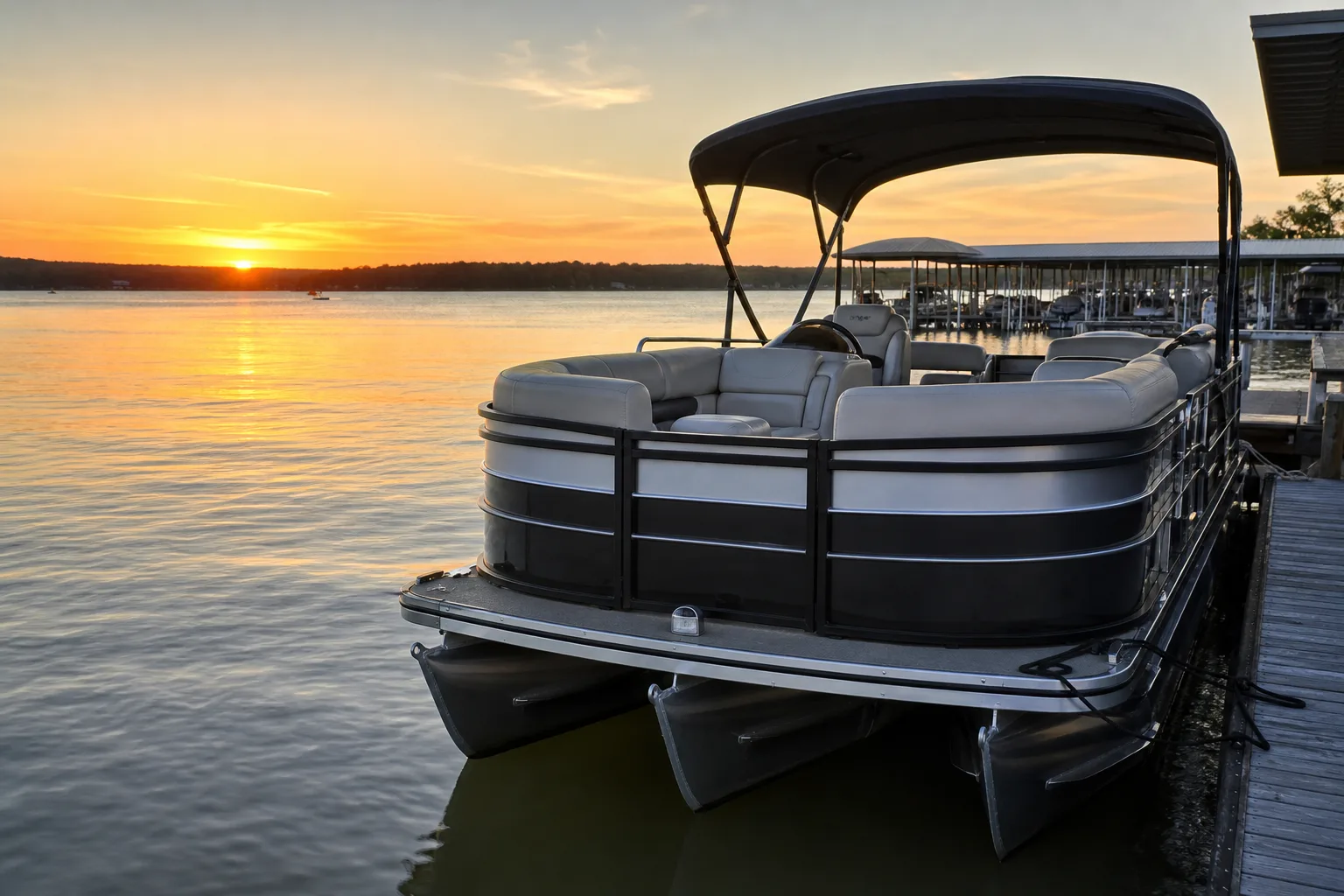
A standard pontoon boat sits on two aluminum tubes, and a tritoon boat adds a third tube down the center. The extra tube gives the boat more buoyancy and a higher horsepower rating, which means a faster, steadier ride and more capacity, but also more weight and a higher price. If you mostly cruise calm water, a two-tube pontoon often does the job; if you tow skiers, boat on bigger water or want speed, a tritoon is worth a look.
This guide compares the two on ride, stability, power, weight, towing and cost, and explains where to find the numbers that actually apply to a specific boat.
Pontoon vs tritoon at a glance
| Feature | Two-tube pontoon | Tritoon (three tubes) |
|---|---|---|
| Tubes | Two outer tubes | Two outer tubes plus a center tube, usually mounted a little lower or slightly larger in diameter |
| Ride at speed | Leans to the outside in turns | Glides on the center tube; can stay flat or lean into a turn |
| Horsepower rating | Lower | Higher |
| Rough water | Best in calm water | Handles chop better |
| Towing skiers and tubers | Possible, but limited by power | Better suited |
| Capacity | Smaller boats | Larger boats, more people and fuel |
| Weight and tow vehicle | Lighter | Heavier; check your vehicle's rating |
| Cost | Lower | Higher |
The table follows Discover Boating, the educational site run by the boating industry, and the manufacturers Bennington and Godfrey. A model-by-model comparison always depends on the boat; use the table as a guide to the trade-offs.
How the third tube changes the ride
Discover Boating explains that on a twin-tube pontoon, the boat leans to the outside of a turn, away from it. With three tubes, the boat rides on the center tube at speed while the outer tubes provide stability. Because the middle tube is mounted a little lower or is slightly larger in diameter, a tritoon can stay flatter or lean into a turn instead of away from it. That is why people associate tritoons with a more car-like feel at higher speed and a steadier ride in rougher water.
It does not mean a tritoon is unsinkable or exempt from weather rules. All pontoons have a flat deck with a lot of surface above the water, and wind and waves still matter. Review the Logbook explainer on marine warnings and advisories, and use the same caution you would on any boat when conditions change.
Power, speed and the capacity plate
The biggest practical difference is the maximum horsepower rating. Discover Boating says a pontoon with three tubes will have a higher horsepower rating than a model with two tubes. In its example of 24-foot boats, the twin-tube model has a 150 hp maximum and 28 gallons of fuel, while the triple-tube model has 225 hp and 63 gallons. That is one example, not a rule: ratings vary by builder, model, tube size and layout.
The number that governs your boat is the one on the manufacturer's capacity plate or listed in the owner's manual. The U.S. Coast Guard's federal powering rule for capacity plates covers monohull outboard boats under 20 feet, so for pontoons the rating comes from the builder and the model. Never put an engine on a pontoon that is rated above that maximum. When shopping, ask the dealer for:
- The maximum horsepower for the exact model and tube configuration.
- The maximum number of people and total weight capacity.
- The dry weight and the weight with engine, fuel and gear.
- What trailer comes with it and its gross vehicle weight rating.
Bennington, for example, says its three-tube boats can carry up to 15 people at 23-28 feet and up to 21 at 30 feet, but it tells owners to use the capacity plate and the dealer for exact limits. Count on the plate for your own boat, not an article.
Weight, towing and storage
A third tube and a bigger engine add weight. Boattest notes that the third tube adds weight, so your tow vehicle has to be able to handle it. Do not guess. The key steps:
- Find the boat's dry weight from the manufacturer's specification sheet.
- Add the engine, fuel, batteries, gear and the trailer's own weight.
- Compare the total to your vehicle's tow rating and the trailer's gross vehicle weight rating.
The full method is in the Logbook guide to boat towing capacity. Width and height matter too, so check the boat's dimensions against your trailer, your route and your storage space. If you plan to keep the boat in a marina, Marinalo's slip price pages show how rates compare by length, and the boat storage options guide compares wet slips, dry stack and trailer storage.
What drives the cost
This guide does not quote prices, because a price depends on the brand, model year, engine and options. The factors that move the cost are consistent:
- The third tube: Discover Boating notes that adding the center tube increases the cost of the boat.
- The engine: a higher-horsepower motor costs more, and a tritoon is built to use one.
- Size and options: larger decks, more seating, towers and electronics add cost.
- Running costs: a bigger engine and fuel tank mean more fuel burned per hour of fun.
- Trailer, slip and insurance: a larger boat typically needs a stronger trailer and may cost more to store.
To model the monthly payment, try the Marinalo boat loan calculator and the boat cost calculator, then compare the numbers for a two-tube and a three-tube boat you are considering. For used boats, the Logbook explains how to value a boat.
Which lakes suit which boat?
Either design works on the lakes in the Logbook; the question is how you use them:
- Calm cruising and sandbar days: a two-tube pontoon is a fine fit, as Discover Boating says about slow evening cruises on calm lakes.
- Big open water with chop: a tritoon's rougher-water ride is the draw. See the guides to Lake Okeechobee and Lake Livingston.
- Hill Country and metro lakes: both work on Lake LBJ and Lake Ray Hubbard. Check each lake's rules for towing sports and no-wake zones.
- Tubing and skiing: a tritoon's extra power helps, but safety rules still apply; read the boat tubing safety guide.
Not sure whether a pontoon is the right category at all? Compare it with a deck boat in deck boat vs pontoon, or browse types of boats.
Buying checklist
- Decide how you will use the boat: cruising, fishing, watersports or entertaining.
- Check the capacity plate and the dealer's specification sheet.
- Check your tow vehicle's rating and the boat's total weight.
- Look at the lakes you will use and their ramps; see the Texas boat ramps and Florida boat ramps pages.
- Ask about warranty, tube material and tube welds.
- Take a test ride in conditions you will actually see, and test a turn at speed.
FAQ
What is a tritoon boat?
A tritoon is a pontoon boat with three tubes instead of two. The center tube adds buoyancy and supports more power.
Is a tritoon faster than a pontoon?
Usually, because it carries a higher horsepower rating. Discover Boating says a triple-tube design is better for towing skiers and boarders and for speeds over 40 mph. The real figure depends on the boat's engine and load.
Is a tritoon more stable?
At speed, yes: the center tube carries the boat while the outer tubes stabilize it, and the boat can lean into turns. At rest, stability depends on the layout and the load.
Does a tritoon cost more?
Typically. The third tube and higher-horsepower engine increase the price, per Discover Boating. Compare specific models and dealer quotes.
Can I tow a tritoon with my SUV?
Maybe, but it depends on weight. Add the boat, engine, fuel, gear and trailer and compare it with the vehicle's rating. See the towing guide.
Where do I find a pontoon's maximum horsepower?
On the builder's capacity plate and in the owner's manual or spec sheet for your exact model.
Sources
- Discover Boating, Tritoon vs Pontoon.
- Bennington Marine, Tritoon vs Pontoon.
- Godfrey Pontoon Boats, Tritoon vs Pontoon.
- Boattest, Tritoon vs Pontoon: What's the Difference?
- Electronic Code of Federal Regulations, 33 CFR 183.53 (scope of the horsepower capacity rule).