
Boat Towing Capacity: Can Your Vehicle Tow Your Boat?
How to know if your truck or SUV can tow your boat: towing capacity, GVWR, GCWR, tongue weight, fuel and gear weight, plus trailer brake laws in Florida and Texas.
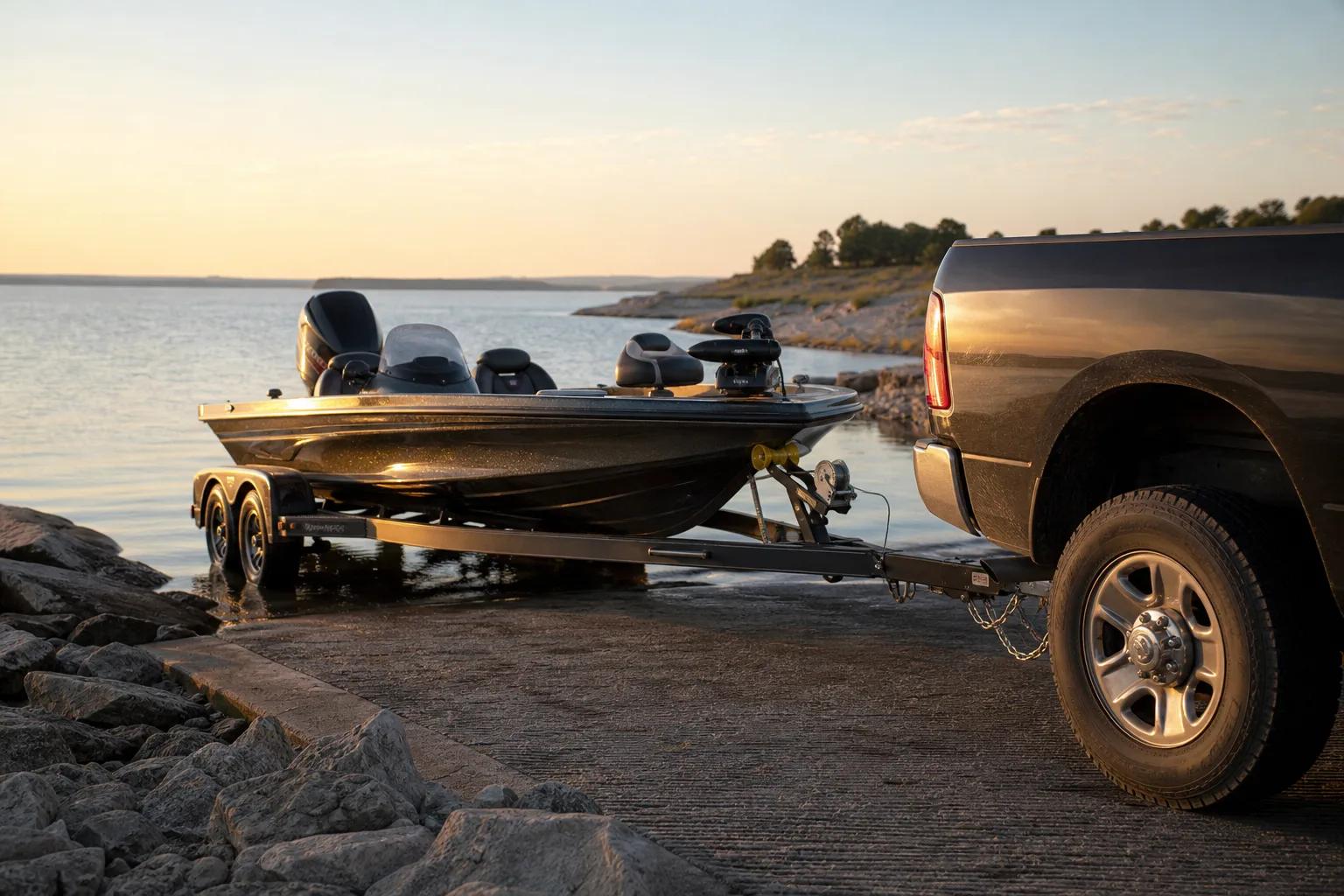
Your vehicle can tow your boat if the total weight of the boat, engine, fuel, gear and trailer stays under the vehicle's towing capacity, the combined weight stays under its gross combined weight rating (GCWR), and the trailer's tongue puts a safe load on the hitch. Look up three numbers in the owner's manual and on the trailer's label, add up what you actually carry, and leave a margin.
This guide walks through the ratings, shows how to add up a boat's real weight, and covers the trailer brake rules in Florida and Texas. It does not use sample weights for specific boats, because the right number is the one on your own spec sheet and scale ticket.
The ratings that matter
| Term | What it means | Where to find it |
|---|---|---|
| Towing capacity | The maximum trailer weight the manufacturer says the vehicle can tow | Owner's manual towing section |
| GVWR (gross vehicle weight rating) | Maximum loaded weight of a single vehicle, including passengers, cargo and fluids (Blue Ox). The tow vehicle and the trailer each have their own GVWR | Door-jamb sticker on the vehicle; label on the trailer frame |
| GCWR (gross combined weight rating) | The maximum combined weight of the towing vehicle plus the trailer and everything on both, including passengers and cargo (Mazda owner's manual) | Owner's manual |
| Tongue weight | The downward load the trailer puts on the hitch | Measured with a tongue scale, or at a public scale |
| Payload | How much weight the vehicle can carry, including people, cargo and tongue weight | Door-jamb sticker |
The manufacturer's towing capacity assumes a specific setup, and the weakest rating is the one that limits you. A vehicle may have a high tow rating but run out of payload first, because tongue weight counts against the vehicle's payload and rear axle rating. One towing guide from Blue Ox notes that too little tongue weight can cause dangerous trailer sway, while too much can overload the tow vehicle's rear axle and affect steering and braking.
Tongue weight: the 10 to 15 percent rule
For a typical trailer, tongue weight is often cited as 10 to 15 percent of the total trailer load. Mazda's owner's manuals, for instance, say the trailer tongue load must be 10 to 15 percent of the total trailer load (the sum of the weights of the trailer and cargo), and Blue Ox gives the same typical range for conventional trailers. Your own vehicle's manual may state a different limit, so use the manual first. A boat on a bunk or roller trailer is usually adjusted by moving the boat forward or back on the trailer or shifting gear.
How to add up the real weight
A boat's "weight" in a brochure is usually the dry weight, which leaves out fuel, gear and often the engine. Use the following list to add up the real total on the road:
- Hull or boat dry weight: from the manufacturer's specification sheet. Check whether the engine is included.
- Engine and controls: add them if the dry weight excludes them. See the spec sheet or the engine's label.
- Fuel: gasoline weighs roughly 6 pounds per gallon, and 40 gallons adds more than 240 pounds (BoatBlurb). Do not forget fuel in portable tanks.
- Batteries, water, ice, coolers and gear: anchors, fenders, skis, tubes and dock lines add up.
- Trailer weight: the trailer's own empty weight, from its label or the manufacturer.
Then compare the totals:
| Check | Compare |
|---|---|
| Trailer + boat + load | Is it under the trailer's GVWR? Is it under the vehicle's towing capacity? |
| Vehicle + passengers + cargo + trailer + boat + load | Is it under the vehicle's GCWR? |
| Tongue weight + passengers + cargo | Is it under the vehicle's payload and rear axle rating? |
The numbers on a spec sheet are only a starting point. Gear piles up, fuel tanks fill and trailers carry extras. The only way to know is to weigh the loaded rig.
Weigh the rig on a public scale
Public truck scales, such as CAT Scale locations at many truck stops, will weigh a vehicle and trailer so you can see the real gross weight and, if you weigh in steps, the axle loads. Park the tow vehicle alone on the first scale, then hitch the loaded trailer and weigh again. Check the scale operator's fee and rules before you go. A roadside weigh station is an enforcement site, not the place to experiment, so use a public scale instead.
What about "how much does a boat weigh"?
There is no standard answer, because weight depends on the hull material, length, engine, fuel capacity and equipment. A small aluminum jon boat is light compared with a loaded fiberglass center console or a pontoon with a big engine. The Logbook explains jon boats, center console boats and pontoon and tritoon boats.
- Pontoon boat weight: varies widely with deck length, tubes and engine. A three-tube boat is heavier than a similar two-tube boat, so read the builder's dry weight and add fuel and gear.
- Boat trailer weight: depends on length, axle count, material and brakes. Look for the VIN or label on the trailer frame, and find its GVWR and empty weight.
- Do not use length alone. Two boats of the same length can weigh very differently.
Trailer brake laws in Florida and Texas
Brake rules depend on the trailer's gross weight, and they are in state statutes. Always check the current law and your vehicle's manual.
| State | Rule |
|---|---|
| Florida (Fla. Stat. 316.261) | Vehicles must have brakes acting on all wheels, except trailers with a gross weight of 3,000 pounds or less, provided the total weight on the trailer's wheels does not exceed 40 percent of the towing vehicle's gross weight and the combination can meet the stopping performance requirements. A trailer with a gross weight over 3,000 pounds must have brakes on all wheels that apply automatically and stay applied for at least 15 minutes if it breaks away from the tow vehicle. |
| Texas (Transportation Code 547.401 and 547.405) | A trailer does not need brakes if its gross weight is 4,500 pounds or less, or if it is over 4,500 but not over 15,000 pounds and drawn at no more than 30 miles per hour. A trailer with a gross weight over 4,500 pounds must have brakes that apply automatically and stay applied for at least 15 minutes after a breakaway. |
Read "gross weight" as the loaded weight of the trailer, not just the empty trailer, and check the statute text for details. A trailer that is legal without brakes may still be a bad idea to tow without them if the tow vehicle is small. Many boaters choose brakes even when the law does not require them.
Other towing tips for boaters
- Check the hitch class, ball size and receiver rating against the trailer.
- Test safety chains, breakaway cable and tires before every trip.
- Test the lights. If something is out, read boat trailer lights not working.
- Plan for the ramp. See Marinalo's Texas boat ramps and Florida boat ramps pages for the nearest launch, and the boat ramps near me page in Florida.
- Take extra time. A loaded rig brakes slower and needs more room to turn.
- Drain water from the boat before you drive, and remember that wet gear adds weight.
If you are shopping for a boat and a tow vehicle at the same time, the boat loan calculator can help you plan the budget, and the deck boat vs pontoon comparison covers trailering differences between hull types.
FAQ
How do I find my vehicle's towing capacity?
Look in the owner's manual's towing section and on the door-jamb sticker for GVWR and payload. Do not rely on a dealership's or online guess.
What is the difference between GVWR and GCWR?
GVWR is the maximum loaded weight of a single vehicle, and the tow vehicle and trailer each have their own. GCWR is the maximum combined weight of the vehicle, trailer and everything loaded on them.
How much tongue weight should a boat trailer have?
Mazda and Blue Ox both cite 10 to 15 percent of the total trailer load for typical trailers. Follow your vehicle and trailer manuals if they differ.
How much does a gallon of gas weigh?
About 6 pounds per gallon is a common rule of thumb for boaters; density varies with temperature and blend.
Does a boat trailer need brakes in Florida?
Generally yes if its gross weight is over 3,000 pounds, and it also needs breakaway brakes. Lighter trailers are exempt only under certain conditions (Fla. Stat. 316.261).
Does a boat trailer need brakes in Texas?
Not if its gross weight is 4,500 pounds or less. Above that, brakes are required with limited exceptions for slow towing, and breakaway brakes are required above 4,500 pounds (Transportation Code 547.401 and 547.405).
Sources
- Mazda USA, Owner's manual, towing: TTW and GCWR (tongue load and GCWR definitions).
- Blue Ox, Towing Guide, Chapter 5: Towing Capacity (GVWR, tongue weight).
- BoatBlurb, Quick tips: what you need to know about gasoline (fuel weight).
- Florida Senate, Florida Statutes 316.261, Brakes.
- Texas Statutes, Transportation Code 547.401, Brakes Required and 547.405.