
Boat Trailer Lights Not Working? A Step-by-Step Fix
Boat trailer lights not working? Check the ground first, then the plug, bulbs and wiring. Includes the 4-pin color code, a multimeter test, LED lights and legal basics.
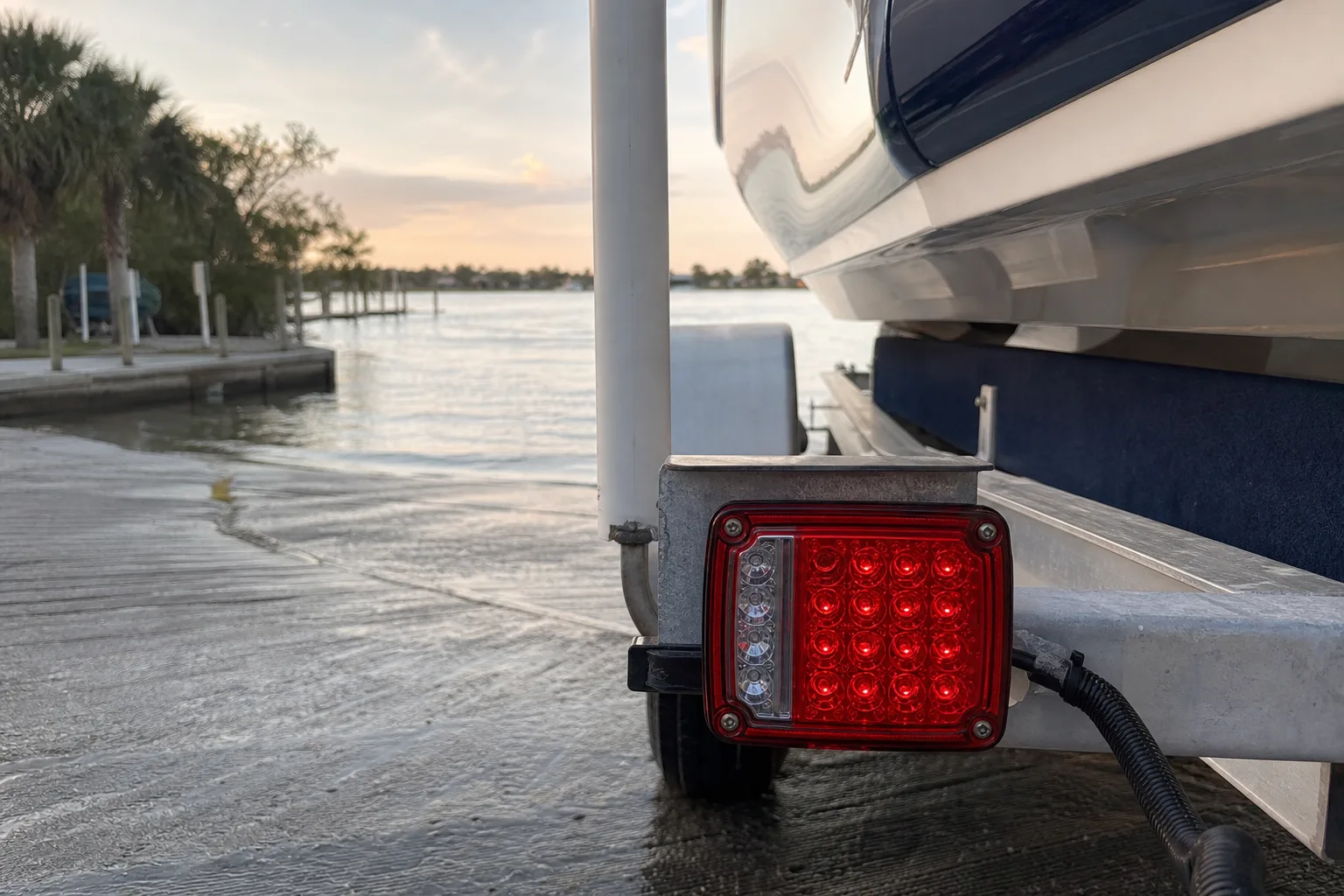
When boat trailer lights stop working, the cause is usually a bad ground, corroded connector or a failed bulb, in that order. Start by checking the white ground wire and the plug on the tow vehicle, then test each circuit with a tester or multimeter, and repair or replace the section that fails. Repeated dunking in water, especially salt water, is what kills most trailer wiring.
This guide gives you the 4-pin wire color code, a step-by-step test, ideas for submersible LED lights, the legal basics for trailer lighting, and a short checklist to run before every launch.
Wiring basics: the 4-pin flat connector
Most small and mid-size boat trailers use a 4-pin flat connector. The standard for this connector is SAE J2863, and the wire colors below are the ones used for it, as listed by trailer-parts retailers and by Wikipedia's summary of the standard.
| Wire color | Function | What goes dark if it fails |
|---|---|---|
| White | Ground | Often everything, or lights that flicker, dim or act strangely |
| Brown | Tail, clearance and marker lights | Running lights |
| Yellow | Left turn signal and left stop light | Left turn and brake |
| Green | Right turn signal and right stop light | Right turn and brake |
Retailers sometimes describe brake function slightly differently, so confirm with a tester on your own vehicle. Larger trailers with brakes use 5-pin or 7-pin connectors, which add more circuits. The pinout for those varies, so check your trailer's wiring diagram. To see how much your tow vehicle can safely pull, read boat towing capacity.
Why boat trailer lights fail
- Bad ground. The white wire must make a clean metal-to-metal connection to the trailer frame. Rust or paint under the ground screw breaks it, and that single fault can make every light act up.
- Corrosion from submersion. Water, especially salt water, gets into sockets, splices and bulb bases. Corroded contacts cause dim, flickering or dead lights.
- Dirty or damaged connector. The plug on the tow vehicle collects dirt and corrosion between trips.
- Burned-out bulbs. Incandescent bulbs fail faster when cold filaments meet hot water.
- Damaged wiring. Wires pinched by the bunk or frame, scraped by the road or chewed through can break or short.
- Tow vehicle problems. A blown fuse or a bad connector on the vehicle looks like a trailer problem.
Step-by-step fix
- Let the lights cool. Never plug in a hot trailer right after launching; heat and water on live contacts speed corrosion. Rinse the connector with fresh water after salt use and let it dry.
- Inspect the plug on the tow vehicle. Check the pins for green or white corrosion and for bent contacts. Clean them with electrical contact cleaner and a small brush.
- Test the vehicle side. Use a 4-way trailer circuit tester, or a multimeter set to DC volts. Ground the black lead to the white pin or to clean metal, then check each pin: brown with the headlights on, yellow with the left signal, green with the right signal, and brake on each. You should read roughly the vehicle's battery voltage. If a pin reads nothing, check the vehicle fuse and wiring.
- Check the trailer ground. Find where the white wire attaches to the frame. Remove it, clean the frame and the ring terminal to bare metal, reattach with a new screw and a star washer, and cover with dielectric grease or sealant.
- Check the trailer plug. Repeat the voltage test on the trailer side of the plug. If the vehicle side is good and the trailer side is dead, the problem is in the trailer wiring.
- Test each light. Look for a cracked lens, water inside, or a loose bulb. Pull the bulb and clean the socket. If the bulb is good, test voltage at the socket.
- Trace the wiring. Look for broken or pinched wires, bad splices and cut insulation along the frame. With a multimeter on continuity (power off), check each wire from the plug to the light.
- Repair or replace. Use heat-shrink butt connectors with adhesive, not twist caps or tape. Seal ends against water. For a trailer with repeated problems, replace the whole harness and use sealed lights.
- Re-test everything with the tester or with a helper watching while you run the lights, left and right signals and the brake pedal.
Quick diagnosis table
| Symptom | Most likely cause | First thing to check |
|---|---|---|
| No lights at all | No power from the vehicle, or no ground | Vehicle fuse and the white ground wire |
| Lights flicker or dim | Poor ground or corroded connector | Clean the ground and the plug |
| Turn signals flash too fast or too slow, or both signals light together | Ground fault, or a mix-up between the yellow and green wires | Ground, then the plug wiring |
| One side dead | Bulb, socket or wire on that side | Bulb and socket |
| Lights work then fail after launching | Water in sockets or splices | Replace with sealed LED lights and re-seal splices |
Submersible LED trailer lights
Submersible, sealed LED lights are designed to tolerate immersion better than standard incandescent lights and they have no filament to break. They also use less power and often last longer. Look for lights marked as submersible or watertight on the package, use a sealed harness, and follow the maker's instructions. Do not assume an LED light is waterproof because it is LED. Most trailer lights are sold with a water-resistance claim; check the product rating and the instructions on mounting.
Tips that apply to any lights: mount them so water drains out rather than collects, seal the wire entry points, use dielectric grease on connectors, and run the wires on the top or inside of the frame where they are protected.
Legal basics for trailer lights
Federal Motor Vehicle Safety Standard 108 (FMVSS 108) sets the lighting requirements for new vehicles and trailers, and states enforce lighting on the road. Rules vary by state, so confirm yours with the state highway patrol or DMV.
- Tail lamps. Florida law (Florida Statute 316.221) requires at least two taillamps on the rear of a trailer, showing red light visible from 1,000 feet to the rear.
- License plate lamp. The same section requires a white light that makes the rear plate legible from 50 feet, wired to light with the headlamps.
- Stop lamps and turn signals. Florida Statute 316.222 requires trailers to have two or more stop lamps and electric turn signals that meet s. 316.234.
- Side markers and clearance lamps. Federal rules for trailers 80 inches wide or wider add clearance and side marker lamps (49 CFR 393.11 groups trailers by the 80-inch width). Some states exempt boat trailers or set their own list, so check your state's vehicle code. Many boaters add clearance and marker lights anyway.
- Reflectors. Most trailers also need reflectors; check your state's rules.
Florida's boating and trailer registration rules are separate; see Florida boating license and registration. We do not quote fines because they differ by state and offense.
Checklist before every launch
- Connect the trailer and test running lights, left and right signals and brakes with a helper.
- Check the plug and ground for corrosion; apply dielectric grease.
- Look over the wiring for loose or dragging wires.
- Check the tires, hitch, safety chains and winch strap.
- Unplug the lights before backing into the water, or let them cool first.
- After the ramp, rinse the connector and lights with fresh water, especially in salt water, and let them dry before plugging in.
- Re-test the lights after you pull out.
Plan the ramp, parking and fuel stop ahead with our Florida boat ramps, Texas boat ramps and boat ramps near me pages. If you store the boat on its trailer, see boat storage options. Also read boat propellers and boat bottom paint for other maintenance that goes with trailering.
FAQ
Why are my boat trailer lights not working?
Most often a bad ground, corroded plug, or failed bulb. Check the white ground wire first, then test each circuit.
What do the colors on a 4-pin trailer plug mean?
White is ground, brown is tail and marker lights, yellow is left turn and brake, green is right turn and brake.
Can I use a multimeter to test trailer lights?
Yes. Set it to DC volts and check each pin for roughly battery voltage with the corresponding light on, using a good ground.
Should I unplug trailer lights before launching?
Yes, and let the lights cool first. Hot bulbs plunged into water can fail, and live contacts corrode faster.
Are LED lights better for boat trailers?
Sealed submersible LED lights tolerate water better and have no filament. Check that the lights are rated submersible.
Do boat trailers need clearance lights?
It depends on width and your state. Federal rules add clearance and side marker lamps for trailers 80 inches or wider, but some states exempt boat trailers. Check your state.