
Boat Bottom Paint: Ablative vs Hard and How to Apply It
Boat bottom paint explained: ablative vs hard vs hybrid, copper rules, warm Florida and Texas water, when trailered boats can skip it, and how to apply it and remove barnacles.
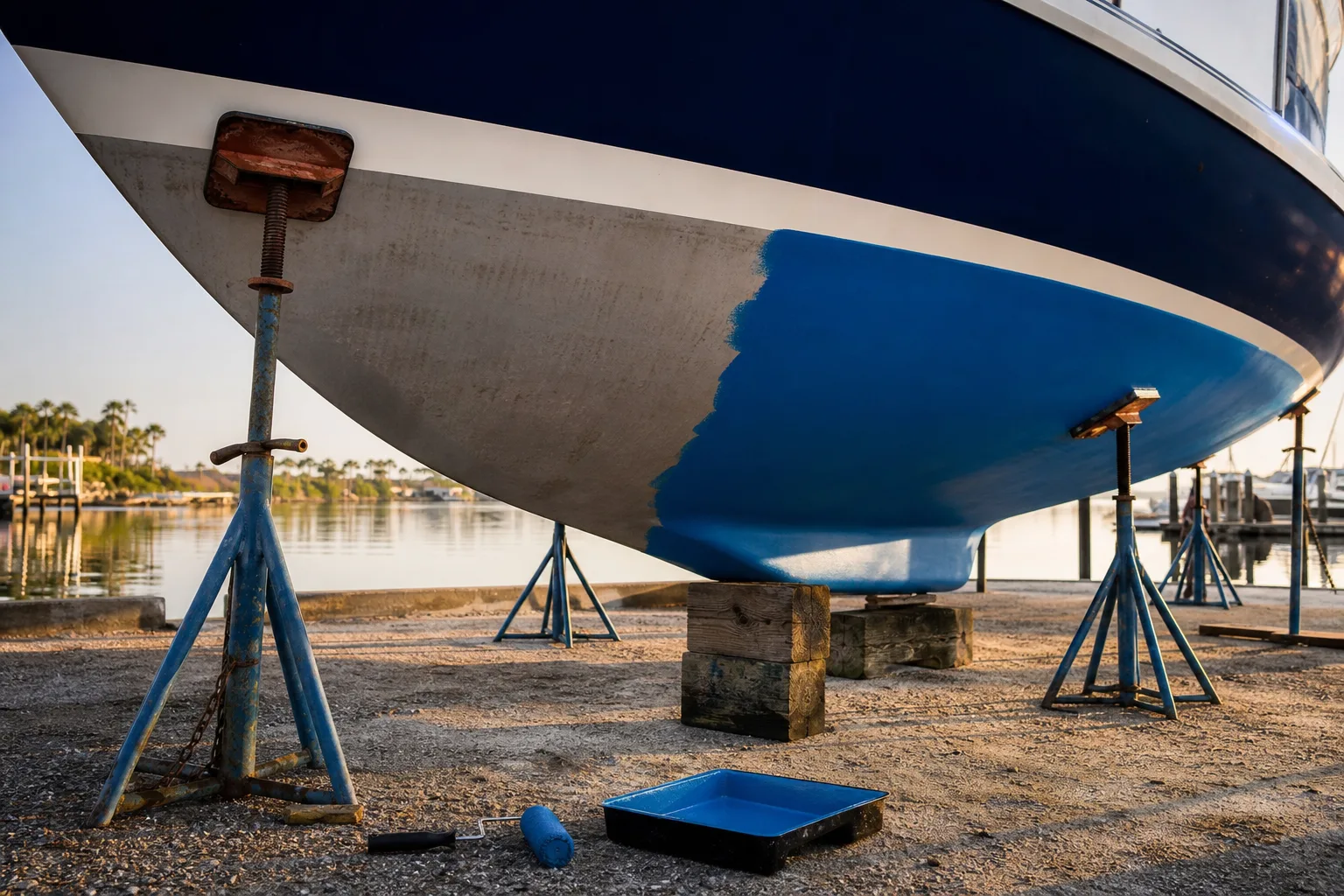
Boat bottom paint, also called antifouling paint, is a coating with a biocide that slows the growth of barnacles, algae and other marine life on a hull that sits in the water. Ablative paints wear away slowly as the boat moves, hard paints stay on the hull and release biocide from the surface, and hybrids sit between the two. If your boat lives on a trailer or a lift and stays out of the water between trips, you may not need bottom paint at all.
This guide compares the paint types, explains the main copper and registration rules, shows when you can skip it, and walks through application, safety and barnacle removal for boats in warm Florida and Texas waters.
Why bottom paint matters in warm water
Growth builds faster in warm, nutrient-rich water, and the Gulf Coast has plenty of both. Fouling on the hull adds drag, which lowers speed and raises fuel use, and it can lower engine RPM. If your boat is a poor performer, check the hull before you change anything else; a fouled bottom is one reason a prop can seem wrong. Our boat propellers guide explains how load and a dirty bottom change RPM.
Where you keep the boat decides how much paint you need. See boat storage options for the choices (wet slip, dry storage, lift, trailer) and how much a boat slip costs for the cost side of keeping a boat in the water all year.
Ablative, hard and hybrid paints compared
| Type | How it works | Good for | Watch out for |
|---|---|---|---|
| Ablative (self-polishing) | Wears away as the boat moves, exposing fresh biocide | Boats that are used regularly; boats hauled and relaunched, if it is a multi-season ablative | Can foul if the boat sits unused; wears faster on fast boats |
| Hard (modified epoxy) | Stays on the hull, releases biocide from the surface | Fast boats and boats used a little or a lot | Builds up over seasons and needs sanding; can lose effectiveness when out of the water for a long time |
| Hybrid | Mix of ablative and hard features | People who want some of both | May not last as long as hard or multi-season ablatives |
| Copper-free | Uses a non-copper biocide or a slick coating | Aluminum hulls and outboard or sterndrive parts where copper can cause corrosion; areas with copper limits | Performance varies; ask local boaters and the manufacturer |
Boating magazine describes the main trade-off: ablatives shed material as the boat moves and are self-polishing, but need regular use; hard paints work whether you use the boat a lot or a little but build up and must eventually be sanded down. The same writer notes that hybrids can give the best of both in performance but lack the longevity of hard or multi-season ablative paints. When recoating, it is best to stay with the same type of paint, or sand off the old coat if you switch.
Always check compatibility. Copper-based paint over bare aluminum, for example, can cause galvanic corrosion, so aluminum hulls and drive legs need paints made for them. Read the label.
Copper, EPA registration and state rules
Antifouling paints are pesticides, because they are designed to kill or deter living things. The EPA registers them under the Federal Insecticide, Fungicide, and Rodenticide Act (FIFRA), and every legal paint carries an EPA registration number on its label. EPA registration notices for bottom paints say the product is registered under FIFRA. Labels also warn that using a product in a way that conflicts with its labeling is a violation of federal law, so follow the directions, including surface prep, coat count and disposal.
Some states have limited copper in recreational bottom paint. Washington is the best-known example. Its 2011 law restricted copper-based antifouling paint on recreational vessels under 65 feet, with phased dates that were later delayed. According to the Washington State Legislature's final bill report for the 2020 session, the restrictions on copper-based antifouling paint on recreational vessels were delayed to January 1, 2026, and the same bill banned paint containing cybutryne (Irgarol) on recreational vessels starting January 1, 2023. Boating magazine has reported that Washington has since lifted the restriction, and the law may have changed again, so check Washington Department of Ecology before buying paint there. Florida and Texas are not covered by that law; check with local marinas, since individual yards and water bodies can have their own rules.
When you do not need bottom paint
- Trailered boats that are launched for a day and pulled out. Wash the hull and drain the boat after each trip instead.
- Boats on lifts that sit out of the water between uses.
- Freshwater boats in cold lakes may need little or none, though check local conditions.
- Short stays in the water of a few days, if you can rinse and dry the hull.
If you do keep the boat in the water for weeks, paint it. If you keep it in a slip for a season, ask your marina what other owners use, because local fouling pressure varies. Compare sourced slip rates on our Florida slip prices and Texas slip prices pages, and find a launch for trailered boats among the Florida public boat ramps.
How to apply bottom paint
- Read the label and the data sheet. They give the prep, primer, coat count, drying times and the maximum time before relaunch.
- Haul and support the boat on stands or a trailer, with access to the whole bottom.
- Clean it. Pressure-wash off slime and growth while it is wet, and remove barnacles (see below).
- Prepare the surface. If the old paint is sound and compatible, scuff it so the new coat can bond. If it is flaking or the wrong type, remove it down to a sound surface.
- Apply primer where the label requires it, and especially on bare gelcoat, aluminum or repairs.
- Tape the waterline and the areas you do not want painted.
- Apply the first coat with a short-nap roller and a brush for corners. Ablatives are applied thick; two coats is a common minimum, with a third on the bow, leading edges, rudders and the waterline.
- Wait for the recoat window in the data sheet, then apply the second coat.
- Do not skip the details. Paint the skeg, trim tabs, the area behind jack-stand pads after moving them, and anything the label says to coat. Avoid painting zincs, transducers and thru-hull bearing surfaces unless the label allows it.
- Launch within the label's window. Some hard paints must go back in the water within a set time; check the data sheet.
Safety and sanding rules
- Wear a respirator rated for the product (the label names the type), eye protection, nitrile or similar gloves, and disposable coveralls.
- Work in good airflow and away from drains and the water. Paint chips and dust must not reach storm drains or the waterway.
- Use drop cloths and collect sanding dust. Old bottom paint can contain copper and other biocides, so use wet sanding or a vacuum sander with a dust collector instead of dry sanding.
- Follow your boatyard's rules. Many yards require containment, specific sanders or a ban on dry sanding, and some only allow their own staff to do bottom work.
- Dispose of used rollers, rags, dust and leftover paint as the label and your local hazardous-waste program direct. Do not pour waste on the ground.
Barnacles on a boat: how to remove them
Barnacles are small shelled animals that cement themselves to hulls, props, rudders and drive legs. They are common on boats in salt and brackish water, including Florida and Texas, and the hard base stays behind even after the animal dies. Barnacles add drag and can damage soft paint or gelcoat when they are scraped off.
- Remove them when the boat is out of the water. Soak the hull with a hose first so the shells loosen.
- Use a plastic or wooden scraper. A metal scraper can cut gelcoat or the paint.
- For stubborn growth, ask a yard about a hull cleaner made for marine growth, and follow its label.
- Rough spots left after scraping should be sanded smooth before repainting.
- Do not scrape barnacles off a boat while it is in the water if your marina bans in-water hull cleaning. Many marinas restrict it, since it releases paint and organisms.
Paints designed for salt water with barnacle protection may not work as well against freshwater algae, so match the paint to where you boat.
FAQ
What is the difference between ablative and hard bottom paint?
Ablative paint wears away as the boat moves, which keeps releasing fresh biocide. Hard paint stays on the hull and releases biocide from the surface, but builds up and needs sanding over time.
Do I need bottom paint on a trailered boat?
Usually not, if the boat comes out of the water after each trip. Paint matters for boats left in the water for days or weeks.
How often should I repaint a boat bottom?
It depends on the paint, the water and how much you use the boat. Follow the manufacturer's data sheet and inspect the hull each season.
Is copper bottom paint legal?
Copper paint is legal under federal rules when it is EPA-registered and used as labeled. Some states, such as Washington, have passed limits, so check local rules.
How do you get barnacles off a boat?
Haul the boat, soak the shells, scrape with a plastic or wooden tool, then sand and repaint. Avoid metal scrapers that cut the finish.
Can I use ablative paint over hard paint?
Often yes in the right order, but check the label. Softer paints usually go over harder ones, not the reverse. When in doubt, sand to a sound surface or ask the manufacturer.