
Inboard vs Outboard Motors: Pros, Cons and Costs
Inboard vs outboard: how outboards, inboards, sterndrives and jets compare on maintenance, draft, space, ventilation rules, fuel and resale, with no guesswork on cost.
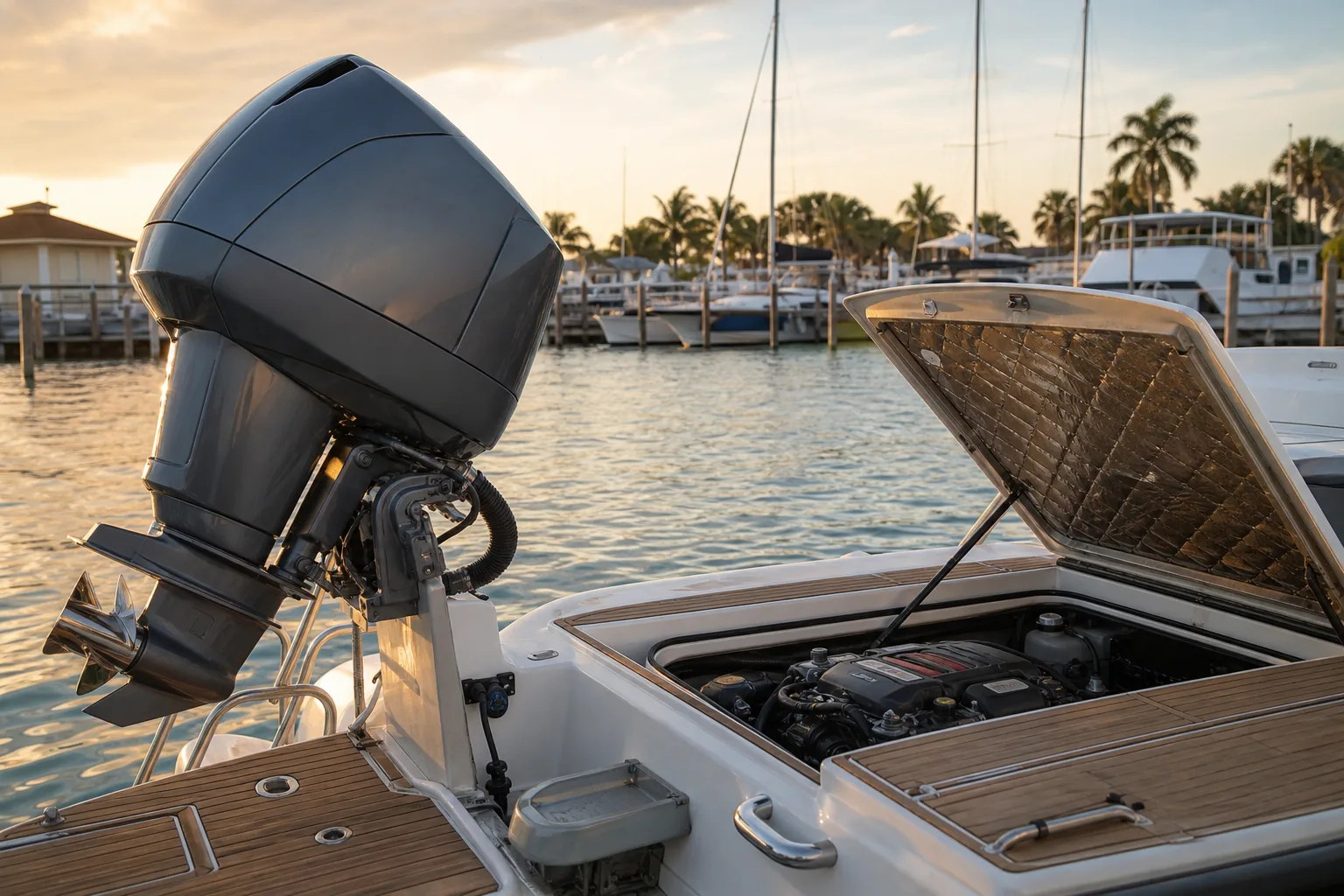
An outboard is a self-contained engine bolted to the outside of the transom, while an inboard keeps the engine inside the hull and sends power through a shaft. Outboards are easier to service, replace and tilt out of the water, so they dominate small and mid-size boats. Inboards and sterndrives keep weight low and the stern clear, which is why you see them on wake boats, cruisers and many older family boats.
Here is how each engine layout works, what you give up and gain with each, the ventilation rules that apply to gasoline engines inside the hull, and how to think about cost without relying on made-up prices.
The four layouts at a glance
| Type | Where the engine sits | Typical boats | Main strength | Main drawback |
|---|---|---|---|---|
| Outboard | On the transom, outside the hull | Center consoles, bay boats, pontoons, small runabouts | Easy service and replacement, keeps the cockpit open | Adds weight and width at the stern, visible engine |
| Inboard (direct drive) | Inside the hull, shaft runs through the bottom | Ski and wake boats, trawlers, older cruisers | Low, centered weight; protected engine | Takes up cabin or cockpit space, harder to service |
| Inboard V-drive | Inside the hull near the stern, drive reversed to point aft | Ski and wake boats | Moves weight aft, frees the middle of the boat | More complex, more to maintain |
| Sterndrive (inboard/outboard, I/O) | Engine inside the hull, drive leg outside on the transom | Family runabouts, bowriders, cruisers | Open cockpit with a steerable, tiltable drive | Bellows, gimbal and drive need regular attention |
| Jet drive | Inside the hull, water pump instead of a propeller | Personal watercraft, shallow-water river boats | Very shallow draft, no exposed propeller | Less efficient and less control at low speed |
Outboards
Outboards are the default choice for fishing boats and pontoons. The whole power package, including engine, steering leg and propeller, sits outside the hull, so you can remove it for service or swap it for a replacement without cutting into the boat. You can tilt it up to reduce draft in shallow water, to clean the lower unit, or to protect it when the boat is on a lift or trailer.
The trade-offs: an outboard adds weight at the very back of the boat, which affects trim, and it takes space on the transom that could otherwise be a swim platform or fishing area. Large outboards also hang beyond the transom, which matters for slip length and lifts. See our center console boats guide for how single and twin outboard setups change a boat's range and slip size.
Inboards: direct drive and V-drive
An inboard puts the engine in the hull, usually near the center, with a shaft running through the bottom to a propeller under the boat. That low, central weight gives a stable, predictable ride, which is why inboards are common on traditional ski boats and trawlers. Because the prop sits under the hull, the stern stays clean for swimming, skiing and docking.
A V-drive is an inboard whose gearbox turns the power back toward the stern, so the engine can sit farther aft and leave more room in the middle of the boat. It is common on wake boats. The cost is more moving parts in the driveline. Inboards are also harder to reach: engine work often happens inside a hatch or under a seat, and removal can mean lifting the engine out through the deck.
Sterndrives (I/O)
A sterndrive combines an inboard engine with an outdrive on the transom. It gives you a steerable, trimmable leg like an outboard but keeps the engine in the boat, out of sight. Rubber bellows and seals protect the drive's connection to the hull, and they need periodic inspection because a failed bellows can let water into the boat. For a deeper look at the fuel system and bilge on boats with engines in the hull, read what is a bilge.
Jet drives
A jet drive pulls in water and shoots it out the back instead of turning a propeller. It lets you run in water too shallow for a propeller and avoids exposed blades, which suits river boats and personal watercraft. Jets give up some low-speed control and fuel efficiency compared with a prop-driven boat. If you stay with a propeller-driven boat, see our boat propellers guide for how pitch, diameter and material work.
Draft and shallow water
Draft is how deep the boat sits. An outboard tilts up, so it can reduce draft for beaching, shallow flats and trailering. Inboards and sterndrives keep the propeller or drive low and fixed, though a sterndrive can usually be trimmed up. Jets have the least draft. Florida's flats and Texas bays reward boats that can go thin, which is one reason bay boats are almost always outboard-powered; see skiff, bay boat and flats boat for how they compare.
Space and layout
Engines in the hull take up room. In a small inboard the engine box can split the cockpit, while an outboard leaves the deck open to the transom. In a cruiser, an inboard or sterndrive often sits under a cabin or sunpad. If cockpit or cabin space is your top priority, outboards usually win on smaller boats; larger cruisers often use inboards or sterndrives to fit living space. Compare actual boats rather than assuming. Our types of boats guide shows which hulls usually pair with which power.
Ventilation and blower rules for gasoline inboards
This is the one big safety difference. Gasoline vapor is heavier than air and collects low in the hull. Federal rules require that a compartment containing a permanently installed gasoline engine with a cranking motor be open to the atmosphere or ventilated by an exhaust blower system (33 CFR 183.610). The blower intake duct must sit in the lower third of the compartment and above the normal bilge water level, and a label near each ignition switch must tell you to run the blower for 4 minutes and check the bilge for gasoline vapors before starting. Boats built after July 31, 1980 with gasoline engines must have a working ventilation system under 33 CFR 175.201.
In practice: run the blower for the full four minutes before every start, smell the bilge, and keep the blower working. Outboards, which are outside the hull, avoid most of this concern, though portable fuel tanks and other enclosed compartments still need attention. Learn how bilge vapors build up in our bilge guide.
Maintenance and costs
- Outboards: routine service is mostly oil, lower-unit gear oil, impeller, spark plugs, filters and anodes. The engine is in the open, so it is easy to reach, but saltwater corrosion on the powerhead and lower unit is common.
- Inboards: regular service includes engine oil, raw-water cooling parts, shaft seals, and cutlass bearings. Access is tighter, so shops often charge more labor time.
- Sterndrives: add bellows, gimbal bearing and drive-leg service on top of engine maintenance.
- Replacement: repowering an outboard usually means unbolting and bolting on a new one; repowering an inboard can mean pulling the engine through the deck.
We do not quote service or engine prices here because they vary widely by brand, size and region. Get written quotes for your boat. To compare the full ownership picture, including slip, fuel and insurance, use the Marinalo calculator, check Florida 30 ft slip prices, and look at Florida fuel docks. If you finance, try the boat loan calculator.
Fuel and resale
Outboards come in gasoline and some diesel and electric models; inboards and sterndrives come in gasoline and diesel. Diesel inboards are common on trawlers and larger cruisers. For gasoline engines, ethanol content matters for fuel hoses, tanks and long-term storage; see ethanol-free gas for boats. On resale, buyers tend to prefer well-maintained, recent engines of any type, and outboards are easier to replace, so an old outboard hurts value less than a tired inboard that is expensive to pull. Check condition and hours, not just the engine type. To estimate what your boat is worth, see how much is my boat worth.
FAQ
Is an inboard or outboard better?
Neither is better for everyone. Outboards are easier to service and replace and free up deck space; inboards give low weight and a clean stern for skiing, wake sports and cruising.
Are outboards more reliable than inboards?
Modern engines of both types are reliable when serviced on schedule. Outboards are simply easier to inspect, repair and replace.
What is a sterndrive?
A sterndrive, or I/O, is an inboard engine connected to a steerable drive leg on the outside of the transom. It combines inboard engine placement with outboard-style steering and trim.
Do inboard engines need a blower?
Gasoline inboards in enclosed engine compartments must have an exhaust blower system or be open to the atmosphere under 33 CFR 183.610. Run the blower for four minutes before starting.
Which has less draft, inboard or outboard?
An outboard can be tilted up to reduce draft. A jet drive has the least draft overall.
Which holds value better?
It depends on condition, hours and the boat. Outboards are easier to replace, which helps resale of the whole boat.