
What Is a Bilge? Bilge Pumps Explained
The bilge is the lowest part of a boat's hull, where water collects. Learn how bilge pumps and blowers work, what the law says about oily water, and how to maintain it.
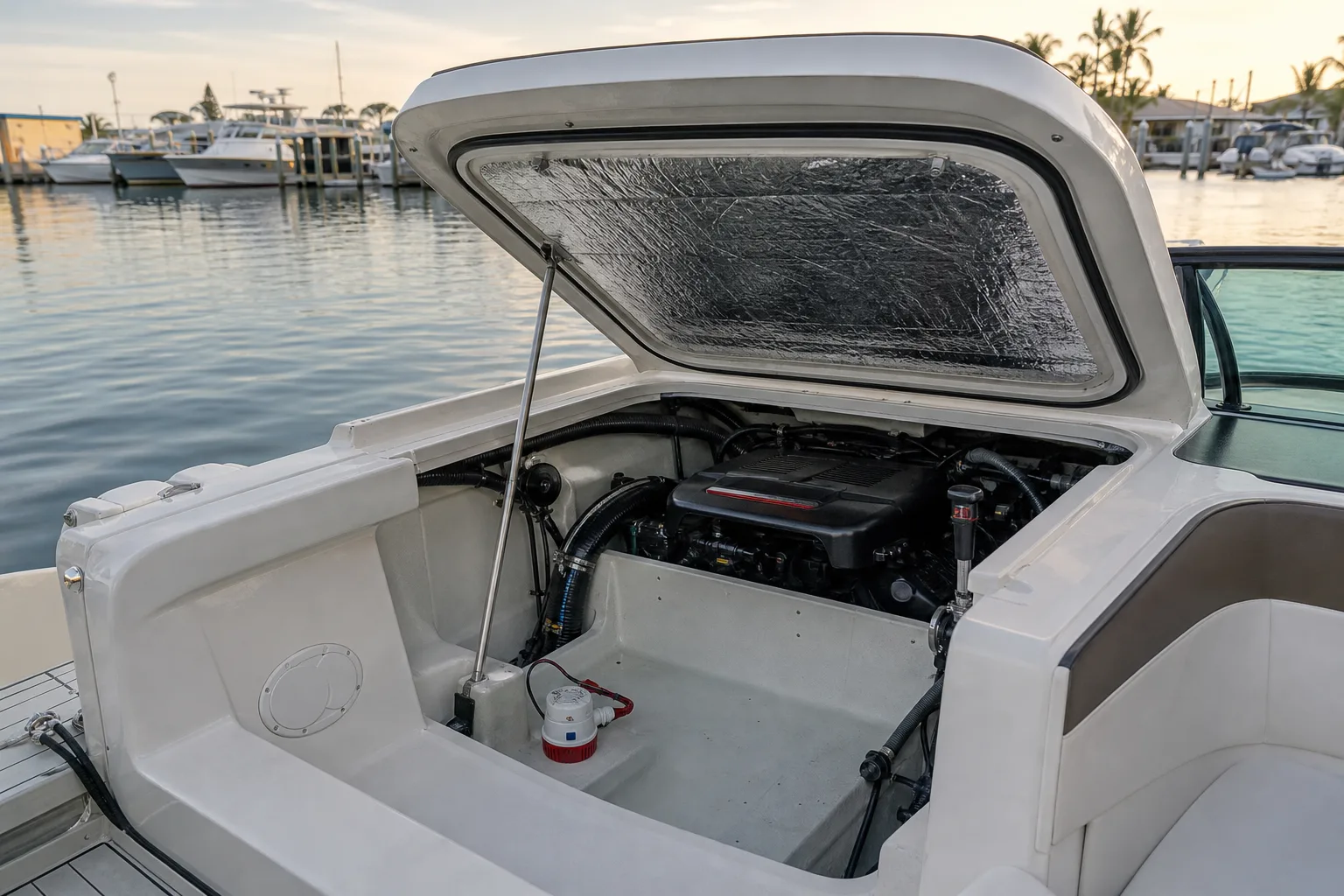
The bilge is the lowest interior part of a boat's hull, where water, condensation and fluids drain and collect. A bilge pump removes that water so it does not build up and affect your boat's stability. If your boat has a gasoline inboard or stern drive engine, the bilge is also where dangerous fuel vapors can settle, which is why a bilge blower matters.
What the bilge is and why water collects there
Water always flows to the lowest point, and on most boats that is the bilge, the space under the cabin sole or cockpit floor near the keel. It is usually a shallow, narrow area around and under the engine, fuel tanks and plumbing.
Common ways water gets into a bilge:
- Rain and spray that runs through hatches, scuppers or deck fittings.
- Dripping shaft seals (packing glands). Some designs are meant to drip a little.
- Leaking hoses, fittings and through-hulls, including cooling water and raw-water lines.
- Condensation from air conditioning, an ice box or cool surfaces.
- Waves and wakes coming over the transom or through the cockpit drains.
- Hull damage or a loose fitting after a grounding or collision.
A small amount of water in a bilge is normal for many boats. What matters is a change. If you see more water than last week, find the source before it grows. A bilge that stays dry for months and then suddenly fills is telling you something.
Types of bilge pumps
| Type | How it works | Best use |
|---|---|---|
| Manual pump | Hand-operated, with a handle or lever | Backup when power fails; common on small boats and kayaks |
| Electric pump (submersible) | A small motor on the bilge floor pushes water out through a hose | Main pump on most powerboats |
| Automatic pump (float switch) | An electric pump with a float or sensor that turns it on when water rises | Boats left in the water or at a slip while you are away |
| Engine-driven pump | Uses engine power to move large volumes | Larger boats that need to move high volumes of water |
Most recreational boats combine an electric pump with a float switch and a manual backup. The electric pump handles routine water. The manual pump or a bucket is what you can use if the battery is dead or the pump fails.
Automatic vs manual switches
A float switch wakes the pump when the water reaches a set level. That is useful when the boat sits unattended at a dock or on a mooring. A manual switch at the helm lets you run the pump yourself. Many boats have both, with a three-position switch at the helm: off, automatic and manual. Some owners add a high-water alarm, so they know when the first pump is not keeping up.
Check what your pump can actually do
Pump ratings are based on laboratory conditions. Real-world output drops with hose length, bends, a clogged strainer and low battery voltage. Do not rely on a catalog number alone. Test your pump by pouring a bucket of water into the bilge and timing how long it takes to clear. Do this at least once at the start of the season.
Bilge blowers and gasoline engines
Gasoline vapors are heavier than air. They can collect in the bilge, and a spark from the starter or another electric device can ignite them. For this reason federal rules require ventilation on many gasoline-powered boats.
- Under 33 CFR 175.201, no one may operate a boat built after July 31, 1980 that has a gasoline engine for electrical generation, mechanical power or propulsion unless it has an operable ventilation system that meets the standards in Part 183.
- Under 33 CFR 183.610, each compartment with a permanently installed gasoline engine with a cranking motor must either be open to the atmosphere or be ventilated by an exhaust blower system.
- The blower intake duct must be in the lower one-third of the compartment and above the normal level of accumulated bilge water.
- The boat must have a label near each ignition switch that tells the operator to run the blower for 4 minutes before starting the engine and to check the engine compartment bilge for gasoline vapors.
That means a few simple habits. Turn on the blower and let it run for the time on the label before you start the engine. Open the engine hatch and sniff for fuel. If you smell gas, do not start the engine; find and fix the leak first. Blowers are also a good idea after you fuel, especially if the boat has fuel tanks nearby. You can find places to fill up in our Florida fuel docks and Texas fuel docks pages.
The rule applies to the compartments described above, so check your owner's manual and the regulation for your hull if you are unsure whether your boat is covered. Portable fuel tanks and enclosed spaces deserve care on any boat.
Oily bilge water and the law
Bilge water often contains traces of oil, fuel, grease and antifreeze. You cannot legally pump it overboard if it causes a sheen. Under the Clean Water Act, oil regulations at 40 CFR Part 110 describe a discharge that can be harmful as one that causes a sheen or discoloration on the surface of the water, or a sludge or emulsion beneath it.
What that means for you:
- Do not pump a bilge that leaves a visible sheen. Keep the bilge pump off if there is oil in the water, or put absorbent in the bilge and handle the waste properly on shore.
- Do not use soap or detergent to hide the sheen. Federal rules also prohibit adding dispersants or emulsifiers to hide a discharge. They only spread the problem.
- Report a spill. If you cause a sheen, report it to the National Response Center at 1-800-424-8802.
- Dispose of oily water properly. Many marinas and boat ramps have used-oil and absorbent disposal. Ask the marina office.
Penalty amounts change over time, so check the current rules rather than relying on a number from a blog post.
Oil-absorbing pads or bilge socks are an easy way to keep small drips from reaching the water. Replace them when they are saturated. An oil leak should be repaired, not just soaked up.
Keeping the bilge clean
A clean bilge is easier to inspect and safer. You can see leaks, smell fuel and notice rust. Tips:
- Fix drips from the engine and fuel system as soon as you see them.
- Remove debris such as leaves, zip ties and wire clippings that can jam a float switch or clog the pump strainer.
- Wipe the bilge with absorbent pads, not with detergent flushed overboard.
- Use a wet-dry vacuum or sponge to remove standing water instead of pumping oily water out.
- Store loose items, such as tools and cans, somewhere else.
Bilge maintenance checklist
- Look and smell. Open the hatch, check for water, fuel, oil, coolant or rust, and check for fuel odor.
- Test every pump. Lift the float switch by hand or use the manual switch. Listen for the motor and watch for discharge at the through-hull.
- Test the float switch. Make sure it moves freely and is not stuck on debris.
- Check wiring and fuses. Look for corrosion, loose connections and wires under water. Use marine-grade, properly protected wiring.
- Clean the strainer and make sure the discharge hose is free of kinks and is connected tightly.
- Check the blower. Run it, listen for the fan and feel for airflow at the outlet. Check the hoses.
- Inspect hoses, clamps and through-hulls for cracks, leaks and corrosion.
- Check the battery. A pump is useless on a dead battery. If the boat stays in the water, make sure the charger or solar panel keeps it charged.
- Carry a backup. A manual pump or bucket in the boat is the cheapest insurance.
Before a long trip, also check the weather and the tide. In shallow Florida and Texas waters, grounding can damage hulls and fittings, and tides change how much clearance you have. See tide times for your area. If you are budgeting for upkeep such as pumps and batteries, our annual boat cost calculator can help you plan.
FAQ
What is the bilge on a boat?
It is the lowest inside part of the hull, where water and other liquids collect.
Is it normal to have water in the bilge?
A small amount can be normal, especially from rain, condensation or a dripping shaft seal. A sudden increase means you should look for a leak.
How do bilge pumps work?
An electric bilge pump spins an impeller to push water out through a hose and through-hull fitting. A float switch or sensor can start it automatically when the water rises.
Do I need a bilge blower?
If your boat was built after July 31, 1980 and has a permanently installed gasoline engine with a cranking motor in an enclosed compartment, federal rules require ventilation by a blower unless the compartment is open to the atmosphere.
Can I pump oily bilge water overboard?
No. Discharges that cause a sheen or discoloration on the water are prohibited and must be reported.