
What Is a Pontoon Boat? Sizes, Layouts and Who It Suits
What is a pontoon boat? Learn how a pontoon is built, the main layouts, how to read the capacity plate, where it shines, where it struggles and how to trailer one.
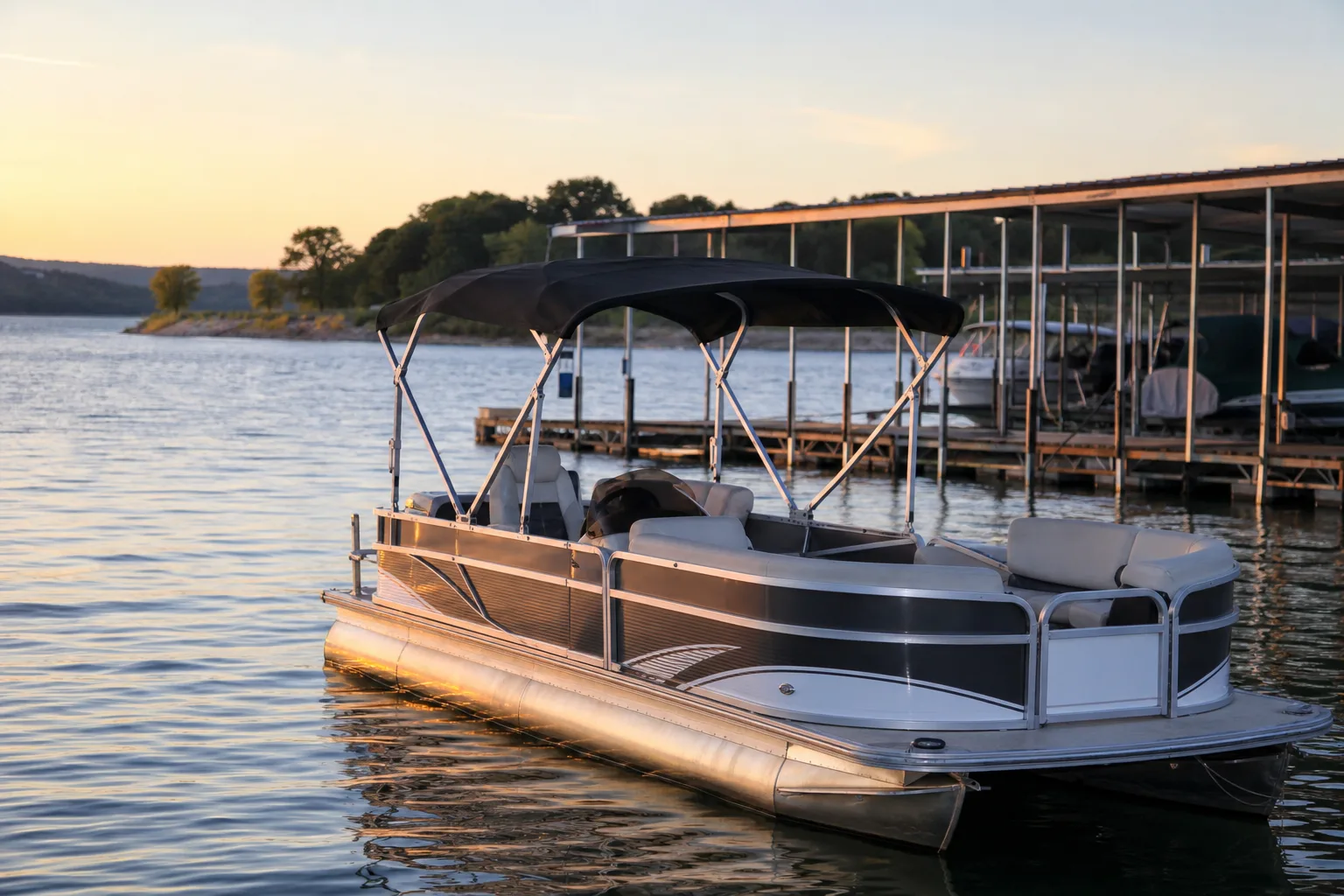
A pontoon is a flat-decked boat that floats on two (or more) long, sealed aluminum tubes instead of a single V-shaped hull. The wide deck gives lots of stable, open space for seating, so pontoons are popular for relaxed cruising, fishing and entertaining on lakes and calm water.
This guide explains how a pontoon is built, the common layouts, how sizes and capacity plates work, where these boats shine and where they struggle, and what to know about hauling one on a trailer.
How a pontoon boat works
The tubes, often called logs or toons, provide the buoyancy. Because they sit far apart and the deck rides on top, the boat has a wide, stable footprint: people can walk around and move weight from side to side without the boat rolling much. The tradeoff is that the flat deck and tubes are less comfortable than a V-hull in rough water.
A short history
Ambrose Weeres of Minnesota is the name most often credited with building the first pontoon boat in 1951, reportedly a plywood platform on steel drums, and he founded Weeres Industries the following year. Boating-industry histories describe it that way, though some writers dispute who was first, and other flat-boat designs may predate it. The idea evolved into aluminum tubes and larger decks as the design spread.
Construction: tubes, deck and frame
| Part | What it is |
|---|---|
| Pontoons (logs) | Sealed aluminum tubes that provide the flotation, divided inside into compartments |
| Frame | Aluminum crossmembers that join the tubes and support the deck |
| Deck | Flat floor, commonly aluminum or marine plywood with a vinyl or similar covering |
| Fencing and gates | Aluminum rails around the deck, with a gate for boarding |
| Furniture | Bench seating, lounges, helm console and storage lockers |
| Power | Outboard motor on a transom bracket at the stern |
| Bimini top | Shade canopy, a standard comfort feature |
Ask the dealer or builder how many compartments each tube has, what the deck is made of, and what the warranty covers. Treat any numbers such as gauge or thickness as maker claims and compare them on the builder's spec sheet.
Common pontoon layouts
Most pontoon models are variations of a few arrangements. Which one suits you depends on how you plan to use the boat.
| Layout | Typical features | Best for |
|---|---|---|
| Cruise | Benches or loungers around the perimeter, helm in the middle or at the side | Relaxed sunset rides with family and friends |
| Fishing | Swivel chairs, a livewell, rod holders, bow and stern fishing seats, sometimes a trolling motor | Anglers who want comfort and room to move |
| Entertaining and lounge | Wraparound seating, tables, bar or cooler, music system | Parties and big groups on the lake |
| Family or multi-use | Mix of lounge seating and fishing stations, possibly a swim platform | Owners who want a bit of everything |
Think about where you will sit most. A pontoon with a rear-facing lounge feels different from one with a captain's chair at the front, and a quick sit-down on the showroom floor tells you more than a spec sheet.
Sizes and the builder's capacity plate
Pontoon boats come in a wide range, from compact models for small lakes to long, multi-lounge models for large groups. Rather than guess a "typical" size, use the builder's capacity plate to see what a particular boat is rated for. Builders mark capacity on a plate; the federal capacity-marking rule is 33 CFR 183.23, and its scope depends on boat type and length, so check the plate on the boat you are looking at. The plate usually lists:
- The maximum number of people.
- The maximum weight capacity (people, gear and motor).
- The maximum horsepower the boat is rated for.
Never exceed the plate. A larger, heavier boat also changes what you need to tow and where you can park it. Plan your slip or dry-storage size before you buy; Marinalo's Texas marina directory and Florida marina directory list slip and storage options by city. If you are weighing size against a budget, see how much a pontoon boat costs.
Where a pontoon shines
- Lakes and calm bays. Flat water is where the stable deck and roomy seating pay off.
- Group outings. The open deck handles lots of passengers, coolers and gear in comfort.
- Slow cruising and swimming stops. Easy boarding from a gate and a low deck make anchoring and swimming simple.
- Casual fishing. The big deck gives space to move around.
Texas is pontoon country. Big reservoirs such as Lake Ray Hubbard, Lake Travis, Lake Conroe and Lake Lewisville all have guides in the Logbook. Marinalo's data shows how many places you can launch: as of October 2026, Marinalo lists 7 public ramps on Lake Ray Hubbard, 14 on Lake Travis and 28 on Lake Texoma.
Where a pontoon struggles
- Open-water chop. A flat deck sitting on tubes slaps and can take water over the bow in steep waves. Wind-blown bays and the open Gulf are a poor match unless conditions are calm.
- High winds. The big profile catches the wind, which makes docking harder. Check the forecast and the Beaufort scale before heading out.
- Speed and sharp turns. Pontoons are built for comfort, not for aggressive handling, so respect the manufacturer's horsepower rating.
- Shallow, rocky water. The tubes can be damaged by hitting stumps and rocks. Know your waterway; see no-wake zones for the rules around docks and shorelines.
If you are comparing a pontoon with a boat that has a deck and a V-hull, read deck boat vs pontoon. For pontoons with three tubes, see pontoon vs tritoon.
Trailering a pontoon
Pontoons are wide and often long, so trailering needs planning. The trailer carries the boat on its tubes, and the rig has to fit your tow vehicle's rating. Add up the boat, motor, fuel, gear and trailer weight and compare it with your vehicle's tow rating; the method is in boat towing capacity. Check the width against state oversize rules, and be sure the trailer's lights work.
Many owners leave a pontoon in a slip or dry stack rather than tow it every weekend. Others keep it on a trailer and launch only a few times a season. Either way, check each ramp before you go; the Texas boat ramps and Florida boat ramps directories list lanes and parking.
Who a pontoon suits
| You are... | Is a pontoon a good fit? |
|---|---|
| A family boating on lakes | Yes, the space and stability suit mixed-age groups |
| A first-time owner who wants easy handling | Often yes, if you stay in calm water |
| An angler who wants a casual platform | Yes, with a fishing layout |
| A boater who runs in open, choppy water | Probably not; consider a V-hull |
| Someone who wants top speed and sharp handling | No; this is not what a pontoon is for |
To see how a pontoon sits among other boat categories, check types of boats.
FAQ
What is a pontoon boat used for?
Relaxed cruising, entertaining, swimming and fishing on lakes and calm water.
How many people can a pontoon hold?
It depends on the boat. Check the builder's capacity plate, which lists maximum persons, weight and horsepower.
Can a pontoon boat go in the ocean?
It can be used in sheltered saltwater, such as calm bays, but it is not designed for open-water chop. Check conditions and the maker's guidance.
Are pontoon boats stable?
Yes, the wide spread of the tubes gives a stable platform on calm water, which is a large part of their appeal.
Who invented the pontoon boat?
Ambrose Weeres of Minnesota is most often credited, with a first boat in 1951, though some historians dispute who was first.
Sources
- Boating Industry News: The pontoon boat, a concept born in Minnesota in the early '50s
- 33 CFR 183.23: Capacity marking required
- Marinalo data, October 2026: Lake Ray Hubbard, Lake Travis, Lake Texoma ramp pages