
Living on a Boat: Monthly Costs and Rules
Can you live on a boat in Florida? Monthly cost built from real marina rate sheets, liveaboard fees, Florida anchoring rules and what else to budget.
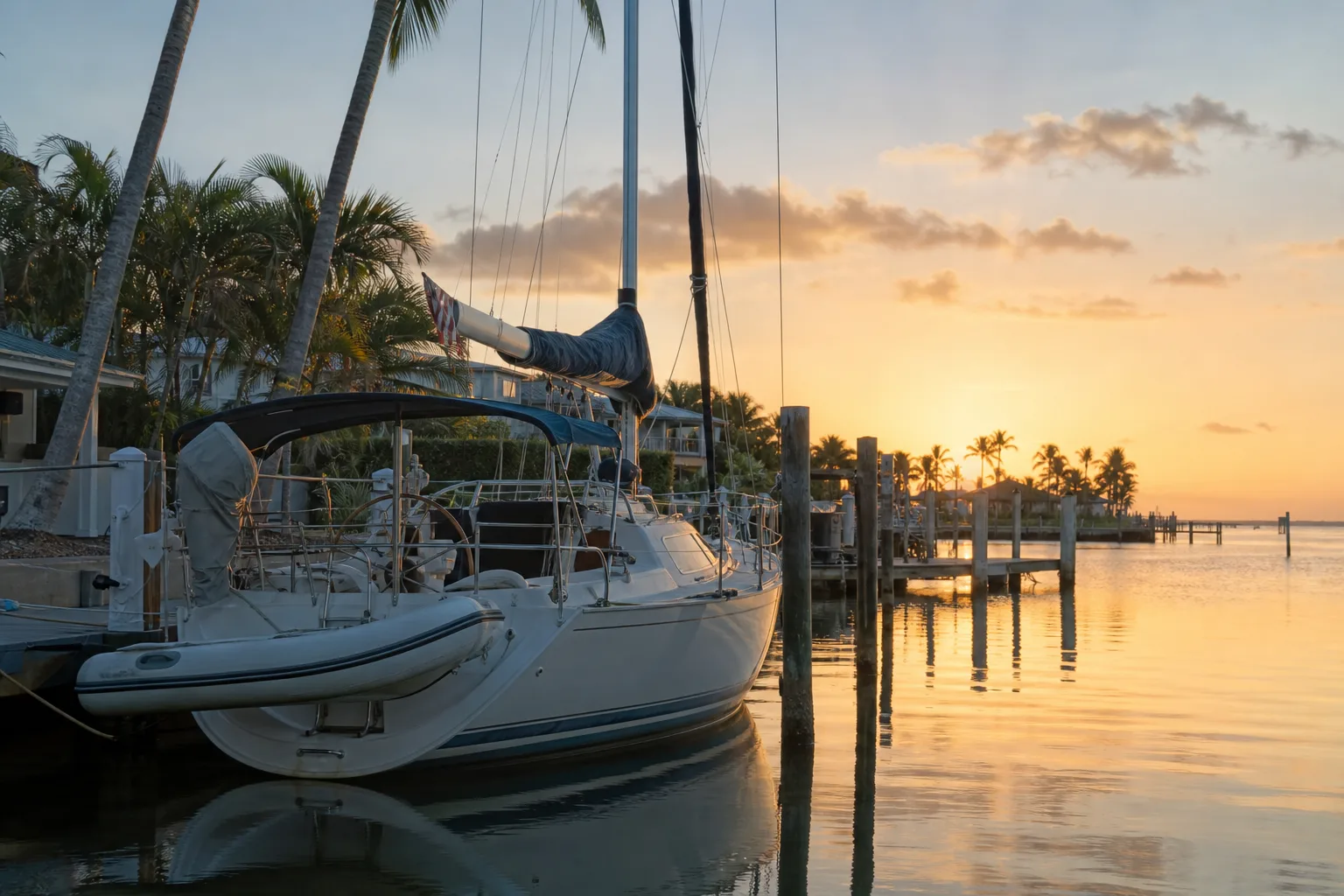
Yes, you can live on a boat in Florida, but where you do it decides the cost and the rules. In a marina, a liveaboard pays the slip rate plus, at many marinas, a liveaboard fee, and many marinas do not allow liveaboards at all. At anchor, Florida limits where and how long you can stay in some areas. In Marinalo data from October 2026, a Florida liveaboard slip for a 40-foot boat works out to about $1,300 to $1,400 a month at the two published rate sheets we priced below, before electricity, insurance and everything else.
This guide builds a monthly budget from real rate sheets, lists what else to budget (without inventing figures), and explains Florida's definition of a liveaboard and its anchoring rules. For a list of marinas that welcome liveaboards, see our Florida liveaboard marinas page, which quotes each rate sheet word for word.
What "liveaboard" means in Florida law
Florida Statutes section 327.02 defines a live-aboard vessel as one of three things: a vessel used solely as a residence and not for navigation, a vessel for which a declaration of domicile has been filed, or a vessel used as a residence that has no effective means of propulsion for safe navigation. Commercial fishing vessels are excluded. The same section separately defines a floating structure as a floating entity not primarily used for transportation, such as a floating residence, and floating structures are not "vessels" under the statute.
In plain terms, a boat that you sleep on a few nights a week and still take out is treated differently from a boat that is your permanent home and rarely moves. Marinas also have their own definitions: some count any overnight stay, others define liveaboards by the number of nights per month. Ask the dockmaster for the exact rule before you sign.
A real monthly budget for the slip
The slip is the biggest fixed cost for most liveaboards. These figures come from Marinalo's liveaboard page, built from official rate sheets read in October 2026. Rates change, so confirm with the marina.
| Marina (rate sheet) | What the sheet says | Illustration for a 40-ft boat, 2 people |
|---|---|---|
| Key West Bight Marina | Liveaboard lease $32.00 per foot monthly, plus $43.60 per person monthly | 40 x $32.00 = $1,280, plus 2 x $43.60 = $87.20, about $1,367 a month |
| Dinner Key Marina (Miami) | Long term: liveaboard $33.50 per foot per month vs $27.50 non-liveaboard | 40 x $33.50 = $1,340 a month (vs $1,100 without liveaboard status) |
| Fort Pierce City Marina | Live-aboard fee of $185.00 (2 people), $25.00 for each additional person, maximum 4; the slip rate is separate | $185 a month on top of the slip rate |
| Green Cove Springs Marina | Plus $45.00 for liveaboards | $45 on top of the slip rate |
The right-hand column is our arithmetic on the published rates, not a quote. For comparison, the median Florida slip rate in Marinalo data was $675 a month for a 30-foot boat (24 marinas) and $976 for a 40-foot boat (26 marinas) in October 2026; these medians come from slip rates for boats in general, not liveaboard leases. See the 30-foot and 40-foot slip pages, and the Florida boat slip prices study for how we measure them.
Marinalo also found rate sheets that say plainly there are no liveaboards, at marinas including Manatee Marina, Miamarina at Bayside, Sailfish Marina, Tavernier Creek Marina and Uncle Henry's Marina. Many others do not mention liveaboards in a rate sheet, so ask.
What else to budget every month
We will not invent figures for these, because they depend on your boat, your habits and your location. Price each one with a written quote or your own receipts for a few months, then add it up.
- Electricity and utilities. Some marinas bill metered power on top of the slip, others include it. Ask whether air conditioning and heating are metered.
- Insurance. Liveaboard status can change what your policy covers and costs, and some insurers will not cover a liveaboard. See boat insurance.
- Maintenance and repairs. A boat that is lived on wears faster. Set aside money for the engine, systems, canvas and bottom paint; see boat bottom paint and marine batteries.
- Haul-outs and storm costs. Haul-out, hurricane prep and deductibles are real expenses in Florida; see hurricane prep for boat owners.
- Pumpout, water, propane and fuel. Small each time, but recurring.
- Internet and phone. Marina wifi can be weak; many liveaboards pay for cellular data.
- Laundry, groceries, parking and a vehicle. Marinas may charge for parking or limit it.
- A tender. If you anchor or moor out, you need a dinghy and a motor; see inflatable boats and dinghies.
- Loan payment and depreciation, if you financed the boat. Marinalo's boat cost calculator and boat loan calculator show these. For loans on a liveaboard, see boat loan rates.
The calculator shows the yearly cost of owning the boat from a median Florida slip price and editable insurance, maintenance, fuel and depreciation assumptions. Then add the living costs above, which it does not include.
Anchoring and mooring rules in Florida
If you live at anchor to avoid the slip fee, Florida's rules apply. These come from sections 327.4108 and 327.4109 of the Florida Statutes. They have been amended repeatedly, so confirm the current text and local ordinances.
- Anchoring limitation areas (327.4108). In listed dense urban areas, including Middle River in Broward County, Sunset Lake in Miami-Dade County and sections of Biscayne Bay, you may not anchor between half an hour after sunset and half an hour before sunrise. Counties other than Monroe can set up their own areas under conditions, capped at 10 percent of the county's navigable waterways, each under 100 acres, marked with buoys and signs. In those county areas a vessel may not anchor for more than 45 consecutive days in any 6-month period.
- Monroe County (the Keys). Vessels within 10 nautical miles of a public mooring field or designated anchoring area must move at least once every 90 days, by at least half a nautical mile or to a different designated anchoring area. Vessels on approved, permitted moorings are exempt. Vessels with enclosed living spaces used overnight as a dwelling, and vessels in public mooring fields, must keep pumpout records showing a pumpout within the last 30 days.
- Distance rules (327.4109). You may not anchor or moor within 150 feet of a public or private marina, boat ramp or boatyard, or within 100 feet outward from the marked boundary of a public mooring field. Inside a mooring field you need a contract or other lawful right. Exceptions include mechanical failure, for up to 5 business days, and bad weather.
- Penalties. A violation of 327.4109 is a noncriminal infraction. Under 327.4108, repeated violations can lead to more serious consequences, including impoundment in some cases.
Cities and counties may also regulate mooring and anchoring of liveaboard vessels outside mooring fields, per a 2021 Florida House staff analysis, so check local rules where you plan to stay. Mooring fields charge their own fees; ask the harbormaster.
Texas
We did not find a Texas statewide liveaboard definition or anchoring rule comparable to Florida's sections 327.4108 and 327.4109. In practice the rules come from each marina, lake operator and city. Some marinas and lakes restrict overnight stays aboard, so ask the marina for its written policy and rate sheet before you plan on living aboard. Marinas are priced differently in Texas, as shown on the Texas 40-foot slip page, where the median monthly rate was $660 from 5 marinas in October 2026.
Practical rules for living aboard
- Ask for the liveaboard policy in writing: the fee per person, pet rules, limits on guests, hookup rules and parking.
- Read the insurance clause and tell your insurer you live aboard.
- Plan for storms. Know your marina's hurricane policy and your own haul-out or evacuation plan.
- Keep a legal address. Florida allows a declaration of domicile for a vessel (it is referenced in section 327.02); ask a Florida tax or legal professional about your situation.
- Dispose of sewage legally. Use pumpout stations and keep records if required.
FAQ
Can you live on a boat in Florida?
Yes, at marinas that allow liveaboards, on private moorings and at anchor where local and state rules permit. Some marinas and some areas prohibit it.
How much does it cost to live on a boat?
The slip alone is about $1,300 to $1,400 a month for a 40-footer at the two Florida rate sheets priced above, plus utilities, insurance, maintenance and living costs. Your total depends on your boat and habits.
Is a liveaboard slip more expensive than a regular slip?
Often, yes. Dinner Key Marina's sheet lists $33.50 per foot for liveaboards vs $27.50 for non-liveaboards, and several marinas add a per-person fee.
How long can you anchor in one place in Florida?
It depends on the area. County anchoring limitation areas have a 45-day limit in a 6-month period, and Monroe County requires a move at least every 90 days near mooring fields.
Do I need a license to live on a boat?
There is no liveaboard license in the sources we reviewed, but you may need a boating safety ID card to operate the boat; see Florida boating license and registration.
Sources
- Marinalo data, October 2026: Liveaboard marinas in Florida (official rate sheets)
- Marinalo data, October 2026: Florida slip prices, 40 ft
- Florida Statutes section 327.02, Definitions
- Florida Statutes section 327.4108, Anchoring of vessels in anchoring limitation areas
- Florida Statutes section 327.4109, Anchoring or mooring prohibitions
- Florida House of Representatives staff analysis, HB 1515 (2021)