
Marine Batteries: Types, Charging and Lifespan
Marine battery basics: starting vs deep-cycle vs dual-purpose, flooded, AGM and lithium, CCA, MCA and amp-hour ratings, charging, winter storage and safety.
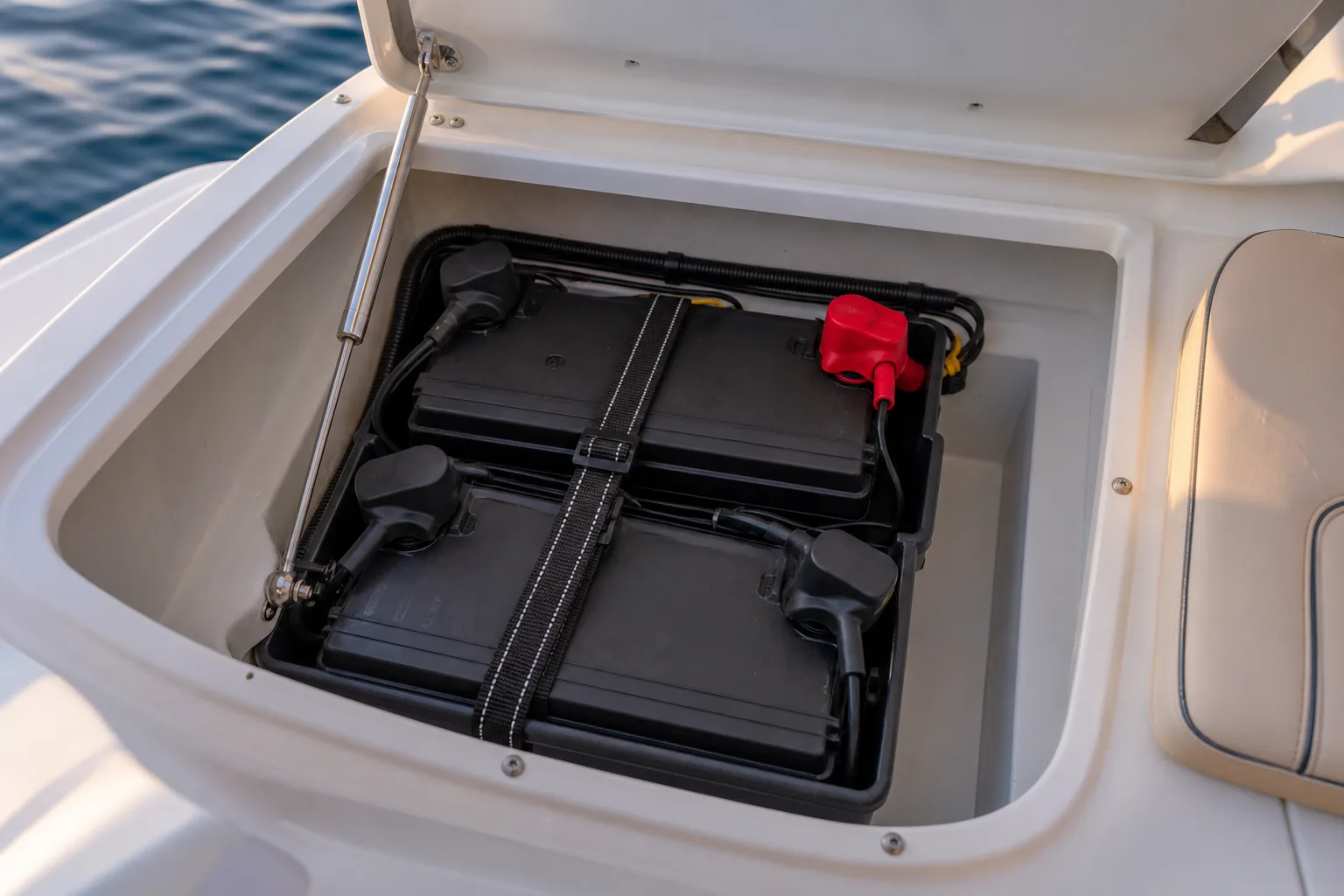
A marine battery is a battery built for the vibration, moisture and repeated discharging of life on a boat. There are three kinds: starting (cranking) batteries that deliver a big burst of power to start an engine, deep-cycle batteries that supply steady power for long periods, and dual-purpose batteries that try to do both. The right choice depends on what you run, and a boat battery should always be charged with a charger made for it.
Starting, deep-cycle and dual-purpose
The three types are built differently for different jobs.
| Type | Built for | Typical use |
|---|---|---|
| Starting (cranking) | A large burst of current in a short time | Starting the engine; once it runs, the alternator takes over |
| Deep-cycle | Steady power over a long period | Trolling motors, electronics, lights and appliances |
| Dual-purpose | A compromise between the two | Small boats with room for only one battery |
A dual-purpose battery combines some cranking power with some deep-cycle ability, but it does not match a specialized battery in either role. Many boats run one starting battery for the engine and a separate deep-cycle battery for accessories, so a long afternoon of fishing with the electronics on does not leave the engine unable to start.
Flooded, AGM and lithium
Type describes the job; chemistry describes how the battery is built.
- Flooded lead-acid. The traditional battery, with plates in liquid electrolyte. Many designs need periodic checks of the fluid level, and the battery must stay upright and ventilated.
- AGM (absorbed glass mat). A sealed lead-acid design where the electrolyte is held in glass mats. It needs no fluid top-ups and resists spills, but it must still be charged with a suitable charger.
- Lithium iron phosphate (LiFePO4). A lithium chemistry used increasingly for house and trolling-motor banks. It needs a charger with a lithium profile, not a standard lead-acid charger, because the charging settings are different.
If you add lithium to a boat that has a lead-acid starting battery, check how the alternator, charging relay and charger will treat it. A conventional automatic charging relay is designed for lead-acid banks, and an alternator can be at risk if a lithium battery's protection circuit disconnects while the engine is running. A DC-to-DC charger between the banks is one commonly recommended way to handle this; ask the battery maker or a marine electrician about your setup.
What the ratings mean
| Rating | What it measures | Matters most for |
|---|---|---|
| CCA (cold cranking amps) | Amps the battery can deliver at 0°F for 30 seconds | Starting batteries, especially in cold climates |
| MCA (marine cranking amps) | The same test at 32°F, a temperature closer to the water | Starting batteries on boats |
| Reserve capacity (RC) | Minutes the battery can supply 25 amps before dropping to 10.5 volts | How long the boat can run if the alternator fails |
| Amp-hours (Ah) | Capacity, usually based on a 20-hour draw from a full charge | Deep-cycle and house batteries |
For a starting battery, check the engine manufacturer's recommended cranking rating and choose a battery that meets or exceeds it. For a deep-cycle bank, add up what you run and for how long to see how many amp-hours you need. Ask the battery maker how deeply the battery can be discharged without shortening its life.
How to choose a battery
- Start with the engine maker's recommendation for the cranking rating of the starting battery.
- List the electronics, lights, pumps and any trolling motor that will run from a deep-cycle bank, and estimate how long they run between charges.
- Check the battery group size and the space in the boat, and make sure it fits the box or tray.
- Decide on chemistry: flooded is the traditional and usually the simplest choice, AGM is sealed, and lithium needs the right charger and wiring.
- Make sure your charger and alternator setup match the chemistry you pick.
Charging basics
- Use a marine charger. Over- or undercharging can shorten a battery's life. Choose a charger designed for marine batteries and set to the right battery type.
- Know the voltage. A 12-volt deep-cycle lead-acid battery typically reaches about 14.4 to 14.8 volts while charging. Lithium has its own profile, so follow the battery maker's instructions.
- Do not rely on the alternator alone. It is meant to keep batteries topped up while the engine runs, not to recover a deeply drained bank.
- Use a maintainer if the boat sits. For infrequent use, keep the battery on a regulated trickle or maintenance charger if shore power is available.
Lifespan
There is no fixed life for a marine battery. Industry guidance from the boating trade group Discover Boating says marine batteries typically last 3 to 5 years, depending on use and maintenance. Lithium makers publish their own ratings, so check the manufacturer's warranty and cycle rating rather than relying on a general figure. Replace a battery if it cranks slowly, swells, leaks or loses capacity.
Winter and off-season storage
- Charge the battery fully. A partly charged lead-acid battery is more likely to freeze.
- Disconnect the terminals, or turn the battery switch off, so nothing draws it down.
- Keep it on a maintainer if power is available where the boat is stored. Otherwise remove the battery and connect it to a maintenance charger.
- Store it somewhere cool, out of direct sunlight.
- Check the voltage regularly and recharge before it gets low.
Florida and Texas rarely freeze for long, but a boat sitting for weeks in summer heat still drains its battery. Our guides to boat storage options and ethanol-free gas cover other off-season steps.
Safety and installation rules
Batteries can spark, leak acid and, if charged badly, give off gas. Good installation is the best protection.
- Secure the battery. Federal rules for boats built with electrical systems (33 CFR 183.420) say a battery must not move more than one inch in any direction when a pull of 90 pounds, or twice the battery's weight if that is less, is applied through its center of gravity. A box or tray bolted to the boat with a strap or bracket is the usual way to do it.
- Keep metal away from terminals. The same regulation requires the installation to keep metallic objects from touching ungrounded battery terminals. The regulation does not spell out terminal covers, but a boot or cover on the positive terminal is a sensible precaution against a dropped tool causing a spark. Check the American Boat and Yacht Council (ABYC) standard E-10 for the full installation guidance for your boat.
- Do not rely on spring tension. Terminal connectors cannot depend on spring tension for the mechanical connection.
- Check terminals. Look for loose connections, corrosion, cracks, bulges and leaks. A baking soda and water mixture cleans corrosion.
- Ventilate and keep it cool. Avoid direct sun, and follow the manufacturer's ventilation advice, especially for flooded batteries.
These federal rules apply to the boat as built. Whatever you add later should follow the same principles. Batteries usually sit near the bilge, so keep the area dry. Check the fuel stops along your route too, with our lists of Florida fuel docks and Texas fuel docks, and find a Florida boat ramp for your next trip.
FAQ
Can I use a car battery in a boat?
Marine batteries are built to handle vibration and repeated discharge. Ask the boat and battery manufacturers before using anything else, and secure whatever battery you use.
What is the difference between CCA and MCA?
CCA is measured at 0°F and MCA at 32°F. MCA is the more relevant number for a boat.
How long does a marine battery last?
Discover Boating says marine batteries typically last 3 to 5 years, depending on use and maintenance. Lithium batteries come with their own manufacturer ratings.
Should I leave the battery connected over the winter?
Disconnect it or switch it off so nothing draws it down, and keep it on a maintainer if you have power. Charge it fully first.
Do I need a special charger for lithium?
Yes. A standard lead-acid charger does not use the right settings for lithium batteries. Use a charger with a LiFePO4 profile.
Are battery terminal covers required?
Federal regulation 33 CFR 183.420 does not state a cover requirement, but it requires that metal objects be kept from touching ungrounded terminals. Covering the terminals is a widely recommended way to do that.