
Inflatable Boats and Dinghies: A Buyer's Guide
How to choose an inflatable boat or dinghy: PVC vs Hypalon/CSM, floor types, RIBs, outboard sizing, Florida and Texas registration when motorized, and tender use.
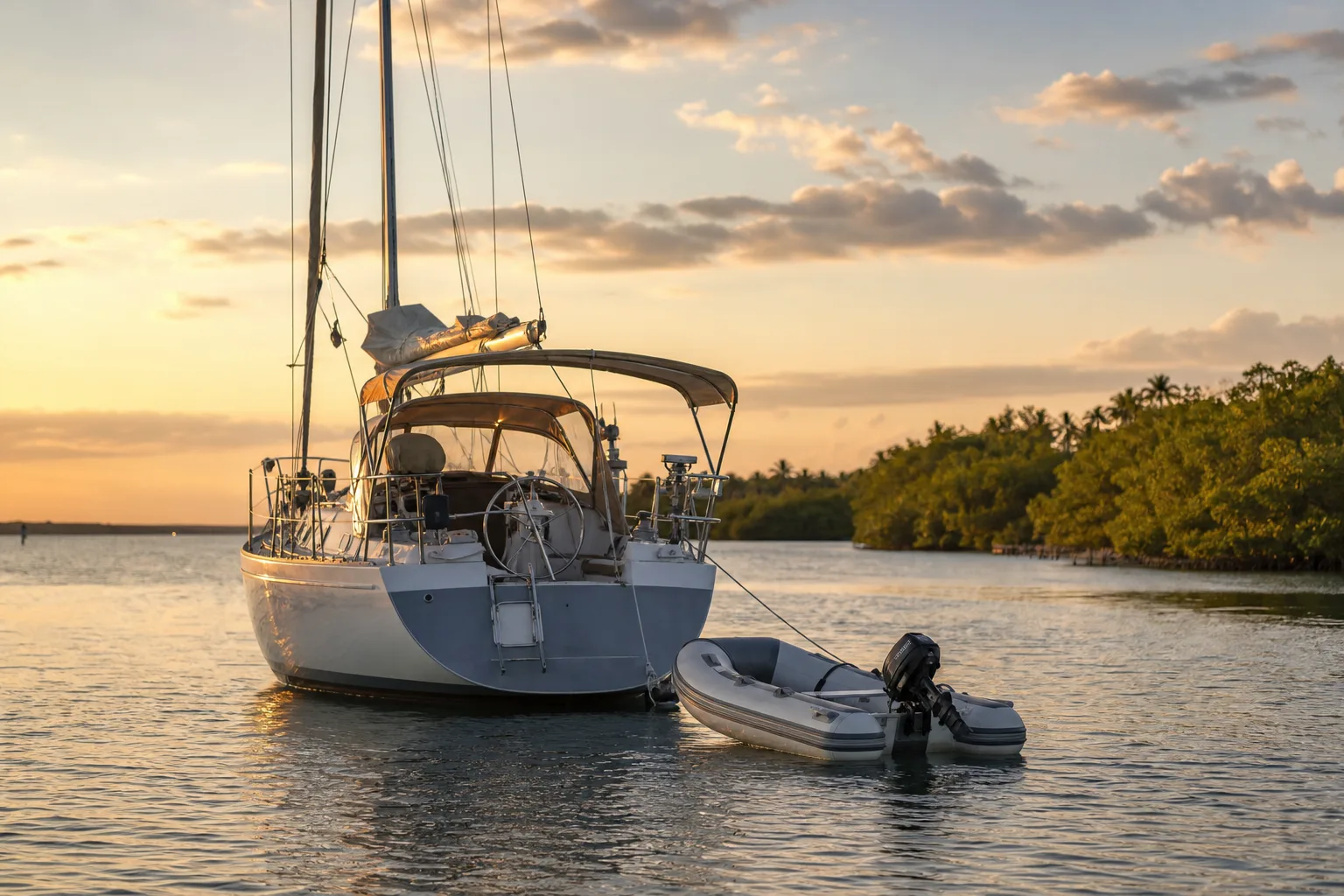
An inflatable boat is a boat whose buoyancy comes from air-filled tubes, which makes it light, stable and easy to store when deflated. The right one depends on the tube material (PVC or Hypalon/CSM), the floor (roll-up, slatted, air or rigid), whether it needs a rigid hull (a RIB), and how much motor the manufacturer says it can carry.
Inflatables are used as tenders to reach a boat on a mooring, as fishing platforms, as rescue boats and as small family boats. This guide covers the main buying choices, how to size an outboard, and what registration rules apply in Florida and Texas once you add a motor.
Inflatable boat, dinghy and tender: what is the difference?
- Inflatable boat. Any boat with inflated tubes as the main structure.
- Dinghy. A small boat, inflatable or rigid, often used to carry people and gear from a larger boat to shore. Many dinghies are inflatable because they can be deflated and stowed.
- Tender. The role a dinghy plays when it serves a bigger boat.
- Inflatable kayak. A paddle craft, covered in a separate guide: inflatable kayaks: pros and cons.
Tube material: PVC vs Hypalon (CSM)
Most inflatables use one of two coated fabrics. PVC is a thermoplastic that can be heat-welded at the seams. Hypalon was DuPont's brand name for a synthetic rubber, chlorosulfonated polyethylene (CSM). Manufacturers that still make this fabric usually call it CSM or use their own trade name, and CSM boats are generally glued rather than welded.
| Feature | PVC | Hypalon / CSM |
|---|---|---|
| Price | Generally lower | Generally higher |
| Weight and feel | Often lighter and stiffer | Often more flexible |
| Sun and heat | Can degrade faster under constant sun if not cared for | Generally better UV resistance |
| Seams | Welded | Glued |
| Best for | Occasional use, boats stored out of the sun | Boats left outdoors in hot sun all year |
These are general tendencies reported by builders and dealers, and they conflict in places, so check the warranty, the fabric weight and how the seams are made, not just the material name. In Florida and Texas sun, shade covers, rinsing and storing the boat out of direct sun make a big difference to tube life with either material.
Floor types
- Roll-up (slatted) floor. Lightweight, packs small, can be rolled up with the tubes. Less rigid underfoot. Common on entry-level boats and tenders.
- Air floor. An inflatable floor that is firm when pumped hard, packs flat and is lighter than a rigid floor. Good if you need to stow the boat.
- Aluminum or wood floor. Stiffer and better for heavier loads and bigger motors, but heavier and bulkier to store.
- Inflatable keel. A V-shaped air keel on some models improves tracking and handling over a flat bottom.
Where a RIB fits
A RIB (rigid inflatable boat) pairs inflatable tubes with a rigid hull, usually fiberglass or aluminum. The hull cuts through chop better, handles higher power and holds its shape. The cost is weight, price and storage: a RIB generally can't be rolled up, so it lives on davits, on a trailer or in a slip. If you want to keep the boat on deck of a bigger boat, a folding inflatable is easier; if you want a stable, fast tender or a small sport boat, a RIB is the usual choice.
How to size an outboard
- Find the rating. The federal capacity plate rule (33 CFR Part 183, Subpart B) covers monohull boats under 20 feet but specifically excludes sailboats, canoes, kayaks and inflatable boats. So a plate may not be present on an inflatable. Look for the builder's plate or the owner's manual instead, which should state a maximum horsepower, a maximum number of people and a maximum load.
- Never exceed it. Too much power makes the boat harder to control and can overstress the transom. Too little can make it hard to plane with a load.
- Check the transom. Make sure the transom height matches the shaft length of the outboard (short, long or extra long). A wrong shaft length changes how the propeller sits in the water.
- Add up the weight. Engine, fuel, people and gear all count against the maximum load.
- Tank and fuel. Use the fuel your outboard maker specifies. Small portable tanks should be stowed securely.
If there is no rating at all on a used boat, ask the manufacturer with the serial or hull identification number. Do not guess.
Registration in Florida and Texas
As with most boats, the question is whether the boat has a motor.
- Florida. The Florida Highway Safety and Motor Vehicles department says all motorized vessels operated on Florida public waters must be titled and registered regardless of length. Non-motorized vessels under 16 feet do not need to be titled or registered. Read our Florida boating license and registration guide for the boater-education rules for those born on or after January 1, 1988.
- Texas. Texas Parks and Wildlife says a motorized boat on public water needs current registration regardless of length, and that adding a motor to a boat that would otherwise be exempt triggers titling and registration. Paddled, poled or oared vessels under 14 feet are exempt. Confirm current details with TPWD.
So a small inflatable dinghy with an outboard is a registered boat in both states, even if it is only a tender. A rowed dinghy under the length limits is generally exempt. When you buy a used inflatable, ask for the title or bill of sale and look for a hull identification number.
Using an inflatable as a tender
- Life jackets. Federal rules require one wearable life jacket for each person on a recreational vessel (33 CFR 175.15), and children under 13 must wear one while the vessel is underway unless they are in an enclosed cabin. Our guide to Coast Guard approved life jackets explains the types.
- Lights. Avoid using the tender after dark unless you know the navigation-light rules that apply to your boat; check with the Coast Guard or your state agency.
- Anchor and oars. Always carry paddles or oars in case the motor stops.
- Security. Lock the dinghy and the outboard when left ashore.
- Dock access. Many marinas and public docks have dinghy rules and fees. Browse the marinas on our Florida and Texas pages, or see the liveaboard marinas list if your tender serves a boat you live on.
- Landing. Public boat ramps are a convenient place to launch a small inflatable.
Care and storage
- Rinse with fresh water after saltwater use and let the boat dry before storing.
- Inflate to the pressure specified by the manufacturer. Tube pressure changes with heat, so check it on hot days.
- Store it out of direct sun and off rough concrete.
- Learn a quick repair: a patch kit and the manufacturer's adhesive belong on board.
- For ideas on where to keep a boat, see boat storage options.
FAQ
Do I need to register an inflatable boat with a motor?
Yes, in both Florida and Texas a motorized boat generally needs to be titled or registered regardless of its length. Rules can change, so verify with FLHSMV or TPWD.
What size outboard can my inflatable take?
Use the maximum horsepower stated by the manufacturer on the boat or in the manual. Federal capacity plate rules do not cover inflatable boats, so the builder's rating is your reference.
Is Hypalon better than PVC?
Hypalon (CSM) is generally preferred for hot, sunny climates and heavy use, while PVC is cheaper and lighter. Care matters more than material for lasting a long time.
Is a RIB better than a regular inflatable?
A RIB handles chop and power better but is heavier and can't be rolled up. A regular inflatable is easier to store.
Can an inflatable boat be used in saltwater?
Yes. Rinse it with fresh water afterward and check seams and valves regularly.