
Inflatable Kayaks: Pros, Cons and Where to Launch
Are inflatable kayaks any good? Compare construction types, pros and cons vs hardshell kayaks, wind and puncture risks, inflation tips and safety basics.
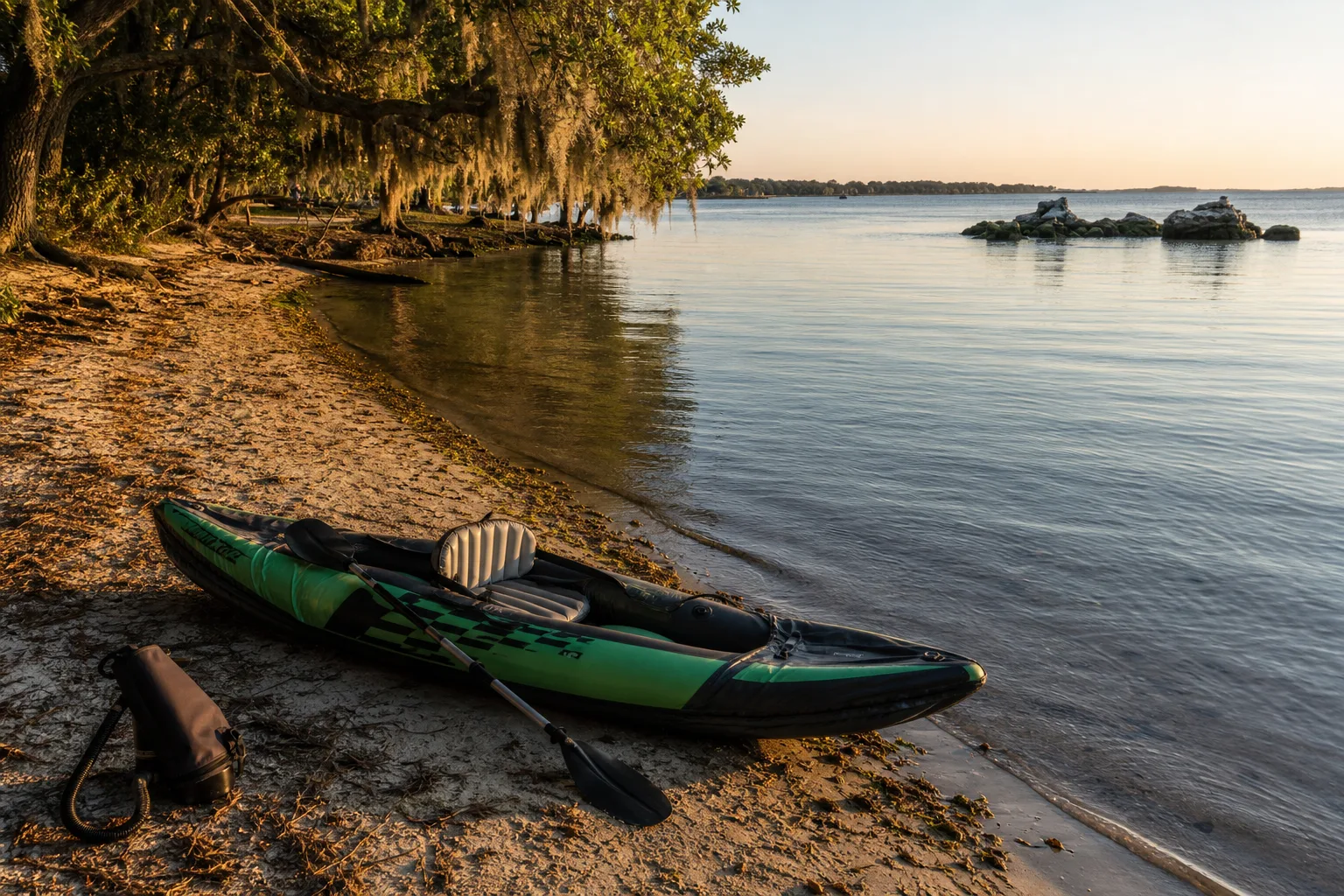
An inflatable kayak is a paddlecraft made of air chambers and tough fabric that packs down into a bag and inflates in minutes. Modern models are stable and surprisingly capable on calm water, and they suit people with limited storage or no roof rack. Their main drawbacks are that they catch more wind than a hardshell, they can be punctured, and they usually track less well on open water.
How an inflatable kayak is built
The hull of an inflatable kayak is an airtight shell of coated fabric that is welded or glued at the seams. What it is made of and how it holds its shape matters more than the shape alone.
Materials
- PVC (vinyl): the most common material in lower-priced kayaks. It is flexible, easy to repair and fairly tough, but it can degrade over time with heat and sunlight if stored badly.
- Urethane or TPU-coated fabrics: used on some higher-end boats. They are lighter, and resist abrasion and sunlight well, but typically cost more and may need specialty repair materials.
- Rubberized synthetic fabrics such as Hypalon or nitrile-based coatings: sold under various trade names, they are known for durability, and cost more than basic PVC.
Manufacturers differ, so read the product description for the exact fabric and the thickness or weight of the material. Look for a replaceable valve, a protective outer layer on the bottom and a warranty you understand.
Hull structure
- Drop-stitch floors: thousands of threads join the top and bottom layers of the floor, so the floor inflates to a firm, flat surface. It feels more like a hard board and helps the boat track better and stand up to being stood on.
- Standard air-chamber floors: several inflatable tubes or pillows make up the floor, which stays softer and less rigid.
- Separate air chambers: most good models have more than one chamber, so a puncture in one does not deflate the whole boat.
Pros and cons compared with hardshell kayaks
| Factor | Inflatable | Hardshell |
|---|---|---|
| Storage | Folds into a bag; fits in a closet or car trunk | Needs a rack, garage space or a trailer |
| Transport | No roof rack needed | Roof rack or trailer, plus straps |
| Setup time | Inflation takes several minutes with a pump | Ready to go |
| Stability | Often very stable, especially wide models | Varies by design |
| Speed and tracking | Usually slower, may wander | Usually faster and straighter |
| Wind | Catches more wind | Sits lower, handles wind better |
| Durability | Resists dings and scrapes; can be punctured | Resists punctures; can crack or scratch |
| Price | Wide range, from budget to premium | Wide range |
The real advantages
- Portability. You can carry one on a plane, in a boat or in a small car.
- Soft landings. Bumping a rock, dock or mangrove root is less likely to hurt the boat, and it is also kinder to people.
- Stability. The wide tubes make many inflatable kayaks steady, which helps beginners, families and photographers.
- Light weight. Many are easier to carry down to the water than hardshell models of the same length.
- Easy to store. Particularly useful in apartments or when you share a garage.
The real drawbacks
- Wind and current. The tall, light hull acts like a sail. A breeze that a hardshell ignores can push an inflatable sideways or stop it from making headway. If you are not sure how strong a forecast wind is, convert it with our knots to mph converter and check it against what you can paddle comfortably.
- Tracking. Many models are shorter and wider than hardshells and wander off course. A removable skeg or fin helps.
- Setup and drying. You have to inflate, deflate, dry and fold the boat. Packing a wet kayak can cause mildew and odor.
- Punctures. Oyster shells, barnacles, fishing hooks, sharp sticks and thorny plants can cut the fabric. Be careful with the bottom layer and with fishing gear.
- Heat. Air expands in the sun, and a boat left in a hot car or in direct sun can overinflate.
Inflation and pressure
Always follow the maker's instructions for the correct pressure; it is usually printed near the valve or in the manual, and it differs between models. Underinflated kayaks feel mushy and track badly. Overinflated ones put strain on the seams and valves.
- Use a pump with a pressure gauge, so you inflate to the stated number and not by feel.
- Inflate in the shade if you can, and check the pressure again after the boat has been in the water. Cold water can reduce pressure, and a sunny day can raise it.
- Let a little air out if the kayak sits in the sun at the ramp or on the beach for a long time.
- Close the valves firmly and check them for sand and grit.
Repair and care
Most inflatable kayaks come with a basic repair kit. Small holes in PVC are usually repaired with a patch and adhesive made for the material, but different fabrics need different glues, so use what the manufacturer recommends.
- Find the leak by spraying soapy water on the surface and watching for bubbles.
- Mark it, deflate, clean and dry the area.
- Apply the patch and adhesive according to the kit instructions, allow the full cure time and re-inflate.
- Rinse after salt water and let it dry completely before you roll it up.
- Store it out of direct sun, in a cool, dry place.
Who should consider an inflatable kayak
- Beginners who want a stable kayak for calm lakes, slow rivers and sheltered bays.
- People without a garage, roof rack or trailer.
- Travelers who want to paddle at different destinations.
- Families who want a forgiving first boat.
An inflatable may not be the best choice if you paddle long distances in wind, in open water or through areas with heavy oyster beds. In that case, a hardshell kayak is likely to serve you better. If fishing is your main goal, see our beginner's guide to fishing kayaks.
Safety and life jackets
An inflatable kayak is still a boat. Federal rules require one Coast Guard-approved wearable life jacket for each person aboard a recreational boat. The Coast Guard also says a throwable device is not required on canoes or kayaks. Wear the life jacket while paddling.
- In Texas, children under 13 must wear a Coast Guard-approved life jacket on vessels under 26 feet while underway, according to TPWD.
- In Florida, children under 6 must wear one on vessels under 26 feet while underway, according to the FWC and Florida law.
- If you are using an inflatable life jacket, the Coast Guard says it is generally intended for people who are over 80 pounds, and a wearer must be over 16 years of age to meet carriage requirements. Check the cylinder and indicator before each trip.
Before you launch, check the weather and tides. Water moving in and out of a channel can quickly overpower a slow, light boat, so look at our tide times for the area you will paddle.
Where to launch
Inflatables need only a gentle bank, beach or ramp. Use a launch with a sandy or grassy edge rather than rough shell or concrete if you can. Look at our directories of Florida kayak launches and Texas public boat ramps to find a spot near you.
Inflate the kayak away from the ramp so you do not block anyone, then carry it down. Bring a small towel, because sand is the enemy of a valve.
FAQ
Are inflatable kayaks any good?
Yes, for calm water. Good models are stable and durable, but they are less efficient in wind and on open water than hardshell kayaks.
Can an inflatable kayak be punctured?
Yes. Sharp objects such as oyster shells and fishing hooks can cut the fabric. Most can be patched with a repair kit.
What is a drop-stitch kayak?
A drop-stitch kayak has thousands of threads connecting the top and bottom of the floor, which gives a firm, flat surface when inflated.
Do I need a life jacket in an inflatable kayak?
Yes. Federal rules require one wearable Coast Guard-approved life jacket for each person aboard.
Do inflatable kayaks need to be registered?
Non-motorized kayaks are exempt in Texas at any length according to TPWD, and in Florida non-motorized vessels under 16 feet are exempt according to the FWC. Adding a motor changes that in both states.
Sources
- U.S. Coast Guard Boating Safety Division: Frequently Asked Questions
- Texas Parks and Wildlife Department: Boating
- Texas Parks and Wildlife Department: Registration Requirements
- Florida Fish and Wildlife Conservation Commission: Paddleboards, canoes and kayaks
- Florida Fish and Wildlife Conservation Commission: Boating regulations