
Fishing Kayaks: A Beginner's Guide to Choosing and Launching
How to choose a fishing kayak: paddle or pedal, stability, length and width, rigging, life jackets, and Florida and Texas registration and license basics.
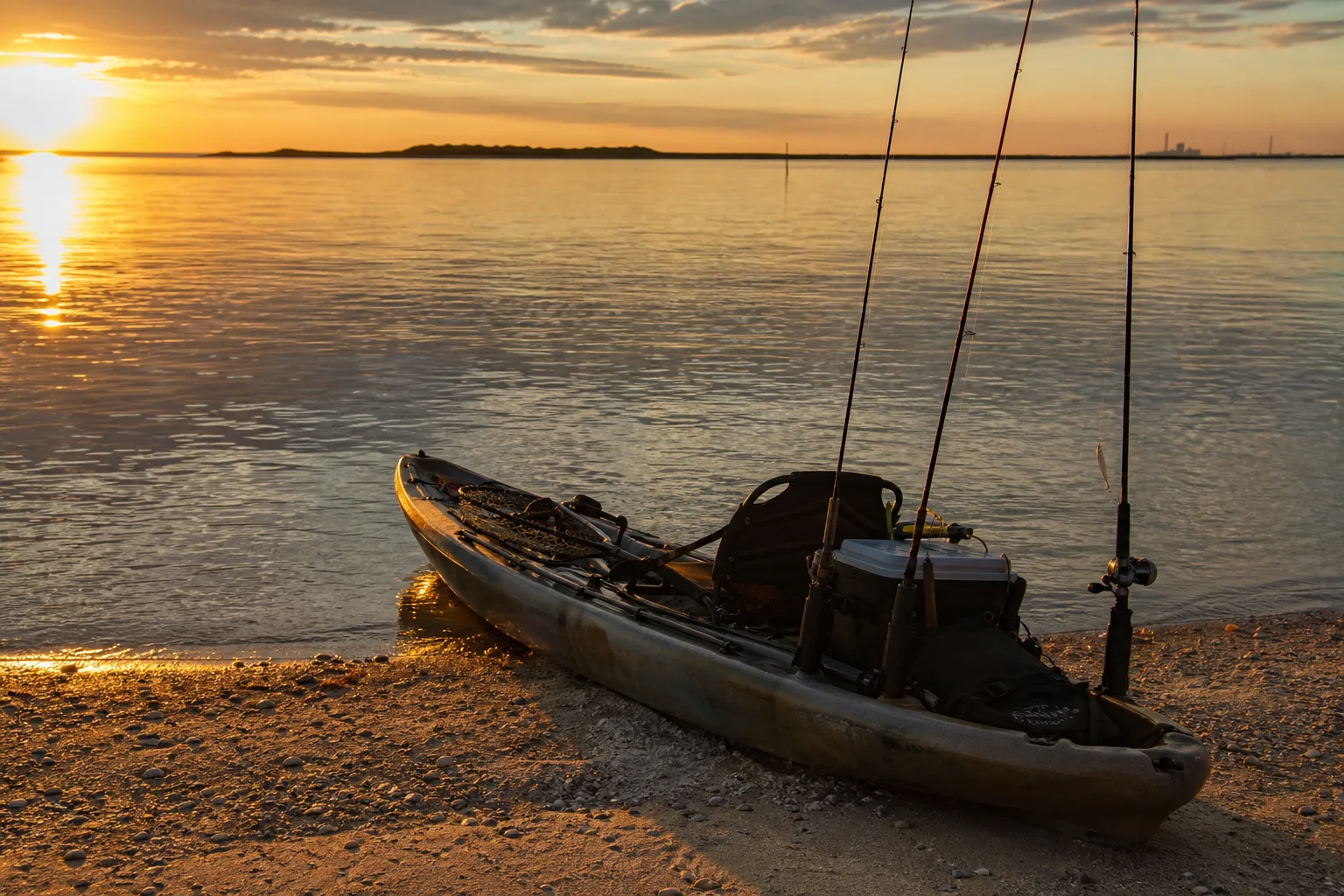
A fishing kayak is a stable, sit-on-top paddlecraft built to carry rods, tackle and a cooler, and to let you stand, sit or turn easily while fishing. Choose one by how you will power it (paddle or pedal), how stable it feels to you, and where you will launch. For most beginners, a wide, stable kayak that you can paddle comfortably is the right first boat.
What makes a kayak a fishing kayak
Almost any kayak can be fished from, but fishing models add features that save you time and money on the water: a wider and flatter hull for stability, flush-mount or track-mounted rod holders, a large open cockpit or tank well for crates and gear, tie-down points, and often a seat that sits high so you can cast or stand. Most are sit-on-top designs. If you are still deciding between sit-on-top and sit-in, that comparison is covered separately; for fishing, sit-on-top is the common choice because you can move around, get on and off easily, and never feel trapped if you tip.
Paddle or pedal drive?
| Feature | Paddle kayak | Pedal-drive kayak |
|---|---|---|
| Hands free for fishing | No, you stop paddling to cast | Yes, pedals move you while your hands hold the rod |
| Cost | Lower | Higher |
| Weight and transport | Lighter, easier to car-top | Heavier, often needs a cart or trailer |
| Shallow water | Excellent | Depends on the drive; some can be raised or removed |
| Maintenance | Almost none | Moving parts to rinse and service |
| Simplicity for a beginner | Very simple | More to learn |
If you fish shallow flats or small creeks, a paddle kayak is often enough and keeps your cost down. If you fish large open bays or want to hold position in wind and current while you cast, a pedal drive is worth testing. Try both at a demo day or rental shop before you buy.
A kayak with a motor, even a small electric trolling motor, is in a different category. See the registration section below.
Stability, length and width
There are two kinds of stability. Initial stability is how steady the kayak feels when you sit or stand on it still. Secondary stability is how well it resists tipping when it leans further. Wide kayaks have high initial stability and are good for fishing and standing. Narrow kayaks glide faster but feel tippier.
- Wider hull: more stable, easier to stand, more room for gear, but slower and harder to paddle in wind.
- Narrower hull: faster and tracks better for long distances, but you need more balance.
- Longer kayak: tracks straighter, glides farther per stroke, and carries more weight; harder to turn and to transport.
- Shorter kayak: turns quickly, easier to store, and good for small creeks; slower and less straight.
Check the manufacturer's weight capacity and add up your body weight, gear, tackle, ice and fish. Stay well below the capacity, because a loaded kayak sits lower and is easier to swamp. Sit in several models if you can, and if you plan to stand, practice it in shallow water first, close to shore.
Basic rigging
Most people over-rig at first. Start simple and add gear after a few trips.
- Rod holders: two are plenty to begin with.
- Paddle leash and rod leashes: a dropped paddle or rod is hard to retrieve.
- Anchor or stake-out pole: to hold position in current or wind. Use a small anchor, and do not tie it in a way that you cannot release quickly.
- Crate or tank well: to carry tackle and a cooler. Tie everything down.
- Fish finder (optional): not essential for a beginner.
- Flag or light: a bright flag makes you more visible to powerboats.
Keep the deck uncluttered. Lines and hooks around your feet are a hazard when you are handling a fish.
Safety: life jackets and signals
Federal rules require one wearable U.S. Coast Guard-approved life jacket for each person aboard a recreational boat, and kayaks are included. The Coast Guard also states that a throwable device is not required on canoes or kayaks. Wear it; do not just stow it. A life jacket on a kayak that you are not wearing will not help if you are separated from the boat. Choose one designed for paddling, with big armholes and a high back that does not interfere with your seat. Look for the Coast Guard approval label inside the jacket.
- Texas: TPWD says children under 13 must wear a Coast Guard-approved life jacket on vessels under 26 feet while underway, which includes paddlecraft. TPWD also advises that paddlers carry a sound-producing device such as a whistle and display a white light visible from all directions between sunset and sunrise or in limited visibility.
- Florida: children under 6 must wear a Coast Guard-approved life jacket on vessels under 26 feet while underway, according to Florida law and the FWC.
Other practical safety steps:
- Check the forecast, wind and tide before you go. Wind against tide can build short, steep waves. Our tide times pages help you plan around the water level.
- Tell someone where you are launching and when you will be back.
- Carry a waterproof phone case or a VHF radio, a whistle and water.
- Learn how to climb back onto a sit-on-top kayak in shallow water before you need to.
- In cold water, dress for the temperature of the water, not the air.
- Watch for boat traffic and large vessels in channels, and stay out of their way.
Do you need to register a fishing kayak?
It depends on the state and on whether you add a motor.
Texas
The Texas Parks and Wildlife Department lists non-motorized canoes, kayaks, punts, rowboats and rubber rafts as exempt from registration regardless of length. TPWD also says that adding an outboard or trolling motor to a vessel negates the exemption, so a motorized kayak must be registered and titled. See the TPWD registration requirements.
Florida
The FWC states that non-motorized vessels less than 16 feet are not required to have a Florida Certificate of Registration or Certificate of Title. Motorized vessels, including canoes, kayaks and paddleboards, must have a Certificate of Registration and Certificate of Title, unless used exclusively on private ponds and lakes. If your kayak will carry a motor, or is 16 feet or longer, check the FWC page for how the rules apply to you. Our Florida boating license and registration guide has more on the rules for powerboats.
Fishing licenses
You need a fishing license in both states unless you qualify for an exemption, and kayak fishing does not change that. Licenses and exemptions differ for fresh water and salt water and for residents and visitors. Prices change, so check the official pages: FWC fishing licenses and permits and TPWD fishing. Also check bag limits, size limits and closed seasons for the species you are after, and any rules for the water body where you launch.
Where to launch
A kayak needs only a gentle slope into the water and a place to park. Many public boat ramps allow paddlecraft, and some parks have dedicated launches that are easier on the legs and easier to access at low tide. Browse our directories of Florida kayak launches and Texas public boat ramps.
Launch etiquette: unload and rig away from the ramp, so powerboats can use it, and move your vehicle promptly. Rinse your kayak after saltwater use.
FAQ
What is the best fishing kayak for beginners?
A wide, stable sit-on-top paddle kayak that you can transport easily is a sensible start. Demo a few before buying.
Do I need to register a kayak in Florida?
The FWC says non-motorized vessels under 16 feet do not need a registration or title. Motorized kayaks do, unless used only on private ponds and lakes.
Do I need to register a kayak in Texas?
Non-motorized kayaks are exempt at any length according to TPWD, but adding a motor, including a trolling motor, removes the exemption.
Do I need a life jacket on a kayak?
Yes, federal rules require one wearable life jacket per person aboard, and you should wear it.
Do I need a fishing license to fish from a kayak?
Yes, unless you qualify for an exemption. Check the FWC or TPWD pages for the current rules.
Sources
- Texas Parks and Wildlife Department: Registration Requirements
- Texas Parks and Wildlife Department: Boating
- Florida Fish and Wildlife Conservation Commission: Paddleboards, canoes and kayaks
- Florida Fish and Wildlife Conservation Commission: Boating regulations
- U.S. Coast Guard Boating Safety Division: Frequently Asked Questions