
Hurricane Prep for Boat Owners: Haul Out, Hurricane Holes and Marina Contracts
How to prepare a boat for a hurricane: haul out or stay in the water, what a hurricane hole is, lines and chafe, marina storm clauses and named-storm insurance.
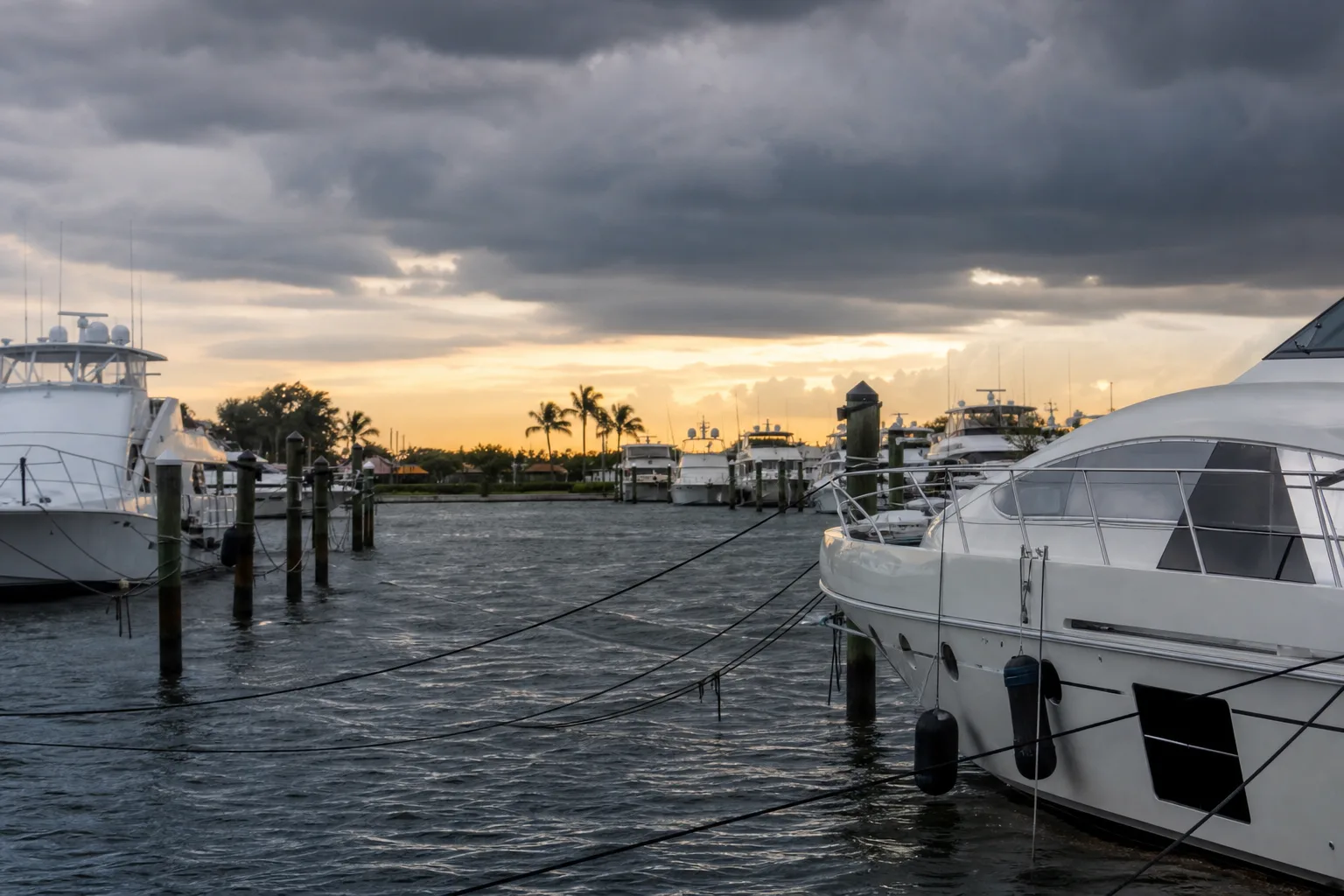
The main choices for a boat in a hurricane are to haul it out and strap it down on land, to leave it in a marina slip prepared for the storm, or to move it to a well-protected hurricane hole chosen long before the storm. Whichever you choose, the plan has to be made before hurricane season, not once a storm is in the forecast cone. That means a written plan, a marina contract you have read, an insurance policy you understand, and a boat that is ready to be secured quickly.
Hurricane season dates
The National Hurricane Center says the Atlantic hurricane season runs from June 1 to November 30. The peak is September 10, with most activity between mid-August and mid-October, and activity sometimes occurs before and after the official dates. Today is October 17, so the season is still active; if your boat lives in Florida or on the Texas coast, your plan should be in place now, not at the next watch.
Haul out or stay in the water?
| Option | Pros | Cons |
|---|---|---|
| Haul out and store on land | Takes the boat out of storm surge and waves; a strapped, blocked boat on a yard or home trailer is not exposed to chafing lines or neighbors' boats. | Yards fill up and take time; you need a spot reserved in advance; boats on stands or trailers can still be damaged by wind or flooding. Cost of haul-out and storage. |
| Stay in a marina slip | Fast, no transport. Some marinas have strong pilings or protected basins. | Storm surge, floating docks and neighbors' boats are major risks. Some marinas require or recommend that boats leave or be hauled. Check your contract. |
| Move to a hurricane hole | Sheltered water, deep or mangrove-lined, can reduce wind and waves. | You need to know it ahead of time, move early, and tie up or anchor with heavy gear. Other boats arrive too, so crowding is a risk. Bridges can close before you arrive. |
| Trailer at home | You control the plan. Smaller boats can be strapped down or moved inland. | Needs space, tie-downs and a way to deal with flooding or falling trees. |
BoatUS, the boat owners association and insurer, advises that boaters develop a hurricane plan well before the season and share it with the marina manager. If the plan includes hauling the boat, join your marina's "hurricane club," if it has one, to get on the priority list. Hurricane clubs usually require signing up well before the first storm and sometimes a non-refundable deposit. You cannot count on a request made once a storm is announced.
See our guide to boat storage options for the choices on land, including dry stack, trailer storage and yards.
What is a hurricane hole?
A hurricane hole is a place with enough protection from wind, waves and surge that boats can ride out a storm there: a narrow river, a creek with mangroves, a protected basin or a canal system. There is no official list and no guarantee. BoatUS has noted on its hurricane resource page that many boats in canals have been damaged in recent hurricanes, so a canal is not automatically a safe place. A good hurricane hole depends on the storm: wind direction changes as a hurricane passes, so a spot that is sheltered from the front half may be exposed in the back half.
If you plan to use one:
- Scout it before the season, by boat, at different tides and with your boat's draft in mind. Check the Marinalo tide tables for local water levels.
- Have the ground tackle ready: heavy anchors, plenty of rode, and extra lines.
- Leave early. Roads close, bridges lock and fuel runs out as a storm approaches.
- Ask local boaters and marinas about spots they trust and about spots that fill up.
Some marinas in Florida literally carry the name, for example the Key West marinas include a Hurricane Hole Marina. The name does not mean the marina is a safe place in a storm; ask about its plan.
If the boat stays in the water: lines, chafe and gear
Staying in the water means using more lines and more care. BoatUS publishes detailed guides on setting lines for an incoming storm and on finding potential breaking points on a boat. In general:
- Double up lines and make them longer than usual to allow for surge, and set them so the boat stays centered as water rises. Check them regularly if conditions allow.
- Protect against chafe. Use chafe guards on every point where a line crosses a chock, rail or piling. A line that chafes through lets the boat break free.
- Use extra fenders, large ones, and consider spring lines to keep the boat off the dock and other boats. See our guide to boat fenders for sizing and placement.
- Strip the boat. Remove sails, canvas, biminis, antennas, loose gear and electronics that can be damaged or become windage.
- Seal and prepare the bilge. Close seacocks you do not need, make sure bilge pumps work, and keep batteries charged. See marine batteries and what is a bilge.
- Document it. Take dated photos and video of the boat and equipment before the storm; your insurer will ask.
Never stay aboard. Nothing on a boat is worth a life, and rescue is not possible in hurricane conditions.
Marina contracts and hurricane clauses
Your slip agreement usually says what happens in a named storm. Read it before the season and ask the marina in writing about anything unclear. Questions to ask:
- Does the marina require boats to leave or be hauled when a storm threatens, and by when?
- What is the marina's hurricane plan, and is there a hurricane club or haul-out list?
- Who is responsible for damage to your boat, to the dock, and to other boats if lines fail? Does the contract limit the marina's liability?
- Can the marina move or secure your boat for you, and at what cost?
- What are the dock and piling heights relative to storm surge, and is the marina exposed?
- Does the marina require proof of insurance, and does it need a plan on file?
Slip contracts and rates vary. For a reference on what slips cost, see Marinalo's Florida 40-ft slip prices and Texas 40-ft slip prices, and the Galveston marinas or Florida marina hub to compare facilities.
Insurance: named-storm deductibles and haul-out benefits
Read your policy for the words "named storm." BoatUS reports that storm deductibles, which raise your deductible for damage in a named storm, are common with recreational boat insurance today. Some insurers lower the deductible for boaters who can show they prepared the boat properly (photos help), or if the boat is hauled after a storm warning. BoatUS also describes a Named Storm Haul-out Reimbursement: when a boat is within the five-day forecast cone of a NOAA-named storm, the policyholder can be reimbursed for 50% of the cost of labor, up to $1,000, to have the boat hauled, prepared and tied down or moved to safety (check the current terms with your agent, as benefits and caps change).
Policies differ, and some insurers exclude named storms, require a hurricane plan, or limit coverage in certain zones. Ask your agent:
- What is my named-storm deductible, and when does it apply?
- Do I need to move or haul the boat after a watch or warning?
- What proof of preparation do you want?
- Does the policy cover haul-out, storage and towing costs?
Drawbridges and timing
If your plan involves moving up a waterway, remember that bridges close. Florida's state drawbridges are typically locked down to boat traffic ahead of a storm while road traffic keeps moving. News reports from Hurricane Ian, Tropical Storm Nicole and Hurricane Milton describe FDOT and counties locking drawbridges to marine navigation in advance of the storm, and boat traffic resumes only after inspection. During Hurricane Milton in 2024, Volusia County told mariners to reach safe harbor before a stated deadline. Timing and scope vary by storm and county, so check the Coast Guard's local Notice to Mariners and county announcements. Do not plan to move at the last minute.
For the weather side of the decision, see special marine warning vs small craft advisory and follow the National Hurricane Center for tropical forecasts.
A simple hurricane plan checklist
- Before June: read your marina contract and insurance policy; join a hurricane club; scout a hurricane hole.
- Write the plan: where the boat goes, who does what, and the triggers (for example, a watch for your area).
- Gather lines, chafe gear, fenders and anchors; label what comes off the boat.
- Take photos and video; save your policy numbers and contacts.
- When a storm is in the five-day cone, start: haul out or move the boat, strip it, and secure it.
- After the storm: wait for authorities to clear the area, check the boat and report damage to your insurer.
FAQ
When is hurricane season?
The Atlantic hurricane season runs from June 1 to November 30, with a peak around September 10, according to the National Hurricane Center.
Is it safer to leave a boat in the water or haul it out?
Getting the boat out of the water and strapped down on land takes it out of surge and waves, but it depends on the yard and the storm. BoatUS notes that marinas also vary in exposure, and that canals are not automatically safe.
What is a hurricane hole?
A sheltered body of water where boats can ride out a storm, such as a creek, river or protected basin. There is no guarantee of safety; wind direction shifts during a storm and crowding can be a risk.
Does boat insurance cover hurricanes?
Often yes, but many policies carry a separate named-storm deductible, and some require a hurricane plan. Check the exact policy language with your agent.
Do drawbridges close before a hurricane?
In Florida, state drawbridges are commonly locked down to boat traffic before a storm, and boat traffic resumes after inspection. Check the Notice to Mariners.
Should I stay on my boat during a hurricane?
No. Leave the boat, and evacuate if told to.
Sources
- National Hurricane Center: Climatology of Atlantic hurricane season
- BoatUS: Hurricane preparation resources
- BoatUS: How to develop a hurricane prep plan (2019)
- WQCS: FDOT begins locking down state drawbridges for Tropical Storm Nicole (2022)
- ClickOrlando: Central Florida drawbridges lock ahead of Hurricane Milton (2024)