
Boat Fenders: Sizes, Types and How to Hang Them
Learn the main boat fender types, how manufacturers size them to boat length, where to hang them against fixed and floating docks, and how to tie them securely.
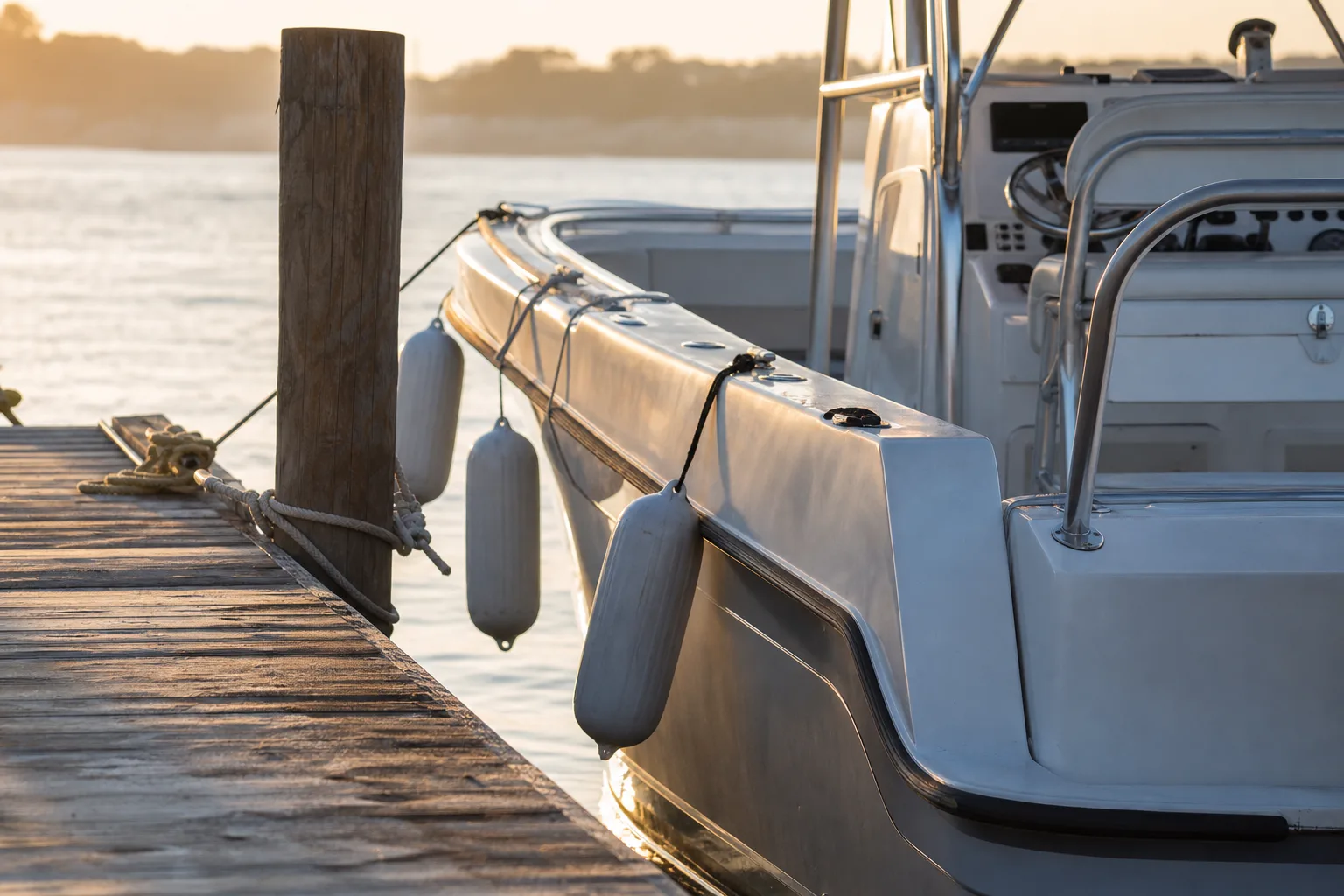
Boat fenders are cushions that hang between your hull and a dock, piling or another boat so you do not scratch or dent the boat. Pick the type for how you dock, choose a size from the manufacturer's chart for your boat length, and hang them so the middle of the fender sits where the hull would touch, which depends on the dock and the tide. Tie them with a clove hitch or an adjustable knot to a solid fitting, not to something that can bend.
This guide covers the fender types, sizing rules that come from published sources, how to hang them at fixed and floating docks and how to tie them. There is no single legal standard for fender size, so treat charts as a starting point and adjust for your boat, dock and conditions.
Types of boat fenders
| Type | Shape | Best for |
|---|---|---|
| Cylindrical | Tube with an eye at one or both ends | The standard choice for hanging along the side; works at most docks |
| Round (ball) | Round or ball-shaped | Larger boats, rafting up and tight spots where the hull meets a corner or piling |
| Flat | Flat pad, often hung on its side | Boats with flat sides, such as pontoons, and docks where a roller fender would not fit |
| Center-hole (through-hole) | Cylinder with a hole through its length | Tying a line through to hold it at one angle; popular on larger boats and when used as a piling fender |
| Inflatable | Vinyl, inflated by air | Rafting and boats with limited storage; deflates for stowage |
Foam-filled fenders do not need air, so they do not deflate if punctured, while inflatable ones are lighter and pack smaller. Choose by how often you dock and how much storage you have.
What size fender do I need?
Manufacturers publish charts that match fender size to boat length. Polyform, which makes the common F and G series, says its chart is a general guide and the final choice is up to the owner, because local conditions and mooring setup matter. Its product listings show examples such as the G-4 for boats 20 to 25 feet, the F-1 for 20 to 25 feet, the F-5 for 30 to 40 feet and the F-8 for 50 to 70 feet.
A common retail rule of thumb is about one inch of fender diameter for every four to five feet of boat length for cylindrical fenders, with round fenders sized larger. One retailer's chart goes from 3 inches for a boat up to 10 feet to 12 inches for a boat of 50 to 60 feet, and suggests one size up for rough water or busy docks. That is a retailer guideline and not a regulation, so compare it with the manufacturer's chart for the model you want.
- Check the maker's chart for your exact fender model.
- Go bigger if you dock in current, wind or a lot of boat wake.
- Go bigger if the dock has rough pilings, cleats or other hard points.
- Heavier boats and boats with high sides need more fender.
How many fenders do you need?
There is no official count. One guide suggests about one fender per 10 feet of waterline length, with at least three on a boat of 20 feet or less. In practice, boaters carry enough to protect the widest part of the hull and both ends on the side that touches the dock, plus a spare for the other side or for a roller fender at a piling. If you dock on both sides depending on the day, carry enough for either side.
Hanging fenders: fixed docks and floating docks
The aim is for the fender to sit exactly where the hull and the dock would touch. The right height depends on the dock.
| Dock | What changes | What to do |
|---|---|---|
| Floating dock | The dock rises and falls with the water, so the height difference with your boat stays fairly steady | Hang fenders at a set height just above the waterline where the hull is widest |
| Fixed dock or piling | The dock does not move, but the water does, so the boat moves up and down against it | Check the tide before you leave the boat and adjust the fender height. Hang them lower on a falling tide if you will be gone for hours |
| Bulkhead or seawall | A flat wall where the hull rubs along it | Use cylindrical or flat fenders, with extra protection at hard points |
| Rafted boats | Two hulls move against one another | Use round or large cylindrical fenders on the outside boat as well |
Tide range decides how often you need to adjust a fender at a fixed dock. Where the range is large, a line that was correct at high tide may leave the fender hanging in air at low tide. Our guide to how the moon affects tides explains why the range varies, and you can check local times on Marinalo's Florida tide pages. For lines that allow for tide changes, see the "docking lines and tide range" section of our boating knots guide.
How to tie boat fenders
A fender knot should hold in a wave, and let you change the height. Common choices:
- Clove hitch. Quick to tie and easy to adjust. Add a half hitch to lock it if the line is slippery or the load can vary.
- Round turn and two half hitches. Holds well on a rail and does not slip.
- Adjustable fender hitches. Some boaters use a locking hitch that allows height changes without untying; any adjustable knot should be tested before you leave the dock.
Tie to a solid fitting, such as a rail or a cleat, rather than something that can bend or break under load. Check your boat's manual if you are not sure which fittings are suited for it. Use the right size of line for the fender eye and keep the tail short so it does not catch on the dock. Our boating knots guide shows how to tie each hitch step by step.
Care and storage
- Pull fenders in when underway. Hanging fenders drag, scuff the hull and look careless.
- Rinse off salt and dirt; scuffs and green algae come off easier if you do not leave them.
- Store them dry and out of direct sun when you can.
- Check the eyes and lines for wear before every season.
- Inspect inflatables for slow leaks.
If you keep your boat at a marina, ask what dock type and piling setup you will have before you buy fenders. You can compare Texas and Florida marinas on Marinalo, including Florida slip prices for 40-foot boats. Boat type affects what you need, and our deck boat vs pontoon article covers hull shapes that suit flat fenders.
FAQ
What size fenders do I need for my boat?
Use the manufacturer's chart for your boat length. A common retailer rule is about one inch of fender diameter per four to five feet of boat length, going up a size for rough conditions.
How many fenders should I carry?
There is no official number. One guide suggests about one per 10 feet of waterline length and at least three for boats of 20 feet or under.
How high should I hang my fenders?
So the fender is centered on the point where the hull would touch the dock. At fixed docks, adjust for the tide.
What knot do you use to tie a fender?
A clove hitch, with a half hitch to lock it, or a round turn and two half hitches, tied to a solid fitting.
Do I need fenders on a floating dock?
Yes. The dock moves with the water, but boats still rub against it in wind and wake.