
Best Time to Fish: Tides, Moon and Solunar Tables Explained
Best time to fish: how a solunar table works, why the evidence is mixed, and how tide movement, light and temperature matter, with real Marinalo tide and solunar data.
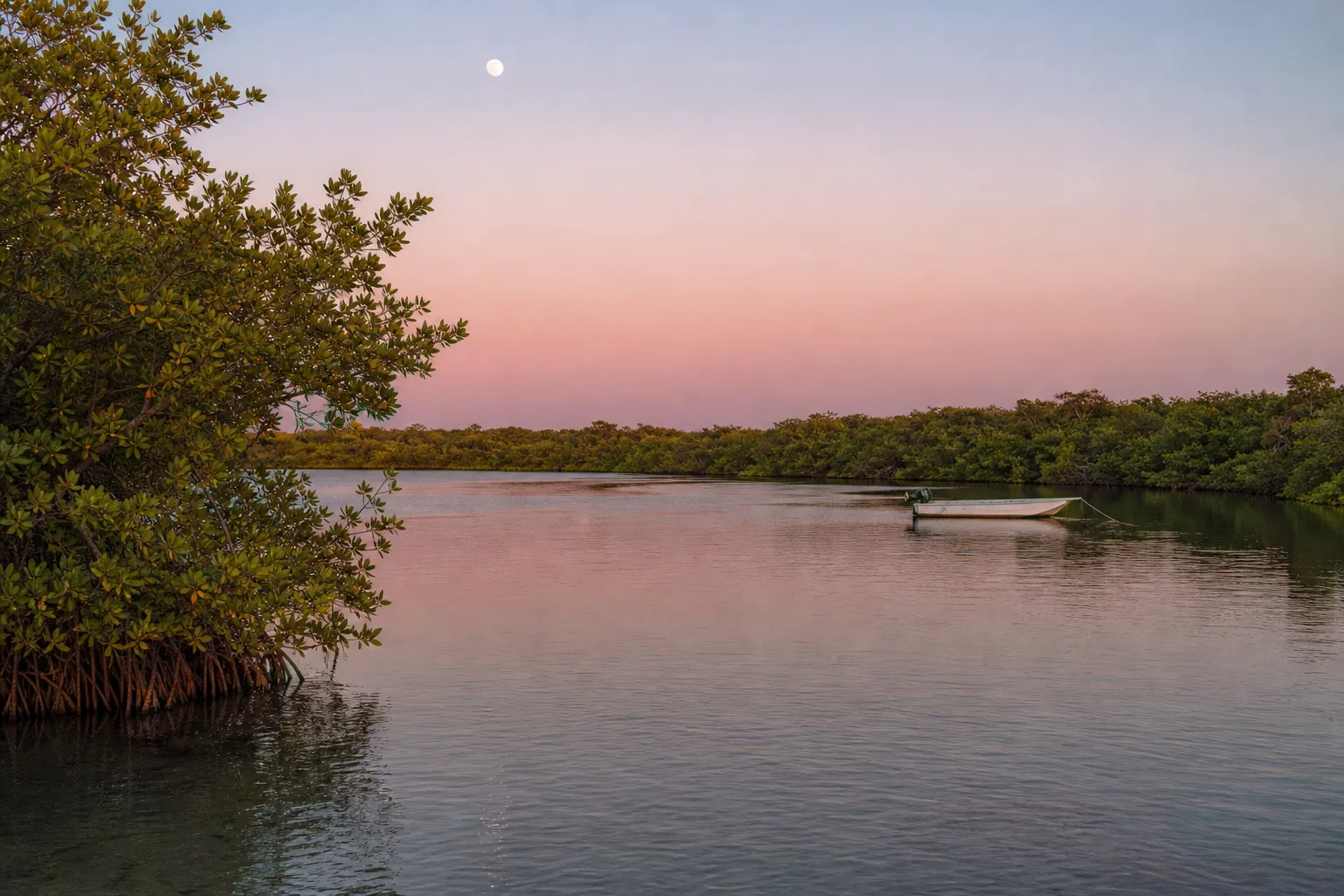
A solunar table lists the daily times when the moon is overhead, underfoot, rising or setting, and predicts that fish feed more at those times. The theory dates to 1926 and the evidence for it is mixed. In practice, the best time to fish is usually when a tide is moving, in low light around dawn and dusk, and at a water temperature the fish like. Use the solunar table as a tie-breaker, not as the plan.
What a solunar table is
A solunar table splits each day into feeding periods based on the moon's position. Sources describing the theory say it was developed by the American outdoor writer John Alden Knight, starting in 1926, and published in his book Moon Up, Moon Down. Under the theory there are four periods in a day: two major periods of about two hours, when the moon is overhead or underfoot, and two minor periods of about one hour, around moonrise and moonset.
Many fishing sites sell the idea as a fishing forecast, a fishing calendar or a list of the best fishing times today. Marinalo's tide pages include the same kind of data. Here is a real example from the Destin tide page for October 17, 2026 (Marinalo data, October 2026):
| Item | Destin, October 17, 2026 |
|---|---|
| Major periods | 4:50 AM to 6:50 AM and 5:15 PM to 7:15 PM |
| Minor periods | 12:42 PM to 1:42 PM and 10:50 PM to 11:50 PM |
| Moonrise and moonset | 1:12 PM and 11:20 PM |
| Moon | Waxing crescent, 41% |
| Tides | High 0.8 ft at 2:45 AM, low 0.1 ft at 3:01 PM |
The page also shows the next seven days, so you can scan the week for days when a major period lines up with a tide change.
Does the solunar theory work?
Honestly, the evidence is mixed. The theory is popular among anglers, but the sources I found were books and popular articles. I found no independent, peer-reviewed study that confirms it. Some famous support comes from Knight's own analysis of record catches and from an early mid-century experiment on oysters, both described only second-hand. A small, non-random sample of trophy fish does not prove a rule. Some anglers swear by the periods, and others see no pattern. Treat the claim as a hypothesis.
That does not mean the moon is irrelevant. The moon and sun drive the tides, and tides move water, bait and fish. That is the part you can plan around.
What matters more: tide movement
NOAA's tides education material says fishermen use their knowledge of tides and tidal currents to improve catches, that fish may concentrate on either ebb or flood currents depending on species and water depth, and that in some areas strong currents concentrate bait and smaller fish, which attracts larger fish. FWC's saltwater fishing tips add that on flats the incoming tide, starting several hours before high water, can be preferable because fish gather closer to shore, while outgoing water can work as schools are pushed off the flat toward deeper water. FWC's snook advice is to fish when there is current, preferably on the outgoing tide, and it says that on two-tide days the current is slow and the bite can be weak.
The lesson is that you need movement, and the best stage of the tide depends on the species and spot. Our guide to ebb, flood and slack tide explains the stages, and how to read a tide chart shows how to find them.
Other factors: light, temperature and weather
- Time of day. FWC lists time of day as one factor to weigh. Low light around sunrise and sunset is a traditional favorite, but some species differ. A UF/IFAS Extension page notes that mangrove snapper prefer to feed at night.
- Water temperature. FWC notes that cold water can make fish sluggish. In winter, midday can be better than dawn.
- Weather and wind. Wind and air pressure change water level and clarity. Check the forecast, and see our Beaufort scale guide to turn wind speed into sea state.
- Species and place. A snook bridge fish, a redfish on a flat and an offshore snapper do not follow the same clock.
I am not citing a measured percentage for any of these, because I did not find a reliable one. Use them as a checklist and keep your own log.
Moon phases and fishing
People often ask about the best moon phase for fishing, and especially about full moon fishing. The moon phase does matter for the tides: tidal range is larger near new and full moon and smaller near the quarters. Our guides to how the moon affects tides and spring and neap tides explain it. Bigger tidal range means more current, which can help, but strong current can also make fishing harder. Marinalo's Destin page, for instance, shows a neap tide from October 22 and a range of just 0.3 ft.
No official source I found says a particular phase is best. If you want to test moon phase fishing, fish similar tide stages at similar times across several phases and write down what you catch.
How to plan a trip with a Marinalo tide page
- Open the tide page for your town and note the high and low times.
- Note the tidal range. At Destin, Marinalo shows a range of 0.7 ft on October 17, so tide is a small factor and wind and pressure may matter more. At Hernando Beach the same day shows a range of 2.7 ft, from 0.5 ft to 3.2 ft, so there is a lot of moving water.
- Pick the stage you want, for example the last of the incoming tide for a flat, or the start of the outgoing tide for a pass.
- Check sunrise and sunset, which Marinalo shows for each day.
- Look at the solunar table. If a major or minor period overlaps your tide window, great. If not, go anyway.
- Check the marine forecast and your launch ramp before you leave. Use the Florida nearest ramp finder to see what is close.
For beach anglers, our surf fishing for beginners guide shows how tide stage affects surf spots. If you are fishing from a boat, read the local rules and licensing page for Florida fishing licenses.
A simple way to test it yourself
Keep a log with date, time, tide stage, wind, water temperature, moon phase and results. After a few months, check whether your good days line up with solunar periods, tide changes or both. That beats a general claim, including this one.
FAQ
What is the best time of day to fish?
Low light around sunrise and sunset is a common choice, but it depends on the species, season and tide. FWC says to weigh tide, moon, time of day and water temperature together.
What is a solunar table?
It is a daily schedule of predicted feeding periods based on the moon's position: two major periods of about two hours and two minor periods of about one hour.
Does a full moon help fishing?
A full moon brings larger tidal range, which means more current. Whether fish bite better is not confirmed by the sources I found, so test it yourself.
Who invented solunar tables?
John Alden Knight developed the solunar theory beginning in 1926, according to published accounts of his work.
What is the best tide to fish?
Moving water is generally better than slack. The best stage, incoming or outgoing, depends on species and place.
Sources
- Marinalo data, October 2026: Destin tides and solunar periods, Hernando Beach tides
- NOAA National Ocean Service, The Importance of Monitoring the Tides and Their Currents
- FWC, Saltwater Fishing Tips
- FWC, A Sketch of the Common Snook in Florida
- UF/IFAS Extension Pasco County, Gulf Coast Catch and Cook: Mangrove Snapper
- Fishing Reminder, Review of Moon Up, Moon Down by John Alden Knight