
What Is a Marine Layer? Coastal Fog Explained for Boaters
A marine layer is cool, moist air trapped under warmer air above the ocean, often bringing low cloud and fog. Here is how it forms and how to boat safely in it.
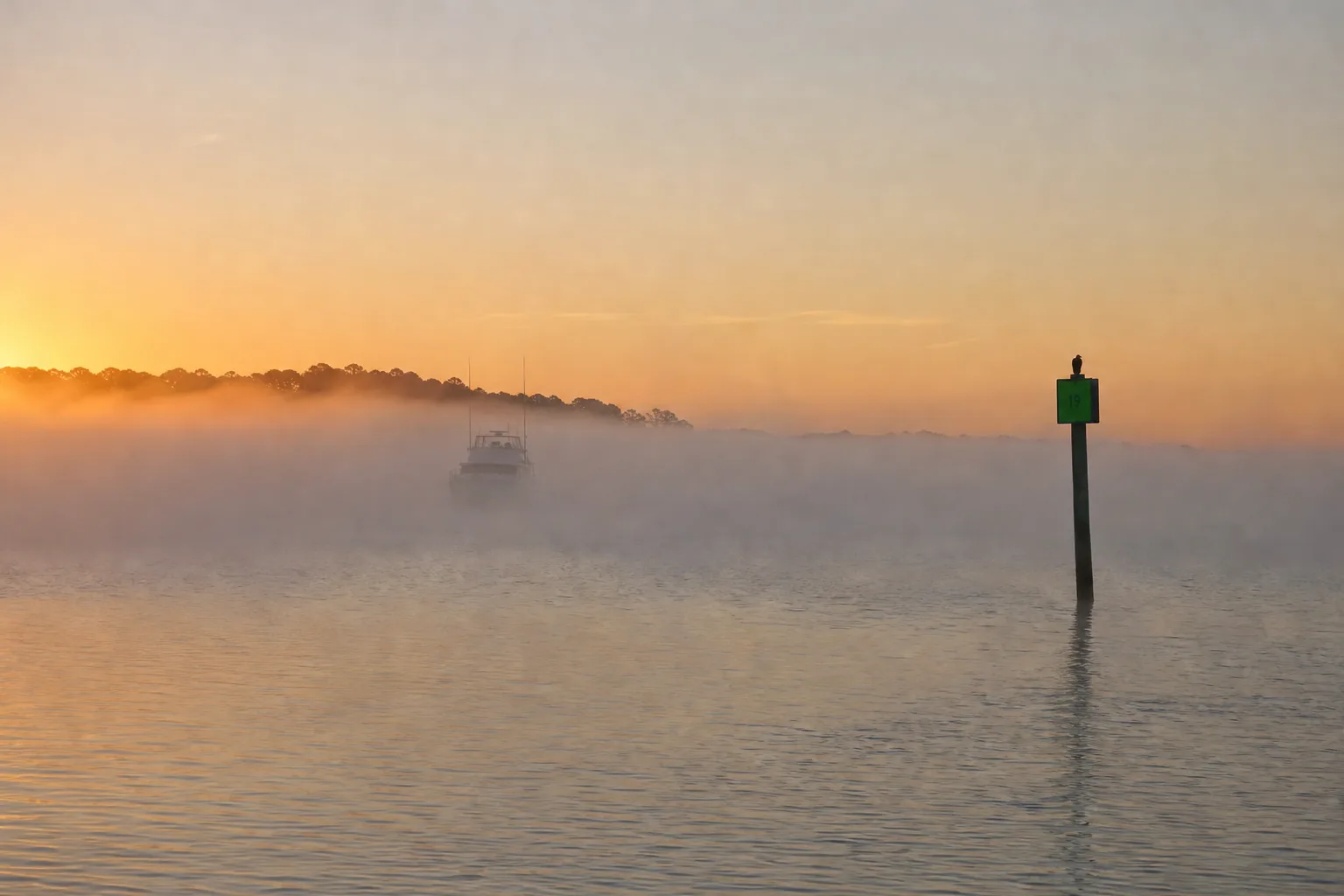
A marine layer is a shallow layer of cool, moist air that sits close to the ocean surface, trapped beneath warmer air above it. When that cool air cools enough, it produces low clouds or fog over the water and along the coast. For boaters, the practical takeaway is simple: a marine layer can cut visibility quickly, so know the forecast, slow down and be ready to make the right sound signals.
What a marine layer is
The National Weather Service JetStream online school explains the marine layer as cool, moist air near the surface that is trapped beneath warmer air. Normally the air gets colder as you go up. In a temperature inversion, the opposite happens: warmer, less dense air sits on top of colder air near the water. Because the cold layer is the heavier one, it does not mix upward, and the layers stay stacked.
The air beneath the inversion can cool to the point where clouds or fog form low to the surface. The depth of the marine layer depends on the larger weather pattern overhead. JetStream notes that when the downward force of the air above is very strong, the marine layer will be very shallow.
Where marine layers are common
The US West Coast
The classic example is California. According to NWS JetStream, cold water flowing south from the Gulf of Alaska cools the air above it, and the water off California can be as much as 30°F (17°C) colder than water at the same latitude on the East Coast. The West Coast marine layer can persist for days or weeks because of the temperature inversion. In Southern California, the persistent layer of low cloud even has nicknames: "May Gray" and "June Gloom."
Gulf Coast sea fog
Florida and Texas boaters will recognize a related pattern. On the northern Gulf, National Hurricane Center offshore forecasts regularly describe dense sea fog when moist southerly flow moves over cooler shelf waters. A forecast from February 2021, for example, said that this flow was allowing dense fog to set up near shore along the coast of Texas and southwest Louisiana. Other NHC offshore forecasts from the Gulf in February and March describe areas of dense sea fog with visibility below 1 nautical mile, in some cases reaching tens of miles from the coast. So on the Gulf, fog is not just a West Coast story, and it tends to show up when warm, moist air is pushed over cooler water.
That is often called advection fog, meaning fog formed when moist air moves horizontally over a cooler surface. The ingredients are the same ones that make a marine layer: warm moist air, cool water, and little mixing.
How fog and a marine layer affect boating
| Effect | What it means on the water |
|---|---|
| Reduced visibility | You may not see channel markers, other boats, crab-trap floats or the shoreline until you are close. Dense fog can come in fast and last for hours. |
| Distorted sound | Horns and engines can seem to come from the wrong direction. Listen as well as look. |
| Wet decks and lenses | Moisture on windshields, binoculars and electronics makes everything harder to read. |
| Fewer clear references | With no horizon, it is easy to lose track of position. A chartplotter or phone GPS helps, but it does not show unlit boats or floating hazards. |
Sound signals in restricted visibility
Fog is "restricted visibility" under the Navigation Rules. The Inland Rules (33 CFR 83.35, Rule 35) set the sound signals a vessel makes in or near an area of restricted visibility, by day or night:
| Situation | Signal | How often |
|---|---|---|
| Power-driven vessel making way through the water | One prolonged blast | At intervals of not more than 2 minutes |
| Power-driven vessel underway but stopped, making no way | Two prolonged blasts in succession, about 2 seconds apart | At intervals of not more than 2 minutes |
| Sailing vessel, vessel not under command, vessel restricted in its ability to maneuver, vessel fishing, or vessel towing or pushing | One prolonged blast followed by two short blasts | At intervals of not more than 2 minutes |
| Vessel at anchor | Ring the bell rapidly for about 5 seconds | At intervals of not more than 1 minute |
A prolonged blast is a blast of about 4 to 6 seconds in the Navigation Rules; a short blast is about 1 second. Many small boats carry an air horn or whistle for this reason. The rules also require every vessel to proceed at a safe speed in restricted visibility, so slow down enough that you can stop in the distance you can see. Check the official text of the rules, or your state boating course, for the full list of signals.
Staying safe when fog rolls in
- Check the marine forecast before you leave. The NWS marine forecast and NHC offshore forecasts mention dense fog and expected visibility.
- Slow down. Speed gives you less time to react. A safe speed in fog is one that lets you stop within the distance you can see.
- Use radar if you have it. Radar sees boats and markers that you cannot, but small craft and floating debris can still be missed. Use it as an aid, not a replacement for a lookout.
- Post a lookout and listen. Shut off music and, if safe, idle down briefly to listen for horns and engines.
- Turn on your navigation lights and make the required sound signals.
- Know where you are. Mark your position on a chart or chartplotter. Stay out of shipping channels if you can; large vessels need far more room to stop.
- Consider anchoring or waiting at the dock. If the fog is thick and you are not sure of your position, it is often safest to get out of the channel and wait.
- Wear life jackets. See our guide to Coast Guard approved life jackets.
Weather service fog messages commonly advise inexperienced mariners in small vessels to stay off the water in dense fog.
What a dense fog advisory means
A Dense Fog Advisory is issued by a local NWS office when widespread dense fog develops and visibility drops to levels that make travel hazardous. Marine dense fog products from NHC describe visibility of less than 1 nautical mile. Exact criteria vary by NWS office, so read the text of the advisory for your area. Fog advisories are a different product from wind-driven alerts; see our explainer on special marine warnings and small craft advisories.
Plan around the weather and the water
Fog and tides interact. A falling tide can strand you on a sandbar when you cannot see the channel markers, and strong currents push you off course while you are slow and cautious. Check the Key West tide chart or any place page in the Marinalo tide tables before heading out, and learn how currents differ from tide height in our guide to ebb, flood and slack tide. If you are launching from a ramp, the Marinalo directory of Florida boat ramps and Texas boat ramps lists ramps near you; a calm morning with fog can become a clear afternoon, so waiting an hour or two is often the best choice.
FAQ
Is a marine layer the same as fog?
Not exactly. The marine layer is the cool, moist air mass trapped under warmer air. Fog or low clouds form when that layer cools enough. You can have a marine layer without fog, but fog often forms within it.
What is a temperature inversion?
A temperature inversion is a layer where air gets warmer with height instead of colder. It acts like a lid and keeps cool, moist air close to the surface.
When is the marine layer worst?
On the West Coast, it is most noticeable in late spring and early summer, hence "May Gray" and "June Gloom." On the northern Gulf, NHC forecasts describe dense sea fog most often in the cooler months, when warm moist air moves over colder water.
What sound signal should I make in fog?
A power-driven vessel making way sounds one prolonged blast at least every 2 minutes. If underway but stopped, it sounds two prolonged blasts about 2 seconds apart, at least every 2 minutes. A vessel at anchor rings a bell rapidly for about 5 seconds at least every minute.
Should I go out in dense fog?
If you can wait, wait. If you must go, slow down, use lights, radar and sound signals, and stay out of shipping channels. Inexperienced boaters in small boats should avoid dense fog.