
Lake Fork Boating and Bass Fishing Guide
Lake Fork in East Texas is a trophy bass lake with a 16-24 inch slot limit. See ramps, level (80.6% full Oct. 17, 2026), timber hazards and marinas in Alba and Yantis.
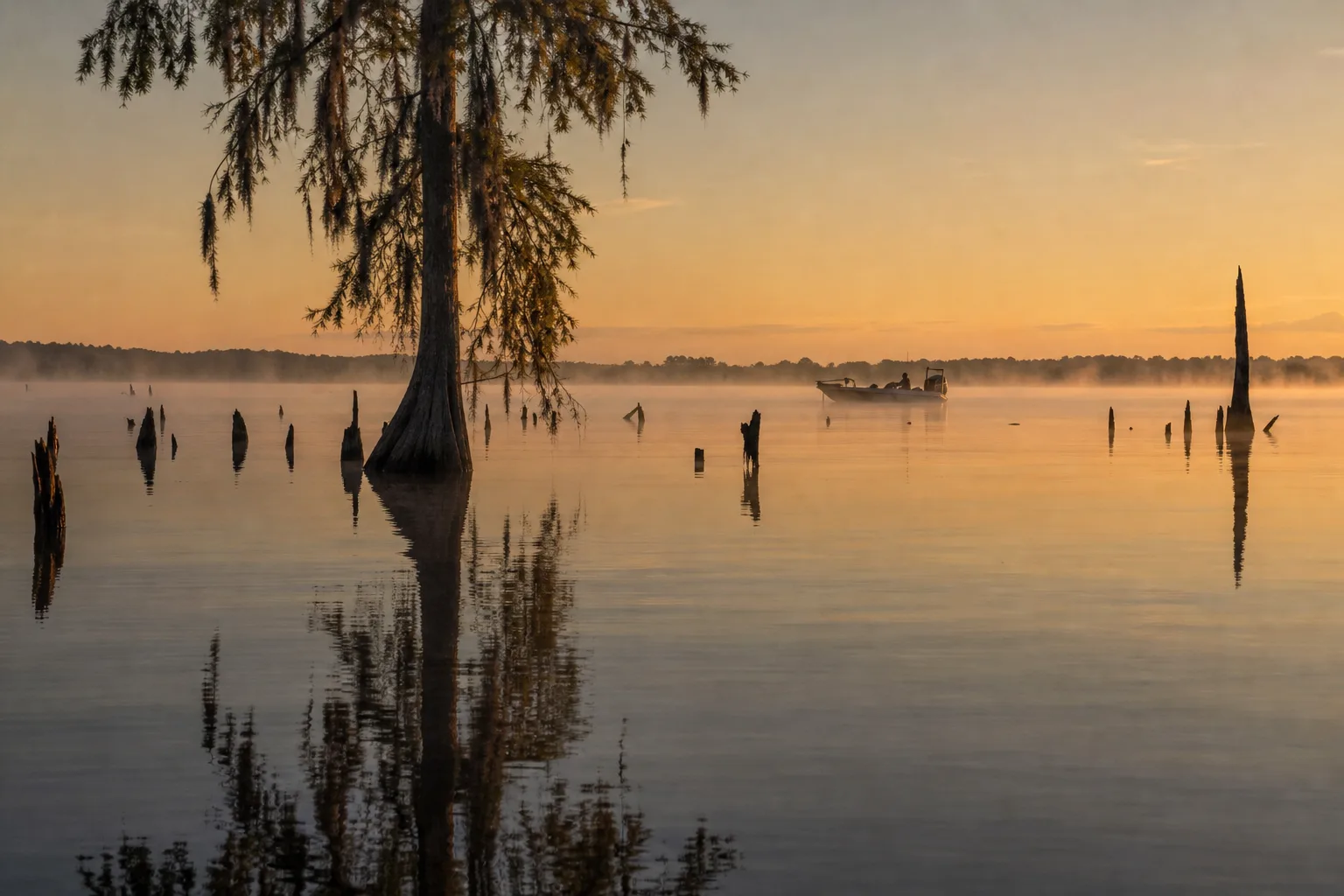
Lake Fork is a 27,264-acre reservoir on the Sabine River in northeast Texas, managed by the Sabine River Authority of Texas and famous for trophy largemouth bass. For largemouth, Texas Parks and Wildlife Department (TPWD) sets a 16-24 inch slot: you may keep bass 16 inches or shorter, or 24 inches or longer, but only one fish of 24 inches or more per day. On October 17, 2026 the lake was 80.6% full at 398.3 feet (Marinalo data, October 2026).
This guide covers the lake's basics, the public ramps, the marinas Marinalo lists, the timber you need to respect, TPWD's current fishing rules and the seasons that anglers fish.
Lake Fork at a glance
| Item | What TPWD and Marinalo say |
|---|---|
| Location | On the Sabine River in Hopkins, Rains and Wood counties, about 5 miles northwest of Quitman (TPWD) |
| Surface area | 27,264 acres (TPWD) |
| Maximum depth | 70 feet (TPWD) |
| Impounded | 1980 (TPWD) |
| Controlling authority | Sabine River Authority of Texas, Quitman, (903) 878-2262 (TPWD) |
| Conservation pool | 403 feet above mean sea level (TPWD) |
| Normal fluctuation | Moderate, 2 to 4 feet (TPWD) |
| Level on Oct. 17, 2026 | 398.3 feet, 80.6% full (Marinalo data from TWDB readings) |
| Public ramps in the TPWD inventory | 26 (Marinalo data, October 2026) |
| Clarity | Moderately clear (TPWD) |
The level on that day was 4.7 feet below the 403-foot conservation pool, which is more than the "normal" 2-4 foot fluctuation TPWD describes. When the lake is low, shallow timber and stumps that sit safely under water in a full lake can be just below the surface or visible.
Public boat ramps
Marinalo's Lake Fork page lists 26 open ramps and launches from the TPWD public boat ramp inventory. Each links to its own page. Marinalo does not show trailer-space counts for this lake, so check the ramp page and call the Sabine River Authority if you need to confirm that a ramp is usable at the current level. TPWD also keeps a statewide boat ramp closure page, linked from its Lake Fork page, where low water closures are posted.
For other Texas lakes, browse the Texas boat ramps hub.
Timber, boat lanes and vegetation
Lake Fork was impounded in 1980 and still has standing timber. TPWD's statement is clear: access through the reservoir is provided by numerous buoyed boat lanes, but submerged timber represents a substantial hazard, so care should be exercised while boating in all areas. In practice:
- Stay in the marked boat lanes when you run at speed, especially at dawn, dusk and in poor light.
- Slow down when you leave a lane. A stump that you cannot see can damage a lower unit or hull.
- Study the lake map. TPWD says a small map is available free from the Sabine River Authority.
- Watch the level. A lower pool means timber is closer to the surface.
- Expect vegetation. TPWD lists hydrilla, Eurasian milfoil, coontail, American lotus, water primrose, water hyacinth, alligatorweed and pennywort, and notes hydrilla often holds bass.
Shallow-draft boats are common on timber-filled lakes. If you are weighing hull types, the Logbook explains jon boats and the differences between a skiff, bay boat and flats boat, which are built for shallow water but mostly used on the coast.
Trophy bass rules (check TPWD before you fish)
TPWD lists these Lake Fork rules on its official regulations page. Rules change, so confirm on the TPWD Lake Fork regulations page or the Outdoor Annual app before you go.
| Species | Rule listed by TPWD |
|---|---|
| Largemouth bass | 16-24 inch slot. Fish 16 inches or less, or 24 inches or longer, may be kept; only one 24-inch-or-longer largemouth per day |
| All black bass | Daily bag limit of 5 in any combination |
| Smallmouth bass (if present) | 14-inch minimum |
| Channel and blue catfish | 25 in any combination; only 10 can be 20 inches or longer |
| Flathead catfish | 18-inch minimum, bag limit 5 |
| Crappie | Dec. 1 through the last day of February: no minimum length, all crappie caught must be kept. March through November: 10-inch minimum. Bag limit 25 year-round |
| White bass | 10-inch minimum, bag 25 |
| Alligator gar | Bag limit 1; harvest must be reported within 24 hours |
The same page reminds boaters that, to help stop zebra mussels, Texas law requires you to drain water from your boat and onboard receptacles when leaving or approaching public fresh water. You need a Texas fishing license unless an exemption applies; check TPWD.
TPWD describes the combination of restrictive harvest rules, Florida-strain largemouth stocking and abundant habitat as a reason Lake Fork became one of the country's premier trophy bass lakes. It also states that more than 65% of the Texas Top 50 largest bass, including the current state record, and more than half of those entered in the Toyota ShareLunker Program, were caught from Lake Fork.
When to fish Lake Fork
According to TPWD, largemouth anglers are most successful in spring, fall and winter. Its tips and tactics page says:
- Spring (mid-February to April): fish are concentrated along the shoreline for spawning; spinnerbaits, plastic worms, jigs and lipless crankbaits are popular.
- Summer: night fishing can be productive and a way to beat the heat.
- Late summer and early fall: schooling fish respond to crankbaits and topwaters.
- Winter: jigging spoons, jigs and crankbaits are most productive.
Crappie anglers fish deep water near the dam in winter and under the Highway 154, Highway 515, CR 2946 and CR 514 bridges in late spring and early fall, per TPWD. Our best time to fish guide covers timing in general.
Fishing beyond bass
Largemouth get the headlines, but TPWD's lake page lists several other fisheries. Crappie fishing is generally good, especially in standing timber and under the lake's bridges. Channel catfish provide an excellent sport fishery, and the catfish population also includes flathead and a few large blue cats. White bass can grow exceptionally large because of abundant prey, and yellow bass, called "barfish," are often caught in winter. Sunfish, mainly bluegill, are caught in spring and summer. TPWD also works with the Lake Fork Sportsman's Association to place man-made fish habitat structures, and it publishes a Habitat Structure Viewer with downloadable GPS coordinates.
Marinas and services
Marinalo's marina pages for two Lake Fork towns list:
As of October 2026, all three show "Rates on request" and Marinalo lists no fuel docks in these towns, so call to ask about slips, fuel and ramp fees. For wider Texas context, see the Texas fuel docks list.
Before you launch: a short checklist
- Check the lake level and any ramp closures.
- Print or download a lake map showing the buoyed boat lanes.
- Drain, clean and dry the boat to follow the zebra mussel rule.
- Check current TPWD size and bag limits.
- Bring a spare propeller and a basic repair kit; timber damages props.
FAQ
What is the bass limit at Lake Fork?
TPWD lists a 5-fish daily bag for black bass in any combination, a 16-24 inch slot for largemouth and a limit of one largemouth of 24 inches or longer per day.
Who controls Lake Fork?
The Sabine River Authority of Texas, according to TPWD.
How big is Lake Fork?
TPWD lists 27,264 acres, a maximum depth of 70 feet and a conservation pool elevation of 403 feet.
Is there a lot of timber in Lake Fork?
Yes. TPWD warns that submerged timber is a substantial hazard and recommends care in all areas, even though the lake has buoyed boat lanes.
How many public ramps does Lake Fork have?
Marinalo lists 26 open ramps and launches in the TPWD inventory (October 2026).
Do I need to drain my boat?
Yes. Texas law requires you to drain water from boats and onboard receptacles when leaving or approaching public fresh waters, per TPWD.
Sources
- Marinalo, Lake Fork boat ramps and level, data as of October 17, 2026 (TPWD ramp inventory, TWDB level).
- Marinalo marina pages for Alba and Yantis, October 2026.
- Texas Parks and Wildlife Department, Fishing Lake Fork.
- Texas Parks and Wildlife Department, Fishing Regulations for Lake Fork.