
VHF Marine Radio: Channels and How to Make a Call
Learn the main VHF marine radio channels (9, 16, 13, 22A, 68-72), whether you need a license, what MMSI and DSC are, and how to make a Mayday, Pan-Pan or radio check call.
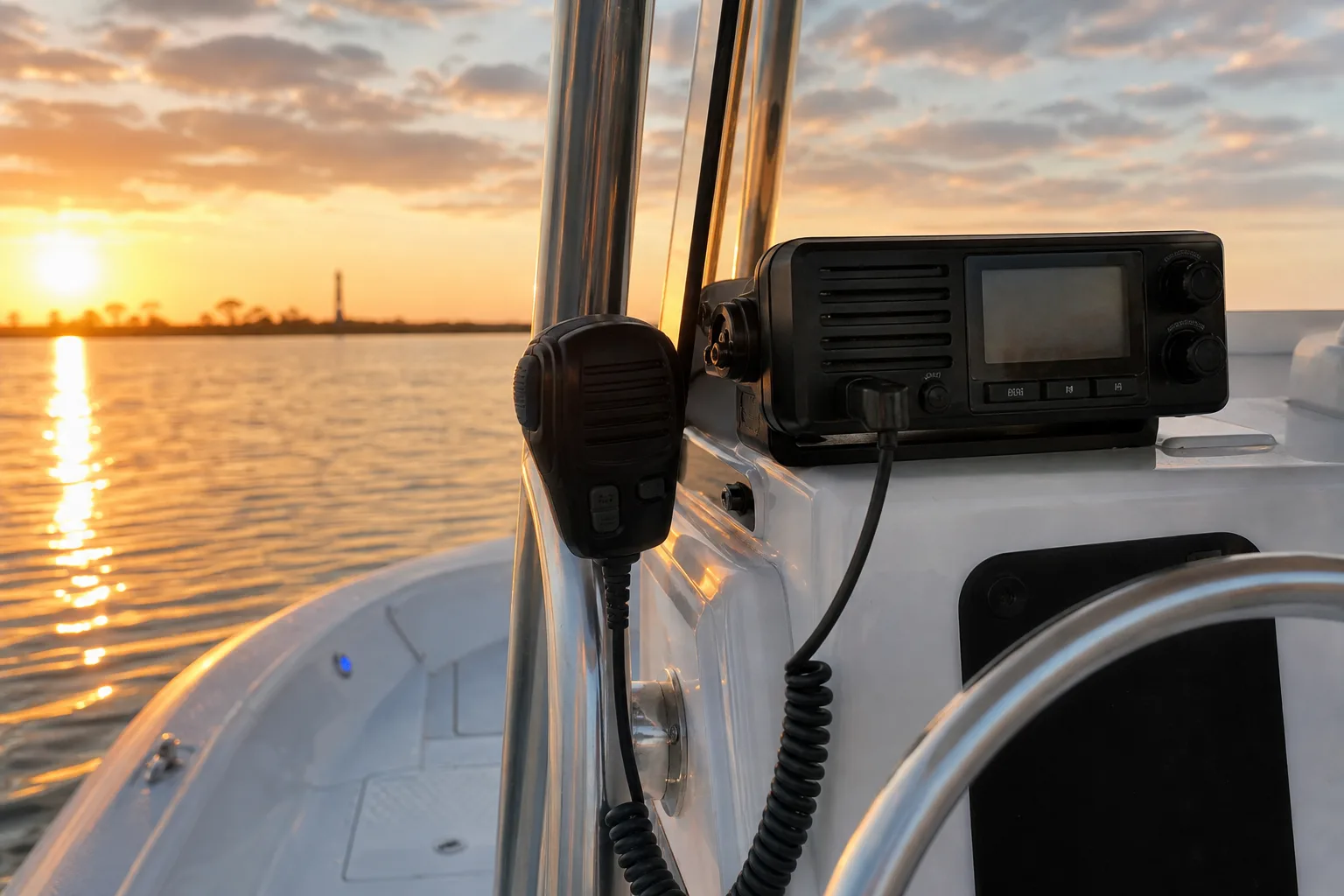
A VHF marine radio is the standard short-range radio for boats, and Channel 16 is its distress and safety channel, which you should monitor whenever the radio is on and you are not using it for something else. In US waters you do not need a license to use a VHF radio on a recreational boat. For everyday calls, use Channel 9, then move to a working channel such as 68, 69, 71 or 72.
Why a VHF radio matters
A VHF radio reaches the Coast Guard, nearby boats, bridge tenders and marina staff, and it is the main way to get help in an emergency on the water. A cell phone has gaps in coverage offshore and reaches only one person at a time; a VHF call goes out to every boat and station in range. Range is line of sight, so it is typically measured in miles, not hundreds of miles, and it depends on your antenna height and power. A fixed-mount radio with a masthead or high antenna reaches farther than a handheld.
Common VHF channels for recreational boaters
| Channel | Use |
|---|---|
| 16 | International distress, safety and calling channel. Distress (Mayday), urgency (Pan-Pan) and safety (Securite) calls start here. The Coast Guard monitors it and announces urgent broadcasts such as storm warnings on it. The FCC requires boats with a VHF radio to keep a watch on Channel 16 when the radio is not otherwise in use. |
| 9 | Recreational calling channel. Use it to reach other boats and marinas, then move quickly to a working channel. Channel 9 is also where Coast Guard guidance now asks you to request a radio check. |
| 13 | Bridge-to-bridge navigation safety. Used between vessels, for example to arrange a passing, and to request bridge openings. Use low power. |
| 22A | Coast Guard use only. If you reach the Coast Guard on 9 or 16, they may ask you to switch here. |
| 6 | Intership safety channel, listed by the Coast Guard Navigation Center as an intership safety channel. In some ports it is also used for port operations. |
| 68, 69, 71, 72, 78A | Working channels for non-commercial vessels, for ship-to-ship and ship-to-shore calls. After you make contact on 9, agree on one of these and switch. Channel 72 is intership only. |
| 70 | Digital Selective Calling (DSC) only. No voice traffic is allowed on this channel. |
| WX channels | Receive-only NOAA Weather Radio broadcasts, available on most marine VHF radios. See our guide to special marine warnings and small craft advisories for what the alerts mean. |
Channel use can vary by area and by the type of vessel, and some channels are reserved for commercial traffic. For the full, current US channel list, see the US VHF channel information page of the US Coast Guard Navigation Center, linked in the sources.
Do you need a license?
For recreational boats traveling within the United States, no FCC ship station license is needed to own and use a VHF marine radio, and the Coast Guard Navigation Center points out that the Telecommunications Act of 1996 allows recreational boaters to use a VHF marine radio, EPIRB and marine radar without one. The rules change if you:
- Travel to a foreign port, such as the Bahamas or Canada. You then need an FCC ship station license, and a Restricted Radiotelephone Operator Permit for the operator.
- Use HF single sideband or a marine satellite terminal.
- Operate a vessel that is required to carry a radio (some commercial and larger vessels).
Boat registration and state licensing are separate topics. See Marinalo's Florida boating license and registration guide and our article on whether you need a license to drive a boat.
MMSI and DSC: the distress button
Most newer VHF radios have Digital Selective Calling (DSC). When you press the red distress button, DSC sends an automatic digital alert on Channel 70 to the Coast Guard and to nearby DSC-equipped vessels, with your boat's identity and, if the radio is connected to a GPS, your position.
To make DSC work, you need a nine-digit Maritime Mobile Service Identity (MMSI) number, programmed into your radio before you transmit. Connecticut DEEP notes that you can get an MMSI free from organizations such as BoatUS, Sea Tow or the US Power Squadrons; the FCC and the Coast Guard list the same private registrants. An MMSI from one of these groups is for domestic use. If you plan to go abroad, you need an FCC ship station license and the MMSI that comes with it, so you will need to reprogram your radio.
Connect the radio to your GPS: without a position fix, a DSC alert tells rescuers who you are but not where. If you have a fixed-mount radio, keep it powered by a healthy battery; see our guide to marine batteries.
How to make a call
A routine call
- Turn on the radio, set it to high power for the first call (low power for close ranges) and turn the squelch up until the static just disappears.
- Listen first. Do not interrupt other traffic.
- Call on Channel 9: say the name of the boat or station you are calling, then "this is" and your boat name. For example: "Marina office, marina office, this is Sea Breeze, Sea Breeze, channel 9."
- When they answer, propose a working channel: "Switch to 68."
- Both boats switch and talk. Keep it short. When finished, say your boat name and "out," and return to Channel 16 or 9.
Radio check
Do not use Channel 16 for a radio check. Try Channel 9 or a working channel and ask a nearby boat or marina for a check. Keep it to one request, and do not repeat it over and over. The Coast Guard has asked boaters to use Channel 9 instead of 16 for routine checks.
Mayday, Pan-Pan and Securite
| Call | When to use it |
|---|---|
| MAYDAY | Distress: imminent danger of sinking or major injury or death. |
| PAN-PAN | Urgency: a potentially dangerous situation where a vessel or person's safety is at risk, but not immediate danger. |
| SECURITE | Safety: important navigation or weather information, such as a submerged log. The word is pronounced like the French "securite," see-cure-ee-TAY. |
The Mayday script
If you have a DSC radio, press and hold the distress button first. Then tune to Channel 16 and transmit, in this order:
- "MAYDAY, MAYDAY, MAYDAY."
- "THIS IS" and the boat name, three times.
- Your position: latitude and longitude, or a bearing and distance from a known landmark.
- The nature of the distress (for example: sinking, fire, man overboard).
- The number of people aboard.
- The assistance you need.
- Useful details: boat length, hull and cabin colors, any injuries.
- "OVER."
Repeat at intervals until someone answers, and stay by the radio. A Pan-Pan call follows the same pattern, starting with "PAN-PAN" said three times, and a Securite call starts with "SECURITE" said three times, followed by the information.
Radio etiquette
- Listen before you transmit.
- Keep calls short; Channel 16 and Channel 9 are for contact, not conversation.
- No profanity, no music, and never a false distress call, which is illegal.
- Use low power for short-range calls so you do not block other users.
- Stay off Channel 16 for chatter and radio checks.
- Check your radio and antenna before the season; a radio you have not tested is not a safety tool.
Before you head out, check weather on the WX channels, and if you are going to a fuel dock or marina, see the Marinalo directory of Florida fuel docks and Texas fuel docks; ask the dock which channel it monitors before you arrive.
FAQ
What channel is used to call the Coast Guard?
Channel 16 for distress, urgency and safety. For a routine radio check, use Channel 9. The Coast Guard may move you to Channel 22A.
Do I need a license for a VHF radio on a recreational boat?
Not for domestic use in US waters. You need an FCC ship station license if you travel to a foreign port, use HF or satellite equipment, or operate a vessel that must carry a radio.
What is an MMSI?
A nine-digit Maritime Mobile Service Identity: a digital address for your boat. It must be programmed into a DSC radio before you transmit, so that your distress alert carries your identity.
What does DSC do?
Digital Selective Calling sends an automatic digital distress alert on Channel 70 to the Coast Guard and nearby DSC radios. It works only with an MMSI programmed in, and shows your position only if the radio has a GPS feed.
What is the difference between Mayday and Pan-Pan?
Mayday is for immediate danger to life or the vessel. Pan-Pan is for urgent situations where safety is at risk but the danger is not yet immediate.
Can I use a handheld VHF?
Yes, the same rules apply. A handheld has lower power and range than a fixed-mount radio, but it can be a useful backup, especially if it is waterproof and floats.