
Starting vs House Marine Batteries: What to Check Before Replacing One
Published · By Marinalo
Review scope · 2026-11-09
Independent AI documentary and editorial review: starting versus deep-cycle distinction, capacity-rating limits, engine-specific requirements and reserve capacity, checked against Trojan, Victron and Mercury Marine official material on November 9, 2026. No product-specific suitability approval, physical testing or human marine expertise.
Separate engine starting, house loads and trolling-motor requirements. Use a model-by-model checklist instead of relying on a marine label or amp-hour rating.
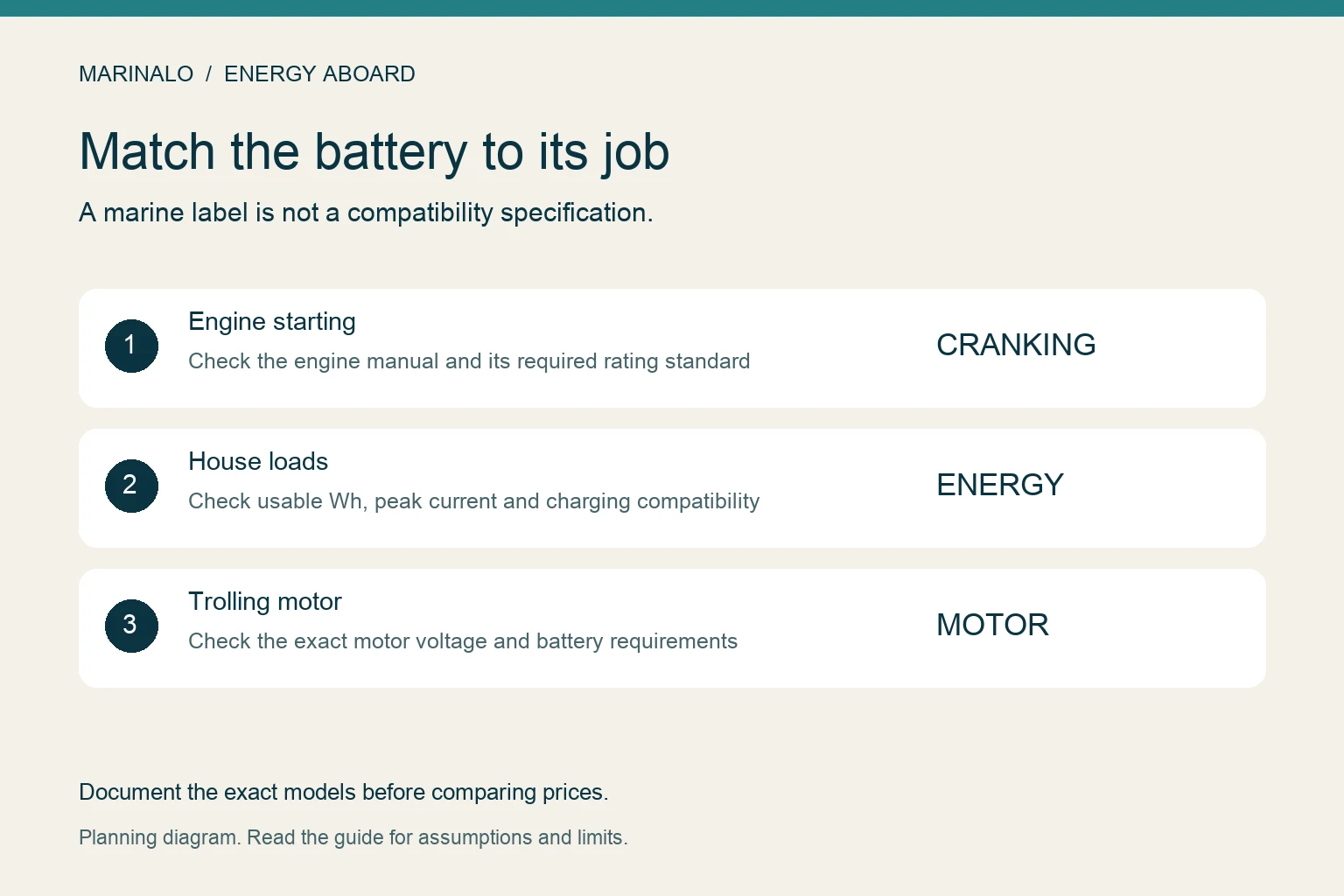
The word “marine” does not specify what a battery can safely power. Before comparing prices, identify the job of the battery you are replacing, the engine or equipment requirements and the way it is charged. This guide is a documentary buying checklist, not a hands-on product test or a wiring procedure.
Three jobs that need different checks
| Use | Primary question | What to record |
|---|---|---|
| Engine starting | Does the exact battery meet the engine maker's requirements? | Required voltage, specified cranking rating and test standard, minimum reserve capacity where required, permitted technology, terminal layout. |
| House loads | Can the bank supply the planned energy and peak loads between charging opportunities? | Nominal Wh, permitted operating window, continuous and surge discharge limits, charging compatibility. |
| Trolling motor | Does the supply match the exact motor and installation requirements? | Motor voltage and current requirements, battery compatibility, manufacturer-approved bank arrangements. |
Trojan distinguishes starting designs intended for brief high-current demand from deep-cycle designs intended for repeated energy delivery. It describes dual-purpose batteries as a compromise between those functions. That distinction is useful, but the label does not replace the specifications of an individual product.
Do not compare unlike ratings
Amp-hours describe capacity under specified test conditions; they are not a measure of cranking performance. Record the discharge duration and temperature behind a capacity claim. For an engine battery, use the cranking rating and test standard requested in the engine manual. Do not treat values labeled CCA (cold cranking amps) and MCA (marine cranking amps) as interchangeable numbers or apply a guessed conversion. Also check any minimum reserve-capacity requirement in the engine manual; a sufficient cranking rating alone may not meet all its requirements.
For house batteries, compare nominal watt-hours when voltages differ. A hypothetical 12 V, 100 Ah battery represents about 1,200 Wh nominal; a 12.8 V, 100 Ah battery represents about 1,280 Wh. This does not establish their usable energy, suitability or value. Those depend on permitted discharge, actual load, conditions and the rest of the system.
Make a replacement record before shopping
- Photograph the existing model label and record the engine or motor model.
- Record the compartment dimensions, battery weight allowance, terminal positions and securing arrangement.
- List every charging source: shore charger, alternator, solar controller and any DC-to-DC charger.
- Record the existing nominal bank voltage and ask an installer to confirm the arrangement if unclear.
- Download the proposed battery's manual, not only the retailer's summary.
Do not disconnect or modify a battery bank merely to complete this record. If a label or connection cannot be inspected safely, leave the field unknown and ask the person servicing the boat.
Compare the whole replacement cost
Use separate columns for battery price, required charger changes, monitoring, installation, disposal and delivery. A lower-priced battery is not a lower-cost solution if it requires equipment changes that the other option does not. Keep warranty duration separate from warranty coverage: read the permitted applications and exclusions rather than treating a long headline term as an assurance for your boat.
An example shortlist might contain one battery explicitly approved for the engine and another with more amp-hours but no documented starting approval. The second option is not a valid starting replacement until its suitability is confirmed, regardless of its capacity or commission rate. For house duty, a different shortlist may be appropriate.
Questions to send before buying
“Is model X suitable for engine or motor Y, with charger Z? Please point me to the relevant manual sections. What changes are required, and what use would fall outside the warranty?” Keep the reply with the product documentation. A missing answer should remain an unresolved requirement, not become a green check mark in a comparison.
Use our energy-budget worksheet for house consumption. If considering a chemistry change, use the lithium upgrade checklist before ordering.
Sources and limits
Source review: November 9, 2026. Trojan: selecting deep-cycle batteries explains the starting, deep-cycle and dual-purpose distinction. Its battery FAQs discuss capacity test rates. Victron: battery banks explains voltage and capacity in bank arrangements. Mercury Marine battery basics directs owners to the engine manual for battery type, MCA and minimum reserve capacity. These general references do not approve any battery for a particular engine or certify an installation.