
Lithium Boat Battery Upgrade: A Compatibility Checklist Before You Buy
Published · By Marinalo
Review scope · 2026-11-09
Independent AI documentary and editorial review: charging-source inventory, alternator protection, BMS behavior and product-specific temperature limits checked against Victron Lithium Smart design/installation and Wiring Unlimited material on November 9, 2026. Cost arithmetic is illustrative. No universal charging settings, physical testing, human marine expertise or installation certification.
Check charging sources, BMS behavior, temperature limits and total installed cost before replacing a boat house battery with LiFePO4.
A lithium house battery purchase changes more than a capacity figure. A suitable battery must work with the boat's charging sources, loads, protection and operating conditions. Use this checklist to collect the evidence for an installer and a supplier before committing to a purchase. It does not establish that a battery advertised as “drop-in” will work in your boat.
Define the scope of the change
Identify whether you are replacing the house bank, engine-start battery or trolling-motor supply. Do not assume that a lithium house battery is approved for starting an engine. Record the exact battery model, nominal bank voltage, intended bank arrangement and the equipment models connected to it. A product-family name is not enough when manuals differ between versions.
Check every charging source
| Source | Evidence to obtain |
|---|---|
| Shore charger or inverter/charger | Supported battery profile, adjustable settings, permitted current and any required BMS control. |
| Engine alternator | An installation design addressing current demand, alternator protection and behavior if the battery or BMS disconnects. |
| Solar controller | Supported charging profile, output limits and the required response to a BMS stop-charge signal. |
| DC-to-DC charger | Compatibility with source and destination systems, configured limits and control requirements. |
A “lithium” button is not proof that every required setting matches the battery manual. Compare actual settings and control requirements. Do not copy charging voltages from an unrelated battery model, and do not assume that adding a DC-to-DC charger by itself makes the entire system compatible.
Understand what the BMS controls
A battery management system monitors and protects the battery, but implementations differ. Some products include it internally; others require external equipment. Ask what happens when charging is prohibited or discharge is interrupted. Identify essential services that could lose power and how the designed system preserves them. BMS protection does not substitute for correctly designed cables, fuses, isolation and installation.
Read temperature limits for the exact model
Charging and discharging can have different permitted temperature ranges. Check how the battery measures temperature, how charging is blocked outside the permitted range and whether any heater has specific power or control requirements. Do not use a universal freezing-point rule in place of the manual: the permitted limits and protective behavior are product-specific.
Compare usable capacity and installed cost
First calculate your loads with the energy-budget worksheet. Then compare documented usable energy, continuous current and surge capability for the intended operating conditions. Keep cycle-life marketing claims tied to their test conditions; a cycle count is not a guaranteed number of years aboard your boat.
Request an itemized installed quote covering the battery, BMS where separate, charging changes, protection, monitoring, securing hardware, labor and commissioning. For illustration, a $700 battery plus $500 of required system changes costs $1,200 before any other charges; it cannot be compared fairly with a $900 quote that already includes those changes. These are arithmetic examples, not market prices.
A decision record with three outcomes
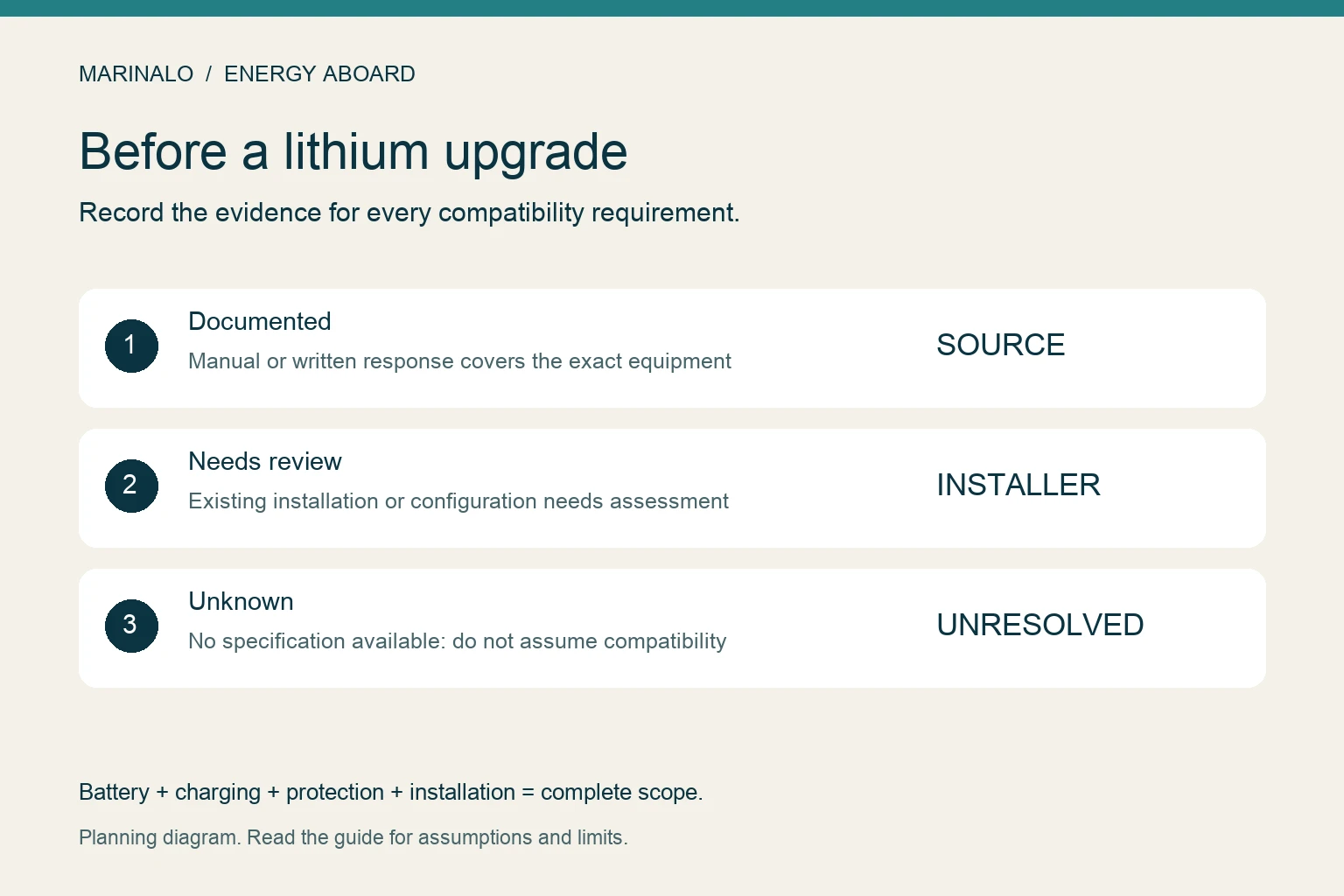
- Documented: a manual or written manufacturer response explicitly covers the requirement and exact models.
- Needs review: the requirement is understood but the installer must assess the existing boat or configure equipment.
- Unknown: no usable specification or response is available. Do not assume compatibility.
Save document versions and dates alongside the quote. Before commissioning, have a qualified marine electrician verify the installation against the equipment instructions and applicable marine requirements. Ask for a handover explaining normal operation, alarms, isolation and what to do when a protection event occurs.
Sources and limits
Source review: November 9, 2026. The Victron Lithium Smart system-design guide covers BMS selection and alternator charging for that product family. Its installation manual documents model-specific charging and temperature controls. Wiring Unlimited: DC wiring discusses cables and protection. They illustrate the questions that need answers; their settings are not universal instructions for other brands. This article is documentary guidance, with no physical product testing or installation certification.