
Boat Battery Sizing: Build an Energy Budget Before Buying
Published · By Marinalo
Review scope · 2026-11-09
Independent AI documentary and editorial review: checked illustrative arithmetic, explicit fully charged departure/no-charge assumption, usable capacity versus nominal energy, losses and power limits. EIA, Victron electrical theory and Trojan capacity-rate/temperature references consulted on November 9, 2026. No physical testing, measured boat consumption, human marine expertise or installation certification.
Work through an illustrative boat energy budget in watt-hours, account for inverter losses and compare usable battery capacity without guessing your daily consumption.
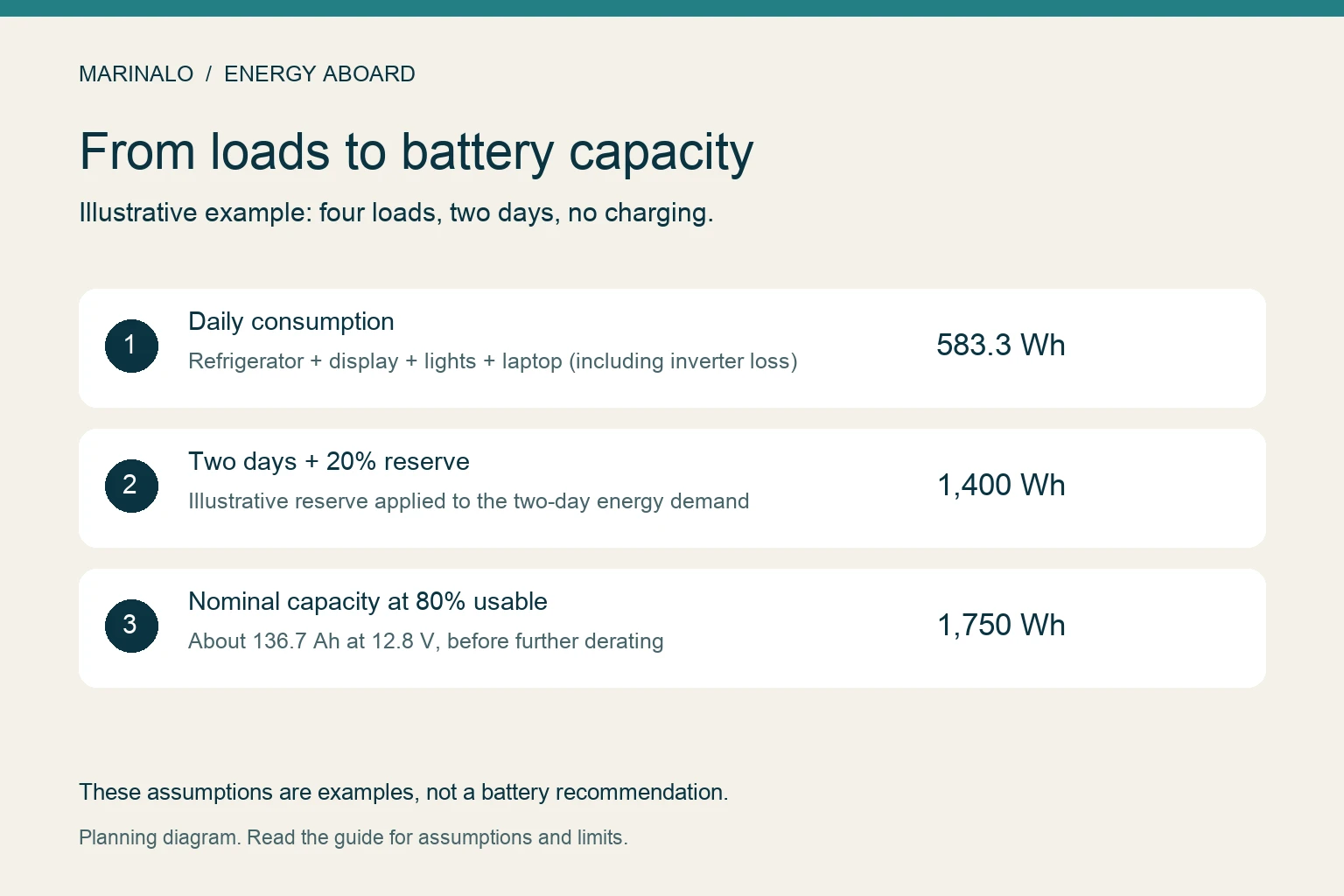
A battery shortlist should start with a trip plan and a list of electrical loads. A boat length or a number of passengers cannot tell you how long a refrigerator, navigation display or inverter will run. This guide gives you a worksheet to fill with your own measurements; the numbers below are invented examples, not measurements from a boat or promises for a product.
1. Describe the time between reliable charging opportunities
Write down the longest interval you want to cover without dependable charging: an afternoon, an overnight stop or several days. List equipment that must remain available separately from optional loads. Keep engine-starting requirements separate from house consumption. Include overnight and unattended loads such as monitoring equipment and pumps, but do not assume an intermittent safety load will always run for its usual duration.
2. Convert each load to energy
Power in watts multiplied by operating hours gives energy in watt-hours: Wh = W × h. When a device gives DC current rather than power, an approximate calculation is W = V × A at the voltage where that current was measured. A maximum input rating is not necessarily average consumption. Measure a cycling appliance over a representative period or clearly label its assumed duty cycle.
| Illustrative load | Assumption | Energy per day |
|---|---|---|
| DC refrigerator | 40 W while running × 8 equivalent running hours | 320 Wh |
| Navigation display | 15 W × 6 hours | 90 Wh |
| Cabin lights | 10 W × 4 hours | 40 Wh |
| AC laptop through inverter | 60 W × 2 hours ÷ assumed 0.90 efficiency | 133.3 Wh from battery |
| Total of these four loads only | 320 + 90 + 40 + 133.3 | 583.3 Wh |
The refrigerator example assumes eight accumulated compressor-on hours over a day, not eight hours of refrigeration. Change it for your measured conditions. The inverter efficiency is an assumption, not a universal value; add its idle draw separately where relevant. Allow for wiring and any other conversion losses, or use measured consumption at the battery to include them without counting the same loss twice. This table omits pumps, communications and many other loads, so it is not a complete departure checklist.
3. Separate nominal capacity from usable capacity
A battery marked 12.8 V and 100 Ah has approximately 1,280 Wh of nominal energy. If, purely for planning, you choose to use 80% of that nominal energy, the allowance is 1,024 Wh before additional derating or reserve. The allowed operating window must come from the actual battery specifications and your operating policy; 80% is not a recommendation for every chemistry or product.
Assuming departure with a fully charged bank and no charging during the trip, the illustrative load list requires 1,166.7 Wh for two days (using unrounded values). Adding an explicitly chosen 20% planning reserve gives 1,400 Wh. At an assumed 80% usable fraction, that means 1,750 Wh nominal, or about 136.7 Ah at 12.8 V. This is a preliminary energy calculation, not a purchase size: aging, temperature, discharge rate, essential-load reserve and the real operating window still need assessment.
4. Check power as well as energy
A battery can have enough watt-hours and still be unsuitable for a load's continuous current or startup surge. Record the battery and BMS discharge limits, the inverter's input demand and the largest simultaneous loads. Do not infer engine-starting capability from amp-hours. Ask a qualified marine electrician to assess wiring, protection and the installed system rather than treating this worksheet as an installation design.
5. Treat charging as a separate budget
Keep an initial no-charge case. Then add only a documented charging scenario, with its duration and losses. A solar panel's rated watts are not guaranteed output throughout daylight; shade, orientation and conditions matter. Similarly, engine runtime alone does not establish how much energy reaches the house bank. Recording actual daily battery consumption and charging is more useful than repeatedly increasing an assumed capacity.
Your purchasing worksheet
- Loads, measured or estimated watts, hours and the reason for each assumption.
- Trip duration, essential-load reserve and expected charging interruptions.
- Nominal voltage, watt-hours, usable operating window and discharge limits.
- Battery dimensions, weight, environmental limits and compatible charging equipment.
- Unresolved questions to send to the manufacturer or installer before ordering.
Next read starting versus house batteries and the lithium upgrade checklist.
Sources and limits
Source review: November 9, 2026. Victron Wiring Unlimited: electrical theory supports the power relationships. The U.S. Energy Information Administration explains watt-hours as energy used over time. Trojan battery FAQs explain why lead-acid capacity depends on discharge rate and temperature. All worksheet loads, efficiency, reserve and usable-capacity percentages above are our stated illustrative assumptions. No equipment was physically tested for this guide.