
How to Back Up a Boat Trailer (Without the Stress)
How to back up a trailer: the hand-at-the-bottom-of-the-wheel method, mirror and spotter tips, empty-lot practice, and ramp etiquette so launching goes smoothly.
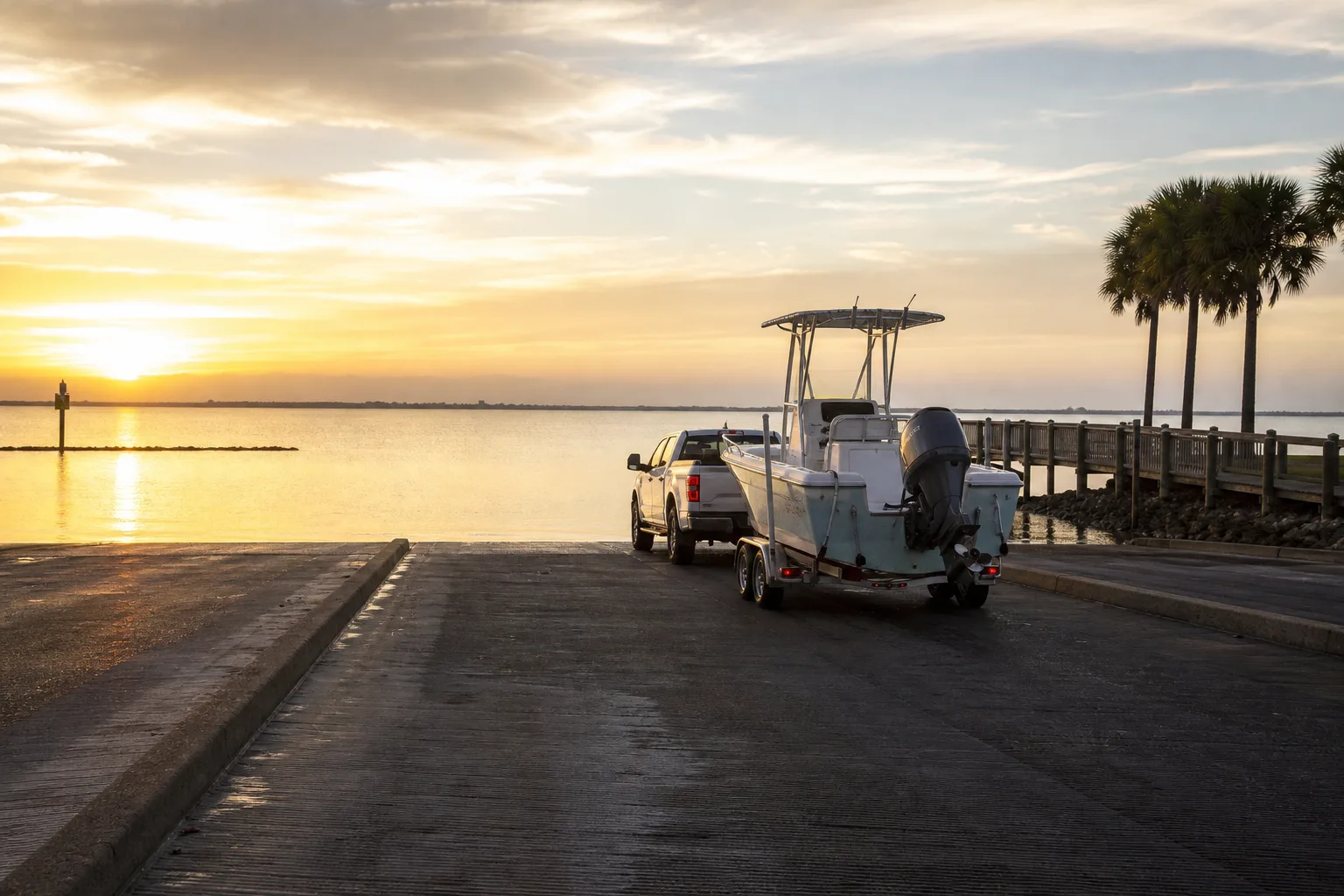
To back up a trailer, put one hand at the bottom of the steering wheel and move it in the direction you want the back of the trailer to go. Go slowly, use your mirrors, make small corrections, and when the trailer starts to point the wrong way, pull forward to straighten out and try again. The "hand at the bottom of the wheel" method makes the steering feel natural instead of backwards.
Backing a boat trailer is a skill, and it is learned by repetition, not talent. This guide covers the method step by step, how to use mirrors and a spotter, how to practice in an empty lot, and the etiquette that keeps a busy ramp friendly.
Why a trailer seems to steer backwards
When you reverse, the trailer pivots on the hitch ball. Turn the wheel left and the front of the truck swings left, but the rear of the trailer swings right, which feels opposite to ordinary driving. The longer the trailer, the slower it reacts, which is why a small utility trailer is twitchy and a longer boat trailer is easier to control. A boat on the trailer also blocks some of your rear view, so mirrors and a spotter matter.
The hand-at-the-bottom-of-the-wheel method
- Straighten the rig. Start with the truck and trailer lined up in a straight line, and the wheels straight.
- Put one hand at the bottom of the steering wheel (the six o'clock position). Leave your other hand free for the gear shift or the mirror.
- Move your hand the way you want the trailer to go. To send the back of the trailer to the left, move your bottom hand left. To send it right, move your hand right.
- Back up slowly, at walking pace or slower. Slow speed gives you time to react.
- Make small inputs. A few inches of wheel movement is plenty. Large inputs make the trailer fold up on the truck.
- Correct early. If the angle between truck and trailer keeps growing, steer back the other way before it gets extreme.
- If it goes wrong, pull forward. Drive ahead a few feet to straighten the rig, then try again. This is normal, not failure.
Keep your eyes moving between both side mirrors. Watch the trailer's inside wheel and the back corner, and let the trailer follow the path of your mirror view.
Using mirrors, a spotter and your own eyes
Set your side mirrors so you can see the sides of the trailer and a bit of the ground behind it. If your boat is wide or tall, towing mirrors that extend are worth considering. Check that the trailer lights work before you set out; see boat trailer lights not working for the usual culprits.
A spotter helps most when the rig is long or the lane is tight. Agree on simple hand signals before you start, and keep the spotter standing where you can see them in your mirror, to the side of the trailer and out of the path.
| Signal | Meaning |
|---|---|
| Palm facing you, waving | Keep coming back |
| Flat palm raised, or fist | Stop |
| Pointing left or right | Turn the back of the trailer that way |
| Hands wide apart, narrowing | Distance remaining |
| Hand across throat | Shut off or stop at once |
The spotter's job is to give information, not to steer. If you lose sight of the spotter, stop. Never allow anyone to stand between the truck and the trailer.
Practice in an empty lot first
An empty parking lot, early on a weekend, is the best classroom. Set up two cones or milk jugs as a "ramp" and practice:
- Backing in a straight line for a long distance.
- Backing into a spot between the cones with the trailer on a gentle curve.
- Backing from the left and from the right (one side is usually easier).
- Pulling forward to reset when you get stuck.
Practice without the boat first, then with the boat on. Know your tow vehicle's limits too: boat towing capacity explains how to check your truck against your boat and trailer weight.
Learn on a ramp with room to spare
Where you practice matters. A ramp with several lanes and plenty of trailer parking lets you take your time without holding up a line of boaters. Marinalo data shows how much these vary. As of October 2026, Marinalo lists 18 boat ramps in the Miami area with 386 trailer spaces, but most of the individual ramps shown there have one lane. The Tampa area lists 10 ramps with 213 trailer spaces, and one of them is a 6-lane ramp with 90 trailer spaces. On a multi-lane ramp, you can pick an open lane and take a couple of tries without blocking anyone.
| What to look for | Why it helps a beginner |
|---|---|
| Multiple lanes | More room to retry, and less pressure from waiting boaters |
| Large trailer parking | You can prep and park away from the lane |
| Prep area near the ramp | You can finish the checklist before you reach the water |
| Calm water, little current or wind | The boat is easier to hold and recover |
To find ramps near you, browse the Florida boat ramps or Texas boat ramps pages, or use boat ramps near me. City pages such as Tampa and Miami show lane and parking counts for each ramp. Texas lakes tend to have many ramps: Marinalo lists 14 public ramps on Lake Travis and 28 on Lake Texoma, so there is usually a quieter one nearby.
Ramp etiquette
A little preparation keeps everyone happy.
- Prep before the lane. Load gear, take off straps and tie-downs (except the winch strap), put in the drain plug, connect a bow line and stern line, tilt the motor as the manual says, and check lights and brakes in the parking area, not on the ramp.
- Go when it is your turn. Do not hold the lane while you finish loading gear.
- Launch fast, then clear the ramp. Move the boat to a courtesy dock and then park the truck, so the next boater can use the ramp.
- At the end, pull out and move to a staging area to drain, strap down and pack up.
- Be patient and helpful. Everyone started as a beginner. Ask for help if you need it, and offer it.
Common mistakes to avoid
- Backing too fast, which makes the trailer fold before you can react.
- Over-steering. Small steering moves are more effective than big ones.
- Staring at one mirror only. Check both.
- Backing with the wheel not straight when you start.
- Forgetting the drain plug or the transom saver and tie-downs.
FAQ
What is the easiest way to back up a trailer?
Put one hand at the bottom of the wheel and move it in the direction you want the back of the trailer to go. Go slowly and use small movements.
Why does my trailer jackknife when I reverse?
Usually from going too fast or over-steering. Pull forward to straighten the rig, then back up again using smaller steering inputs.
Is a longer trailer easier to back?
Generally yes. Longer trailers react more slowly, which gives you more time to correct.
How can I practice backing a boat trailer?
Use an empty parking lot with cones, first with an empty trailer and then with the boat. Practice both left and right approaches.
Where should a beginner learn to launch?
A ramp with several lanes, plenty of trailer parking and calm water. Check lane and parking details on a ramp directory before you go.
Sources
- Marinalo data, October 2026: Miami boat ramps, Tampa boat ramps, Lake Travis boat ramps, Lake Texoma boat ramps
- Your trailer manufacturer's and tow vehicle's owner's manuals