
Arriving at an Unfamiliar Marina: What to Confirm Before You Go
Published · By Marinalo
Review scope · 2026-11-08
Full-text AI editorial review with targeted primary-source checks; historical snapshots and operational details require confirmation as noted. No exhaustive factual certification, site visit or human maritime validation.
A practical arrival brief covering boat dimensions, approach information, berth assignment, fuel access and fallback plans, with official chart and weather sources.
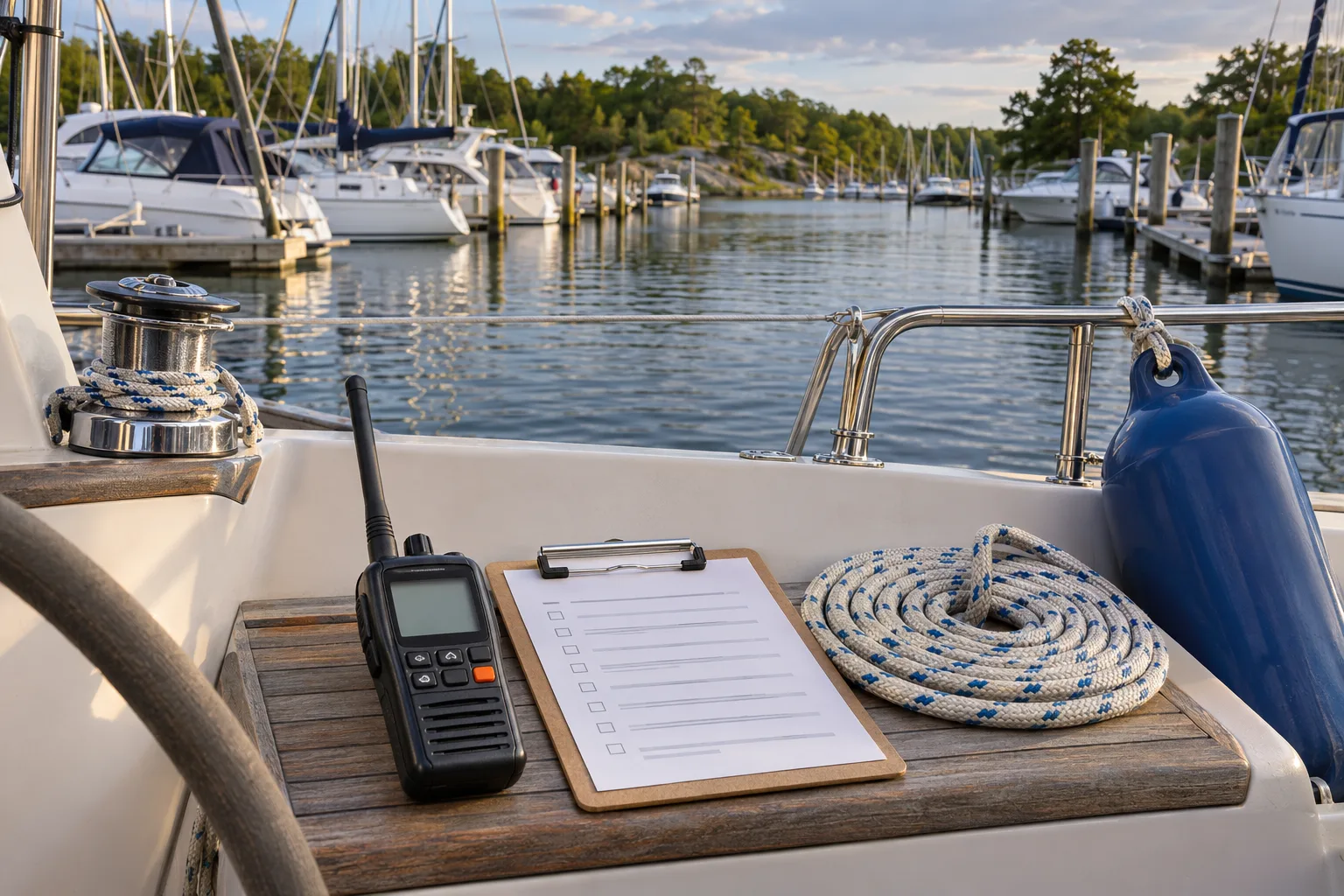
A berth confirmation establishes your booking arrangements, but it does not confirm every detail needed for a safe approach. Before departure, confirm the assigned berth, current approach guidance, dimensions, communication channel and arrival instructions directly with the marina. Record unanswered questions instead of filling them with assumptions.
This is a planning worksheet for recreational boaters, not local pilotage or a substitute for training, current charts and the skipper's judgment. Marinalo's directory coordinates and straight-line distances are not navigable routes.
1. Describe the boat the dockmaster will actually receive
Provide overall length including overhangs, beam, loaded draft and air draft where bridges affect the route. Specify whether an outboard, swim platform, dinghy or davits extend beyond the hull. Give the requested power connection and arrival window. Ask the marina to confirm the assigned berth against those details rather than assuming a nominal “40 ft slip” accepts every boat marketed as a 40-footer.
Keep a copy of that exchange. If the assigned berth changes, confirm the fit again. A different berth can change the available width, shore-power connection or approach direction.
2. Distinguish an advertised depth from a usable approach
Ask where the marina's depth figure applies: entrance, fairway, berth or fuel dock. Ask when it was checked and which water-level reference it uses. A single number without a location or datum is insufficient for comparing it with a tide prediction.
Consult current official charts and relevant notices. NOAA's United States Coast Pilot supplements charts with information that is difficult to show graphically, including local waterway and harbor details. Use the relevant volume and updates for the route. A marina's recent observation can help identify an issue, but does not replace those publications.
Our tide-chart guide explains why height, datum and current predictions are separate checks. Never use a positive tide height by itself as proof that an approach is deep enough.
3. Write down the arrival arrangement
| Information to confirm | Why it matters |
|---|---|
| Berth number and dock layout | You need to locate the assigned space before beginning the maneuver. |
| Port or starboard side alongside, or stern-to arrangement | The crew can prepare appropriate lines and fenders before entering. |
| Contact method and marina working channel | Use the marina's published instructions; do not assume every port uses the same channel. |
| Dock staff availability and after-hours procedure | An open entrance does not mean assistance or check-in is available. |
| Power connection and dock facilities | Confirm compatibility rather than relying on a generic “shore power” listing. |
| Change or cancellation procedure | You need a clear way to report a delayed or abandoned arrival. |
4. Check conditions for the whole trip
The National Weather Service recommends checking the local marine forecast before departure. Check the route and return window as well as the destination. Review warnings, wind, sea state and visibility, and continue monitoring updates underway. A calm berth photograph tells you nothing about today's exposed approach.
Decide in advance what conditions would make you delay or divert, using the boat's capabilities, your training and crew experience. Identify a feasible alternative before leaving. Do not let a paid reservation become the reason to continue into conditions you cannot manage.
5. Treat fuel as a separate stop
Ask whether the fuel dock is accessible by water to your boat, which fuel is sold, whether it is operating and how payment works. Check its hours separately from the marina office. If fuel is essential to completing the trip, confirm the stop directly before departure and plan adequate reserves.
A “nearest” listing describes proximity within a directory. It does not account for islands, bridges, restricted channels or an indirect water route. Two fuel docks a mile apart in a straight line may require very different journeys. Use the fuel directory to find candidates, then check the route and the operator's information.
Your one-page arrival brief
- Boat dimensions and loaded draft: ______
- Marina contact, confirmed berth and arrival window: ______
- Chart, notices and approach information checked: ______
- Depth reference, tide station and current information: ______
- Forecast update time and conditions that would change the plan: ______
- Fuel arrangement, alternate destination and contact ashore: ______
Keep the brief accessible to the crew and update it when the plan changes. For the booking itself, see how to compare marina quotes.
Editorial note: Marinalo planning checklist, with NOAA Coast Pilot and National Weather Service references checked November 8, 2026. It contains no claim of a site visit or professional pilotage certification.