
How Deep Is a Fathom? Depth Units Every Boater Should Know
How deep is a fathom? One fathom is exactly 6 feet or 1.8288 meters. Get a conversion table, learn where fathoms show up on NOAA charts and more.
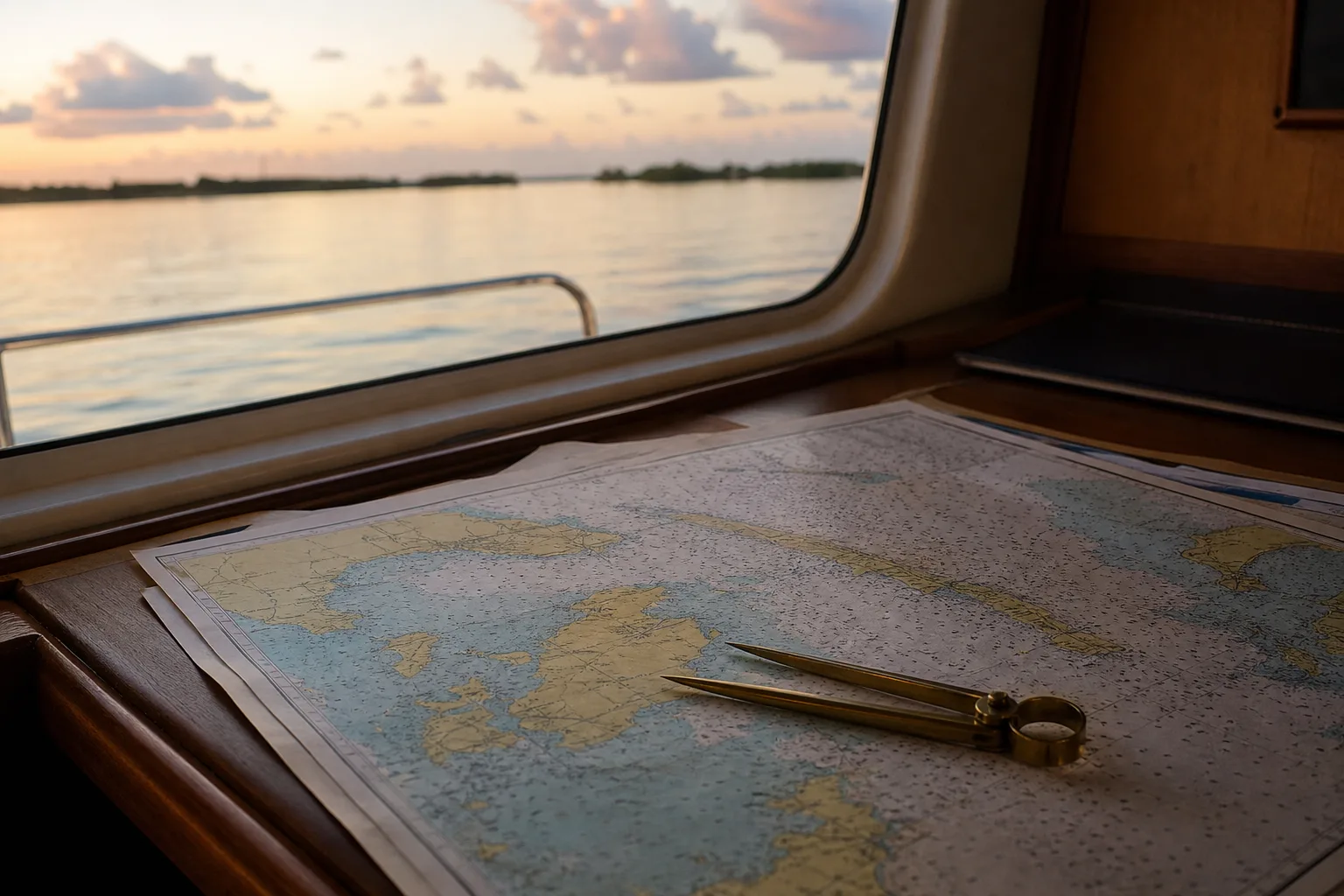
A fathom is a unit of water depth equal to exactly 6 feet, or 1.8288 meters. So 10 fathoms is 60 feet, and 100 fathoms is 600 feet. The unit is still used in some marine charts and in nautical language, so every boater should be able to convert it at a glance.
Fathoms, feet and meters at a glance
The conversion is exact: 1 fathom = 6 feet = 1.8288 meters. The meter figure follows from the international foot, which is defined as exactly 0.3048 meters, and 6 times 0.3048 is 1.8288.
| Fathoms | Feet | Meters |
|---|---|---|
| 1 | 6 | 1.83 |
| 2 | 12 | 3.66 |
| 3 | 18 | 5.49 |
| 5 | 30 | 9.14 |
| 10 | 60 | 18.29 |
| 20 | 120 | 36.58 |
| 50 | 300 | 91.44 |
| 100 | 600 | 182.88 |
To convert fathoms to feet, multiply by 6. To convert feet to fathoms, divide by 6. To convert fathoms to meters, multiply by 1.8288. Meters are rounded to two decimal places in the table.
Where the word "fathom" comes from
The word comes from an Old English word for the outstretched arms, and the fathom began as the distance between a person's outstretched hands, roughly a man's armspan. That fits how it was used: sailors measured depth by hauling in a weighted line hand over hand and counting the armspans as it came aboard. The standardized value of 6 feet is close to the typical armspan of an adult.
The word also gave English the verb "to fathom," meaning to understand something deeply. If you have ever said that something is "unfathomable," you were using a depth term.
The phrase "mark twain" in old river boating meant two fathoms, or 12 feet, which was a safe depth for a steamboat. It is not a modern navigation unit, but it shows how common fathom calls once were.
Why boaters still care about fathoms
You are more likely to hear "feet" for depth on a recreational boat in the United States. Your depth sounder, if it is set to U.S. units, will normally display feet. But fathoms still appear in a few places:
- Nautical charts. Some NOAA charts show depths in fathoms or in fathoms and feet.
- Anchoring and rode. Some anchor lines and chain are marked in fathoms.
- Fishing and offshore talk. Offshore anglers often describe ledges and drop-offs in fathoms, especially on older charts.
- Older maps and books. Cruising guides and older charts sometimes use fathoms.
Fathoms on NOAA charts
NOAA charts do not all use the same unit. According to chart-reading references based on NOAA's Chart No. 1, which explains chart symbols and abbreviations, soundings can be shown in feet, fathoms, fathoms and feet, fathoms and fractions, or meters and decimeters. The unit used is printed on the chart, in the title area and in large letters outside the chart border. Always check it before you read a depth. Misreading a chart in fathoms as feet could make the water look much shallower than it is. Misreading feet as fathoms is the opposite mistake, and a much more dangerous one.
On a chart that uses fathoms and feet, a depth may appear as a number with a small subscript. A sounding shown as 4 with a small 2 next to it means 4 fathoms and 2 feet, or 26 feet. Read the main number as fathoms and the subscript as extra feet.
Depths on U.S. charts are measured from a reference level called the sounding datum. For most U.S. coastal charts that datum is Mean Lower Low Water, the average of the lowest tide of each day. This means the real depth is usually a bit more than the charted depth, but on a falling tide, or in places with a big tide range, check the tide times before you assume you have enough water. Our tide times pages can help, and the explanation of spring and neap tides shows why the range changes through the month. The charted depth also does not account for wind, storm surge or low-water events, so give yourself a margin.
You can find current NOAA charts through the NOAA Office of Coast Survey, which is listed in the sources below.
Other depth and distance units
Feet
For most recreational boating in the United States, feet are the common unit for depth, draft and boat length.
Meters
Meters are the standard in most of the world. Some NOAA charts use meters and decimeters, and charts from other countries often do. A meter is a little more than 3 feet. The exact conversion is 1 meter = 3.28084 feet.
Cable
A cable (or cable length) is a traditional nautical unit of distance, about one-tenth of a nautical mile. It is used in navigation instructions such as "the buoy is two cables off." Its exact length has varied between navies and countries, so you will not usually need to convert it. If you want an exact distance, use nautical miles.
Nautical mile
A nautical mile is exactly 1,852 meters (about 6,076 feet, or about 1.15 statute miles). It is based on a minute of latitude, which is why it is used for navigation. Convert with our nautical miles to miles converter, and use the knots to mph converter for speed, since one knot is one nautical mile per hour.
Quick comparison
| Unit | Measures | Exact value |
|---|---|---|
| Fathom | Depth | 6 feet = 1.8288 meters |
| Foot | Depth, length | 0.3048 meters |
| Meter | Depth, length | About 3.28084 feet |
| Nautical mile | Distance | 1,852 meters |
| Knot | Speed | 1 nautical mile per hour |
Reading depth in practice
A few habits will keep you out of trouble:
- Check the chart unit first. Look at the chart title and the large letters outside the border.
- Know your draft. The depth you need is your boat's draft plus a safety margin, not just the draft.
- Allow for the tide. A depth that is fine at high tide may leave you aground a few hours later.
- Trust your eyes and your sounder together. Charts can be out of date, and shoals shift, particularly near inlets and after storms.
- Set your depth sounder to the unit you can read quickly. Most U.S. boaters choose feet.
When you launch, remember that a public ramp's depth at the bottom of the slab can change with the tide. Browse Florida boat ramps or Texas boat ramps for places to launch, and compare them with the water you plan to cross.
FAQ
How deep is a fathom in feet?
One fathom is exactly 6 feet.
How many meters is a fathom?
One fathom is exactly 1.8288 meters.
How deep is 10 fathoms?
Ten fathoms is 60 feet, or 18.288 meters.
Why is it called a fathom?
The word comes from an Old English word for outstretched arms. The unit began as the length of a person's armspan, which is how sailors measured a depth line by hand.
Does NOAA still use fathoms?
Some NOAA charts show soundings in fathoms or in fathoms and feet, while others use feet or meters. The unit is printed on each chart, so check it before you read a depth.
What is a cable in nautical measurement?
It is a traditional unit of distance of about one-tenth of a nautical mile. Its exact definition has varied, so use nautical miles for precise work.